
RTM Property Management: Why Your RTM Still Needs a Good Managing Agent
Your RTM company carries the landlord’s management duties from day one. Here is what they are, when an agent makes sense and how to contract with one.
 By Sam Charlesworth8 min read
The short version
- The RTM company carries repairs, insurance, service charge, section 20 and fire safety duties, whoever does the paperwork.
- No law requires an RTM company to appoint a managing agent; the test is coping in a bad year.
- A management agreement lasting over 12 months can need section 20 consultation if fees exceed £100 a leaseholder.
- Put spending limits, client account terms, commission disclosure and handover rules in writing.
- An agent cannot take on the company’s legal liability, so insist on regular reporting.
RTM property management is the day-to-day running of a building after a right to manage company has taken over from the freeholder: repairs, services, buildings insurance, service charge budgets and accounts, section 20 consultation and fire safety. The law puts those duties on the RTM company, not on an agent. Hiring a managing agent is optional, but a good one does most of the work while the directors keep the decisions.
This guide sets out exactly what your RTM company becomes responsible for, how to decide between self-managing and appointing an agent, and what to put in the management agreement so the arrangement protects the company. It covers England, where these rules apply as at October 2026.
What RTM property management actually involves
On the acquisition date, section 96 of the Commonhold and Leasehold Reform Act 2002 (CLRA 2002) transfers the landlord’s “management functions” under the leases to the RTM company. The Act defines them as functions relating to services, repairs, maintenance, improvements, insurance and management. Schedule 7 then applies landlord-and-tenant legislation to the company as if it were the landlord. In practice, the company takes on this list:
| Duty | Where it comes from | What it means in practice |
|---|---|---|
| Repairs and services | The leases, via CLRA 2002 s96 | Keeping the structure and common parts in repair, plus cleaning, lighting, gardening and lifts, to the standard the leases require |
| Service charges | Landlord and Tenant Act 1985 ss18–30, applied by Sch 7 | Reasonable costs only (s19), demands with the statutory summary of rights (s21B), the 18-month rule (s20B) |
| Major works and long contracts | LTA 1985 s20 and the 2003 Consultation Regulations | Consultation where any leaseholder pays more than £250 for works, or more than £100 a year under an agreement lasting over 12 months |
| Service charge money | Landlord and Tenant Act 1987 s42 | Money is held on statutory trust for the leaseholders, separate from the company’s own funds |
| Buildings insurance | The leases; LTA 1985 s30A | Placing cover where the lease puts it on the landlord, and answering leaseholders’ requests for policy information |
| Fire safety | Regulatory Reform (Fire Safety) Order 2005; Fire Safety (England) Regulations 2022 | A written fire risk assessment of the common parts, reviewed regularly, and fire safety information for residents |
| The landlord’s remaining role | CLRA 2002 ss98 and 101 | Notice to the landlord before granting consents, and reporting lease breaches within three months |
| Company administration | Companies Act 2006 | Annual accounts, confirmation statement, registers and board minutes |
Taller buildings bring more. If your block is at least 11 metres high, the 2022 Regulations add quarterly checks of communal fire doors and annual best-endeavours checks of flat entrance doors. A block of 18 metres or 7 storeys with at least two homes is a higher-risk building under the Building Safety Act 2022, with registration and accountable person duties on top.
Every one of these duties sits with the company and its directors, whoever does the paperwork. Our guide to RTM company directors’ responsibilities covers the personal side of that.
Self-manage or appoint a managing agent?
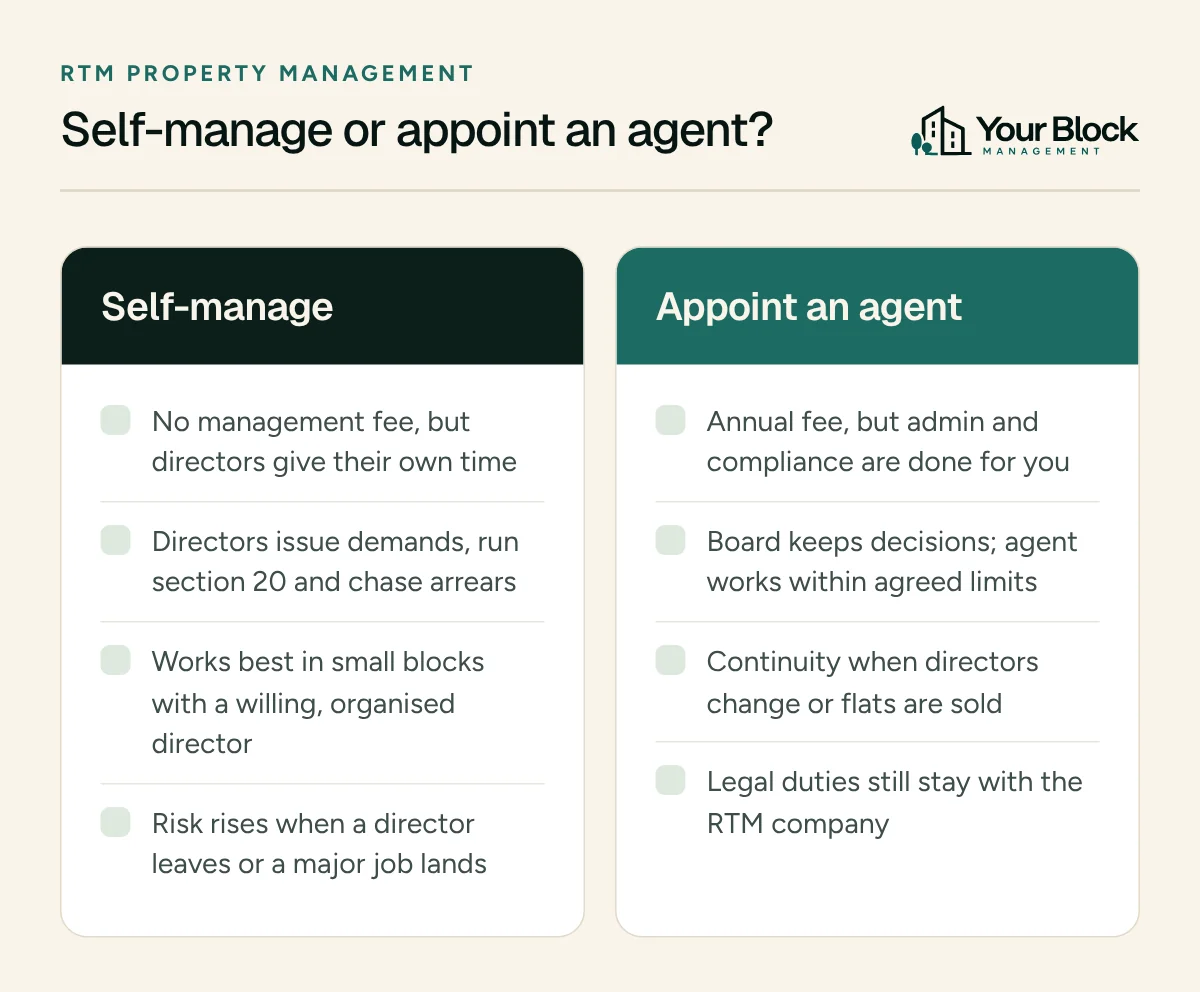
Nothing in CLRA 2002 requires an RTM company to appoint an agent. Some small blocks self-manage well, usually where a director has the time, the skills and the patience to chase contractors and late payers. The honest test is not whether you could do it in a good year. It is whether you could do it in the year the roof fails, a director moves away and a leaseholder disputes the budget at the tribunal.
Illustrative example: a 10-flat RTM block needs a £40,000 roof replacement. That is £4,000 per flat, so section 20 applies. Someone must issue a notice of intention, wait 30 days, collect at least two estimates (one from a contractor wholly unconnected with the company), issue a statement of estimates, wait another 30 days, and then place the contract. Get a step wrong and, unless the tribunal grants dispensation, the company can recover only £250 from each leaseholder: £2,500 in total against a £40,000 bill. Our guide to section 20 consultation walks through the stages.
Some boards choose a middle route: a managing agent on a limited scope, such as accounts and compliance only, with directors handling contractors themselves. That can work if the agreement says clearly who does what.
What a good managing agent does for an RTM company
A managing agent acts for the RTM company. It should never become a substitute landlord. The directors decide; the agent does the work and reports back. A good one will:
- Set and run the budget: draft the annual service charge budget, issue compliant demands, chase arrears and produce year-end accounts.
- Handle repairs: take reports, instruct contractors within agreed limits and keep a record of every job.
- Run consultation: prepare and serve section 20 notices on time and keep the evidence.
- Keep the compliance calendar: fire risk assessment reviews, insurance renewals, lift inspections, electrical tests and, where relevant, fire door checks.
- Look after the money: hold service charge funds in a designated client account in trust, and reconcile it regularly.
- Support the board: agendas, meeting packs, minutes, and answers to buyers’ solicitors when flats are sold.
What stays with the board: approving the budget, choosing major contractors, agreeing the insurance programme, authorising spending above the agent’s limit and deciding disputes with leaseholders. For a fuller list of agent duties, see what a managing agent is supposed to do.
What to put in your RTM property management agreement
The agreement is where most problems are prevented. The RICS Service Charge Residential Management Code (4th edition), approved by the Secretary of State and in force since 7 April 2026, applies to RTM companies and gives agents guidance on terms of engagement and client money. Courts and tribunals take it into account. Ask any agent how their terms match it. At minimum, the agreement should cover:
Scope and fees
- A clear list of services included in the annual fee, and a schedule of every extra charge (section 20 administration, tribunal work, out-of-hours call-outs, sale packs).
- How the fee is reviewed, and whether VAT is added.
- Any commission, fee or other income the agent receives from insurers, contractors or anyone else, disclosed in writing. Since 31 December 2023 the FCA’s rules require insurers to give information about multi-occupancy policies, including commission, that can be passed to leaseholders.
Term and notice, and the section 20 trap
An agreement for a term of more than 12 months is a qualifying long-term agreement under section 20ZA. If any leaseholder’s share of its cost will exceed £100 in an accounting period, the company must consult first or risk capping recovery. In Corvan (Properties) Ltd v Abdel-Mahmoud [2018] EWCA Civ 1102, a management agreement for one year that then continued until ended on three months’ notice was held to be a qualifying long-term agreement. Agree the term and notice period with that rule in mind, and take advice if you want a longer contract.
Authority and control
- A spending limit per job, above which the agent needs written board approval, and an emergency exception with a duty to report the same day.
- Who can instruct the agent: named directors, not any leaseholder who emails.
- Reporting: what the board receives and how often (for example a monthly bank reconciliation and a quarterly management report).
Money
- Service charge and reserve funds held in a separate client account in the company’s name or designated as trust money, never mixed with the agent’s own funds.
- Who can authorise payments, and whether two signatures are needed above a set amount.
- Whether the agent belongs to a client money protection scheme and what it covers, and who keeps any interest earned.
Complaints, insurance and exit
- The agent’s complaints procedure and its redress scheme. Businesses doing property management work in England must belong to The Property Ombudsman or the Property Redress Scheme.
- Professional indemnity insurance, with the level of cover stated.
- Data protection terms, because the agent will hold leaseholders’ personal data on the company’s behalf.
- Handover on termination: all records, keys, contracts, funds and a final reconciliation within a fixed number of days.
Note what the agreement cannot do: it cannot move the company’s legal duties onto the agent. If the agent misses a fire risk assessment review, the company is still the responsible person. That is why reporting matters as much as price.
Choosing an agent for an RTM block
Ask for a sample management report, a sample year-end account and a copy of their standard agreement before you shortlist. Ask how they handle a leaseholder who disagrees with the board, because in an RTM block that leaseholder is also a member of the company. Our guide to shortlisting block management companies has a fuller set of questions. If you are also reviewing cover, read what insurance a block needs.
Regulation is coming but is not here yet. On 29 September 2026 the Government announced licensing, mandatory qualifications and an independent regulator for managing agents, but there is no legislation and no date. For now, membership of professional bodies is voluntary, so judge agents on their terms, their reporting and their answers.
How Your Block works with RTM boards
At Your Block we built our service around volunteer RTM and RMC directors: we draft agendas and meeting packs, track fire, insurance and safety dates with reminders, and hold service charge money in a separate client account. We say we don’t take commission on insurance or contractors. Every resident, owner or tenant, gets a portal login to report repairs and see budgets against actual spending, with informal polls kept separate from the company’s formal decisions. You can read what full block management includes, or compare notes with our guide to the lessons from right to manage companies that ended up in court.
Frequently asked questions
Does an RTM company have to appoint a managing agent?
No. The Commonhold and Leasehold Reform Act 2002 lets the RTM company manage the building itself. Many small blocks do. The company still carries every landlord management duty under the leases and service charge law, so if no director has the time and skills to run budgets, consultation and fire safety reliably, an agent is usually the safer choice.
Can our old managing agent stay on after the RTM takes over?
Yes, if the RTM company chooses to appoint them. The freeholder’s contract with that agent does not bind the RTM company automatically. Before the acquisition date, the outgoing manager must give contractor and contract notices so you know what is running. You can then appoint the same agent on new terms or choose another.
Does a two-year management agreement need section 20 consultation?
It can. An agreement for more than 12 months is a qualifying long-term agreement. If any leaseholder’s contribution will exceed £100 in an accounting period, the company must consult under the 2003 Regulations or risk recovery being capped at £100 per leaseholder per period. The Court of Appeal has held that a one-year term that then rolls on can count.
Who is liable if the managing agent gets something wrong?
As against the leaseholders, usually the RTM company, because the duties under the leases and service charge law are the company’s. The company may then have a claim against the agent under the management agreement, which is why professional indemnity cover, clear authority limits and regular reporting belong in the contract.
Do managing agents for RTM blocks need to be regulated?
There is no licence or regulator yet. Businesses doing property management work in England must belong to a government-approved redress scheme: The Property Ombudsman or the Property Redress Scheme. The Government announced licensing and qualifications on 29 September 2026, but no legislation or start date exists.
Sources and further reading
- Commonhold and Leasehold Reform Act 2002, section 96 (management functions under leases)
- Landlord and Tenant Act 1985, section 20ZA (qualifying long term agreements)
- Corvan (Properties) Ltd v Abdel-Mahmoud [2018] EWCA Civ 1102
- Landlord and Tenant Act 1987, section 42 (service charge contributions held in trust)
- Approval of Code of Management Practice (Residential Management) (Service Charges) (England) Order 2026 (SI 2026/298)
This article is general information about the law in England, not legal advice. Leasehold law is changing, so check your lease and get professional advice for your own situation. Spotted something out of date? Tell us and we’ll fix it.