
Managing Agent: What They're Supposed to Do For You (Print This Out)
Your managing agent works for the landlord or board, but the law and the RICS Code still set the bar. Here’s the full duty list.

The short version
- A managing agent works for the landlord, RTM or RMC, but must still follow your lease and the law.
- The RICS Code 4th edition has applied since 7 April 2026; tribunals take breaches into account.
- Service charge money is held on trust and demands must carry the statutory summary of rights.
- Redress scheme membership has been compulsory since 2014, with fines up to £5,000 for non-members.
- Licensing and qualifications were announced in September 2026 but are not yet law.
A managing agent is the firm your landlord, right to manage (RTM) company or residents’ management company (RMC) pays to run your building: collecting service charges, organising repairs, keeping the block safe and insured, and accounting for every pound. They work for that client, not for you personally, but your lease, the law and the RICS Code still set the standard they must meet.
This page is the duty list. It’s written for England, organised so you can print it and tick it off, and it separates what your agent must do from what is simply good practice and what isn’t their job at all.
Who does a managing agent actually work for?
The agent’s contract, the management agreement, is with its client: the freeholder, the RTM company or the RMC. Individual leaseholders usually aren’t party to it. That has three consequences:
- The agent takes instructions from the client. If the freeholder decides not to redecorate this year, the agent can advise but can’t overrule.
- Your legal rights under the lease are mostly against your landlord, and the agent carries them out on the landlord’s behalf. If the agent gets it wrong, the landlord is still answerable to you.
- You still have direct routes: complaining through the agent’s compulsory redress scheme, using your statutory rights to information, and challenging charges at the First-tier Tribunal.
In an RTM or RMC block, the leaseholders are usually members of the client company, so you have a stronger say: the board you elect instructs the agent. If you’re still unsure whether yours is an agent or a management company, our guide to what block management covers untangles the terms.
The three rulebooks your managing agent must follow
- The management agreement. Sets the scope of services, fees, number of site visits, response times, reporting and notice period. Ask your landlord or board for a copy: it tells you what has actually been paid for.
- Your lease. Sets what the landlord must repair, insure and provide, what can be charged, how service charges are calculated and when accounts must be produced. The agent is administering the lease, so it can’t charge for things the lease doesn’t allow.
- The RICS Service Charge Residential Management Code, 4th edition. Approved by the Secretary of State under section 87 of the Leasehold Reform, Housing and Urban Development Act 1993 and in force since 7 April 2026, replacing the 3rd edition. It applies to managing agents, landlords, RTM companies, RMCs and self-managed blocks. Breaching it isn’t a criminal offence in itself, but courts and tribunals take it into account. It puts weight on competence, transparency, terms of engagement, client money, building safety, planned maintenance and reserve funds.
On top of these sit the statutes: mainly the Landlord and Tenant Acts 1985 and 1987, the fire safety legislation and the Building Safety Act 2022.
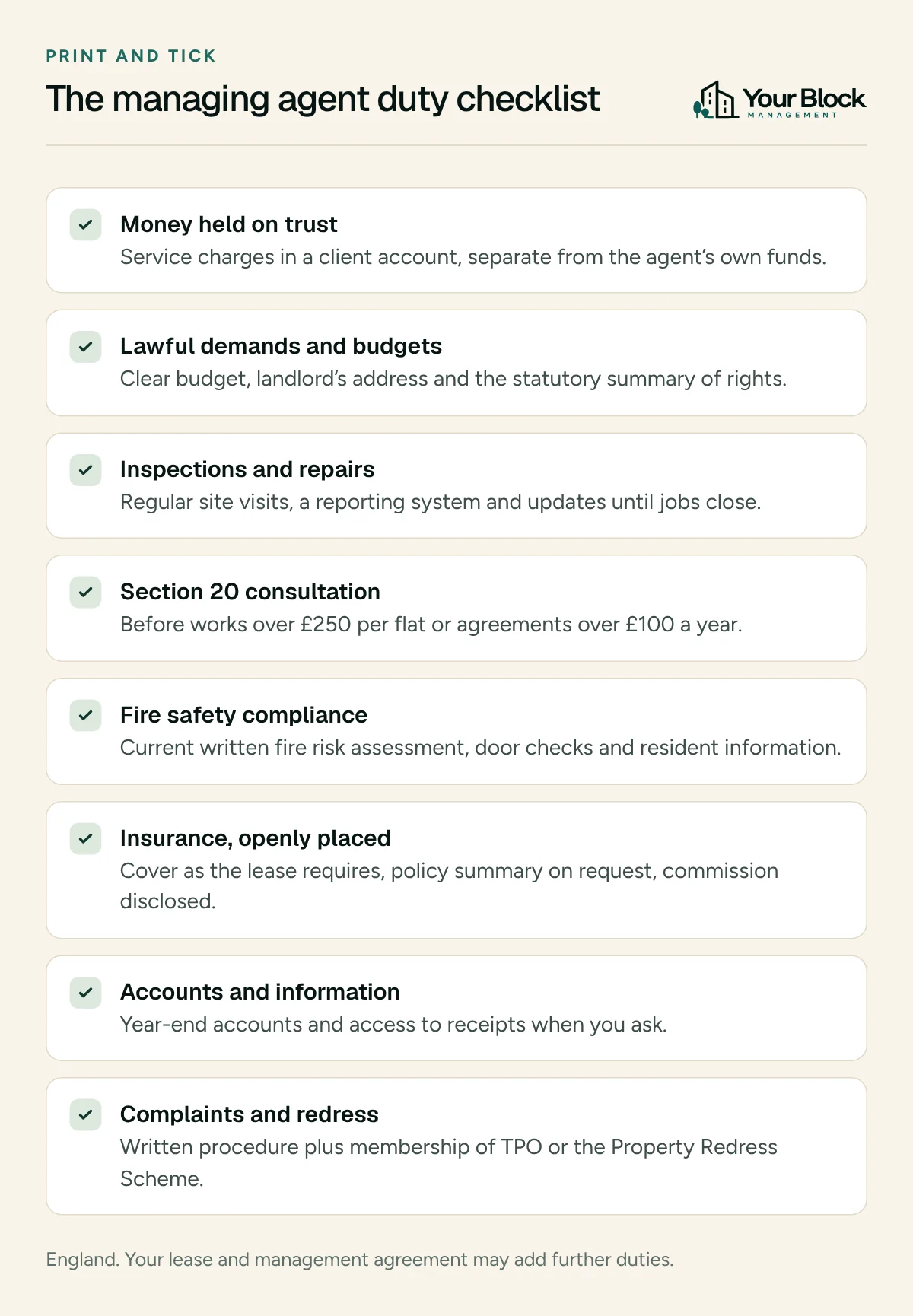
The managing agent duty list: print this out
1. Money and service charges
- Prepare an annual budget in line with the lease, with clear headings and reasons for increases.
- Issue demands that include the landlord’s name and address (section 47, Landlord and Tenant Act 1987) and the statutory Summary of rights and obligations (section 21B, Landlord and Tenant Act 1985). Without the summary, you can lawfully withhold payment until it’s served.
- Only charge costs that are reasonably incurred, for work of a reasonable standard (section 19, LTA 1985).
- Demand costs within 18 months of incurring them, or warn you in writing within that time (section 20B, LTA 1985).
- Hold service charge money on trust (section 42, LTA 1987), in a client account separate from the agent’s own money.
- Produce year-end accounts as your lease requires, and respond to requests for a summary of costs and to inspect receipts (sections 21 and 22, LTA 1985).
- Manage reserve funds where the lease allows, and chase arrears fairly and consistently.
Our guide to where every pound of your service charge goes shows how to check the figures.
2. Repairs and maintenance
- Inspect the common parts regularly, at the frequency in the management agreement, and act on what’s found.
- Run a clear repair reporting system and keep residents updated until the job is closed.
- Plan longer-term work: a planned preventative maintenance programme helps set sensible reserve contributions.
- Get competitive quotes and check contractors’ insurance and competence.
- Consult leaseholders under section 20 before major works where any one leaseholder would pay more than £250, or before long-term agreements costing anyone more than £100 a year. Skipping it can cap recovery at those amounts. See our guide to what a section 20 notice means.
3. Fire safety and compliance
- Make sure the responsible person has a written, up-to-date fire risk assessment for the block and acts on its findings.
- In buildings over 11m, organise quarterly checks of communal fire doors and annual best-endeavours checks of flat entrance doors (Fire Safety (England) Regulations 2022).
- Give residents fire safety instructions and information about fire doors.
- Arrange other common-parts checks the building needs, such as lift inspections, legionella and asbestos management, emergency lighting and fire alarm servicing.
- In higher-risk buildings (18m or 7 storeys and above), support the accountable person with Building Safety Act duties.
4. Buildings insurance
- Arrange and renew cover as the lease requires, at a reasonable cost.
- Provide a summary of cover and allow you to inspect the policy on request (section 30A and the Schedule to the LTA 1985).
- Be open about commission. Commission isn’t banned, but FCA rules since 31 December 2023 mean insurers must provide information on pricing and commission, including directly to leaseholders on request.
- Handle communal claims and help you notify claims affecting your flat. More in our guide to block management insurance.
5. Communication and records
- Answer correspondence within published timescales, and tell you who your property manager is.
- Give you an address in England and Wales for serving notices (section 48, LTA 1987).
- Keep accurate building records: lease copies, contracts, warranties, compliance certificates and maintenance history.
- Provide information for flat sales (the management pack) promptly and at the published fee.
6. Meetings and governance
- For RTM and RMC clients: prepare agendas and reports, attend board meetings and AGMs as agreed, and take minutes.
- If contracted, handle company secretarial work and Companies House filings.
- Report regularly to the client on spending against budget, arrears, repairs and compliance.
7. Complaints and redress
- Run a written, accessible complaints procedure with timescales.
- Belong to a government-approved redress scheme: The Property Ombudsman or the Property Redress Scheme. This has been compulsory for property management work in England since 1 October 2014, and councils can fine non-members up to £5,000.
- Tell you which scheme it belongs to and how to escalate once its own process is exhausted.
What isn’t a managing agent’s job
- Repairs inside your flat that the lease makes your responsibility, such as your own plumbing, kitchen and internal decoration.
- Your contents insurance or your own landlord insurance if you let your flat.
- Neighbour disputes about noise or behaviour, unless they involve a breach of the lease that the landlord decides to enforce.
- Overruling its client. Spending decisions and policy belong to the landlord or board.
- Giving you legal advice about your own position. It can explain the process, but you may need LEASE (the Leasehold Advisory Service) or a solicitor.
- Doing things for free that the agreement excludes. Extra work is often chargeable, which is why the fee schedule matters.
What’s changing for managing agents
On 29 September 2026 the Government announced that managing agents will need a licence and qualifications, overseen by an independent regulator able to revoke licences. This is a proposal: there is no legislation and no start date. Today there is still no statutory licence or qualification for block managers.
Separately, the service charge transparency measures in the Leasehold and Freehold Reform Act 2024 aren’t in force yet. The Government said in July 2026 that standard demand forms, annual reports and standardised accounts will follow through regulations, with leaseholders expected to start seeing changes during 2027.
What to do if your managing agent isn’t doing the job
- Put it in writing. Name the duty, the problem and what you want done, by when.
- Use the formal complaints procedure and keep copies.
- Involve the client. Tell the landlord or board: they hold the contract and can enforce it.
- Escalate to the redress scheme once the agent’s procedure is exhausted.
- Challenge unreasonable charges at the First-tier Tribunal (section 27A, LTA 1985).
- Change the agent. Through the board, or if the landlord won’t act, consider right to manage. Our guide to changing managing agent covers the handover.
At Your Block we publish our own complaints procedure and set out in our services exactly what full management includes, because the duty list above should never be a mystery to the people paying for it.
Frequently asked questions
Does my managing agent work for me?
Not directly. The agent’s contract is with its client, usually the freeholder, RTM company or residents’ management company. But the agent must still apply your lease and the law, follow the RICS Code, and belong to a redress scheme you can complain to. In RTM and RMC blocks, leaseholders usually control the client company, so they have more influence.
Is the RICS Code legally binding on managing agents?
It is approved by the Secretary of State under section 87 of the Leasehold Reform, Housing and Urban Development Act 1993. Breaching it is not an offence in itself, but courts and tribunals take it into account. The 4th edition has applied since 7 April 2026; the 3rd edition still applies to proceedings about earlier acts.
Do managing agents need a licence?
Not currently. There is no statutory licence or qualification for block managers in England, although they must belong to The Property Ombudsman or the Property Redress Scheme. On 29 September 2026 the Government announced licensing, qualifications and an independent regulator, but no legislation or start date has been published.
Who do I complain to about a managing agent?
Start with the agent’s written complaints procedure. Tell the landlord or board too, because they hold the contract. If the complaint isn’t resolved, take it to the agent’s redress scheme. Disputes about whether service charges are payable or reasonable go to the First-tier Tribunal (Property Chamber).
Sources and further reading
- SI 2026/298: approval of the RICS Service Charge Residential Management Code (4th edition)
- Landlord and Tenant Act 1985, section 21B
- Landlord and Tenant Act 1987, section 42
- Redress Schemes for Lettings Agency Work and Property Management Work (England) Order 2014
- Property Wire: Government confirms regulation of leasehold managing agents
This article is general information about the law in England, not legal advice. Leasehold law is changing, so check your lease and get professional advice for your own situation. Spotted something out of date? Tell us and we’ll fix it.