Right to Manage Qualifying Criteria: Does Your Building Pass? (Check Before You Spend a Penny)
A self-test for your block: the building tests, the five exclusions, the 50% membership rule and the awkward cases, before anyone spends money.
 By Sam Charlesworth10 min read
The short version
- The building must be self-contained, with at least two flats held by long leaseholders.
- Long leaseholders must hold at least two-thirds of all flats in the premises.
- Since 3 March 2025, non-residential parts can take up to 50% of floor area.
- Resident landlords in small conversions and council landlords exclude a building.
- Members must include qualifying tenants of at least half of all flats on claim day.
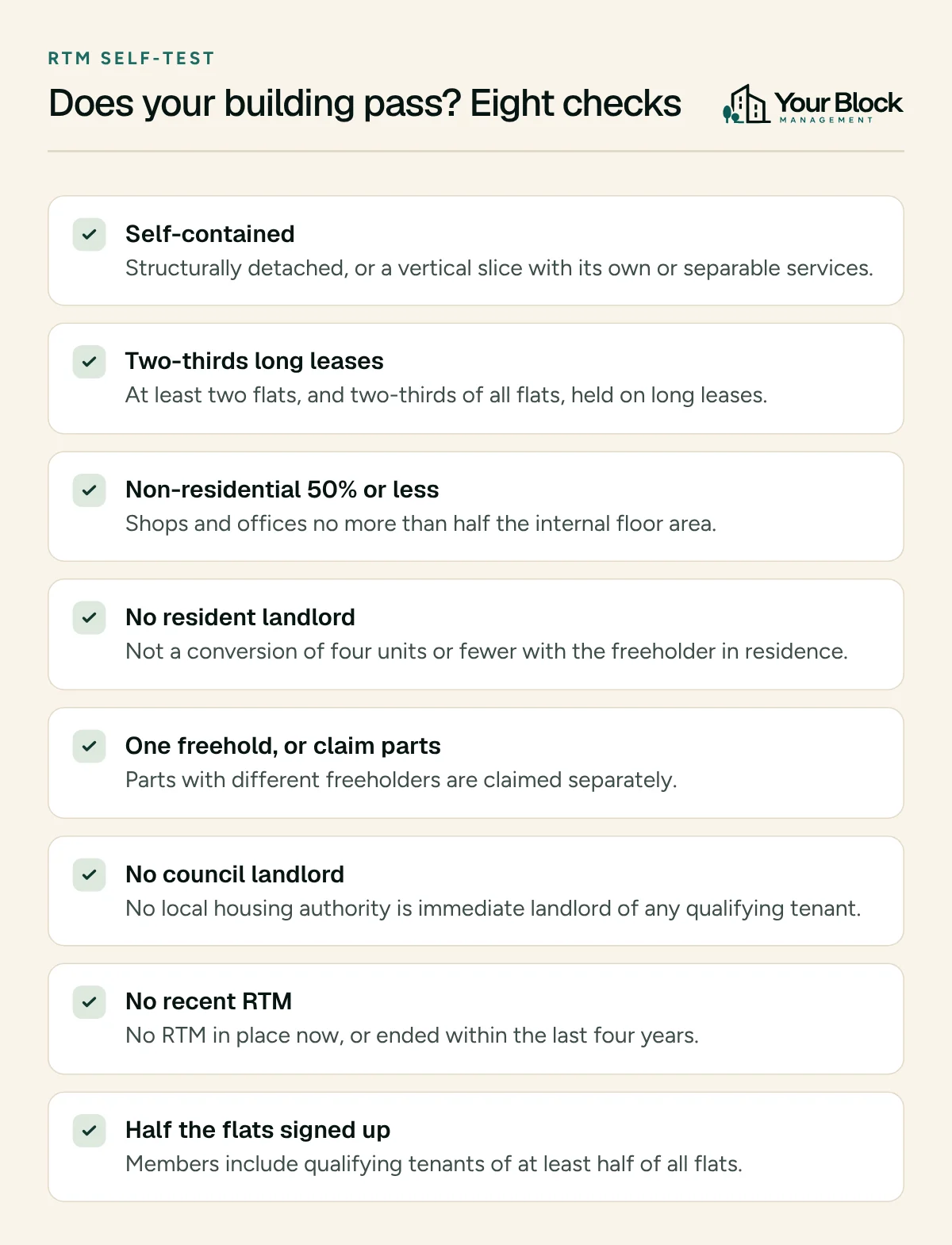
The right to manage qualifying criteria come down to three tests and five exclusions. Your premises must be a self-contained building or part of one, contain at least two flats held by long leaseholders, and long leaseholders must hold at least two-thirds of all the flats. Then no Schedule 6 exclusion can apply, and you need half the flats signed up to the RTM company.
This is an eligibility self-test. Work through it before anyone forms a company, pays for advice or knocks on doors. The law is in Chapter 1 of Part 2 of the Commonhold and Leasehold Reform Act 2002 (CLRA 2002) and applies to England as at October 2026. For what happens once you pass, see our full right to manage guide.
The right to manage qualifying criteria at a glance
There are three kinds of test, and a building has to pass all of them:
- The building tests (section 72): is the property the right kind of premises, with enough long leaseholders?
- The exclusions (Schedule 6): even if it passes section 72, does one of five exceptions knock it out?
- The participation test (section 79): on the day the claim notice is served, are enough qualifying tenants members of the RTM company?
The first two are about the building and its ownership, so persuading neighbours will not change them. The third is about people, and it is where most blocks struggle. The checklist below covers everything; the rest of this guide explains each item and the awkward cases.
Test 1: Is your building self-contained?
Section 72(2) says a building is self-contained if it is structurally detached. A standalone block of flats passes easily.
Part of a building can also qualify, but only if all three conditions in section 72(3) and (4) are met:
- it is a vertical division of the building (a slice from ground to roof, not a horizontal floor or two);
- its structure means it could be redeveloped independently of the rest; and
- its relevant services (anything delivered by pipes, cables or other fixed installations, such as water, gas, electricity and heating) are provided independently of the rest, or could be without works that would significantly interrupt the services to the other part.
Two court decisions shape how this works on estates:
- One building per claim. In Triplerose Ltd v Ninety Broomfield Road RTM Co Ltd [2015] EWCA Civ 282, the Court of Appeal held that an RTM company cannot acquire the right to manage more than one self-contained building. An estate of four blocks usually means four claims and four companies.
- Shared estate facilities stay out. In FirstPort Property Services Ltd v Settlers Court RTM Co Ltd [2022] UKSC 1, the Supreme Court held that the right to manage does not extend to facilities shared with other blocks, such as estate roads, gardens or a car park used by the whole development. The estate manager keeps running those and can keep charging for them.
Tests 2 and 3: Counting flats and qualifying tenants
What counts as a flat
Section 112 defines a flat as a separate set of premises, forming part of a building, built or adapted as a dwelling, where the whole or a material part lies above or below another part of the building. So a terrace of houses side by side is not a block of flats for RTM purposes, however it is managed. Shops and offices are not flats either, which matters when you count.
Who is a qualifying tenant
A qualifying tenant is the tenant of a flat under a long lease (section 75). In practice:
- A long lease is mainly one granted for a term of more than 21 years (section 76). It is the original term that counts, not what is left. A 99-year lease granted in 1985 is still a long lease today.
- Each flat has only one qualifying tenant. Joint owners count together as one.
- Where a flat has a chain of long leases, only the tenant at the bottom of the chain counts.
- A lease to which business tenancy protection (Part 2 of the Landlord and Tenant Act 1954) applies does not count.
- A sublease granted in breach of the superior lease, where the breach has not been waived, does not count.
- People renting on assured shorthold tenancies are not qualifying tenants. The flat owner who lets to them usually is. Our guide to which tenants can claim the right to manage covers this in more detail.
The two-thirds maths
You need at least two flats held by qualifying tenants, and qualifying tenants must hold at least two-thirds of all the flats in the premises. Flats the freeholder still owns, or lets on short tenancies, count in the total but not as qualifying flats.
| Illustrative block | Flats on long leases | Share | Passes? |
|---|---|---|---|
| 9 flats, freeholder owns and rents out 3 | 6 of 9 | 66.7% | Yes, exactly two-thirds |
| 9 flats, freeholder owns and rents out 4 | 5 of 9 | 55.6% | No |
| 12 flats, 2 let on short tenancies by the freeholder | 10 of 12 | 83.3% | Yes |
| 3 flats, freeholder lives in one, two sold on long leases | 2 of 3 | 66.7% | Passes section 72, but check the resident landlord exclusion |
The five Schedule 6 exclusions
A building that passes section 72 can still be shut out by Schedule 6. There are five exclusions.
1. Too much non-residential space (now 50%)
The right to manage does not apply if the non-residential parts take up more than 50% of the internal floor area. Common parts such as hallways and stairs are ignored. A garage, parking space or storage area used with a particular flat counts as residential. The limit was 25% until 3 March 2025, when section 49 of the Leasehold and Freehold Reform Act 2024 was brought into force by SI 2025/131.
Illustrative example: a three-storey building with a 200 square metre shop on the ground floor and 400 square metres of flats above (ignoring the stairwell). The shop is a third of the internal floor area. Before March 2025 that failed the 25% test. Now it passes comfortably. If your mixed-use block was turned down in the past, check again. Note that the same increase has not been brought in for buying the freehold, where 25% still applies.
2. Self-contained parts with different freeholders
If different people own the freehold of different parts of the premises, and any of those parts is itself a self-contained part of a building, the right to manage does not apply (paragraph 2). The usual answer is to claim each self-contained part separately.
3. A resident landlord in a small conversion
This exclusion catches premises that:
- are not a purpose-built block (one that, as built, contained two or more flats), so it is aimed at converted houses;
- contain no more than four units (flats, other dwellings and business units all count); and
- have a freeholder, or an adult member of their family, living in one of the flats as their only or principal home, and they have done so for the last 12 months. A new freeholder of premises that already had a resident landlord is also covered if they moved in within 28 days of buying.
4. A local housing authority landlord
The right to manage does not apply if a local housing authority (a district, borough or unitary council) is the immediate landlord of any of the qualifying tenants. Right-to-buy leaseholders in a council block are therefore excluded. A housing association is not a local housing authority, so this exclusion does not catch it.
5. Right to manage already exercised, or ended in the last four years
You cannot claim if an RTM company already has the right to manage the premises, or had it and lost it less than four years ago. The tribunal can disapply the four-year bar if it would be unreasonable, and the bar does not apply if the right ended because the RTM company bought the freehold.
The participation test: can you sign up half the flats?
On the day the claim notice is given, the RTM company’s members must include qualifying tenants of at least half of the total number of flats in the premises (section 79(5)). It is half of all flats, not half of the qualifying tenants. If there are only two qualifying tenants, both must be members (section 79(4)).
Illustrative example: in the 12-flat block from the table, 10 flats are on long leases. Half of 12 is 6, so you need 6 of those 10 owners as members on the day. With 5 you cannot serve the notice, however keen they are.
Two further points catch people out:
- An old RTM company can block a new one. A company cannot be the RTM company for premises if another company already is (section 73(4)). If neighbours formed one years ago and it was never dissolved, deal with that first. Search the Companies House register for the building’s name and address.
- Procedural slips are no longer fatal. Since the Supreme Court’s Cresta Court decision of 27 August 2026, a missed invitation notice or a short 14-day wait does not by itself defeat an otherwise valid claim. The membership numbers, though, are an entitlement test. Get them wrong and the claim fails.
The RTM company guide explains who can join, and how membership ends when someone sells.
Tricky cases worked through
These short scenarios are illustrative, not real buildings.
Flats above a parade of shops
Six flats over two shops. Measure the internal floor areas, ignoring common parts. If the shops are 50% or less of the total, the building passes. If a shop’s storeroom is let with a flat, it counts as residential.
A Victorian house split into four flats
The freeholder lives in the ground-floor flat and has done for years. Not purpose-built, four units, resident landlord: excluded. If the freeholder moves out and stops occupying it as their only or principal home, the exclusion stops applying.
A purpose-built block of four where the freeholder lives in one flat
The resident landlord exclusion only applies to buildings that are not purpose-built blocks. This one passes Schedule 6, as long as at least three of the four flats are on long leases.
Two blocks joined by a shared entrance
If they are structurally attached, each block only qualifies on its own if it is a vertical division that could be redeveloped independently, with independent or separable services. This is a question of fact and often disputed, so get a professional view before serving anything.
Estate of three blocks with a shared car park
Each block needs its own claim, and the car park stays with the estate manager. Budget for the fact that you will still pay estate charges.
A council-built block where some flats were bought under the right to buy
If the council is still the immediate landlord of any right-to-buy leaseholder, the block is excluded. If the freehold has since been sold to a private company or a housing association, it may qualify.
How to check before you spend a penny
Most of this can be checked for very little money:
- List every flat and unit in the building, with who owns each one.
- Get the title registers for the freehold and the flats from HM Land Registry. They show who owns the freehold and the date and term of each lease.
- Measure or estimate the floor area of any shops or offices against the residential floor area.
- Search Companies House for any existing RTM company for your building.
- Count heads: how many qualifying tenants would join? You need half of all flats.
- Get a second opinion on anything borderline, such as self-contained parts or mixed ownership. LEASE, the government-funded Leasehold Advisory Service, gives free initial advice. Our guide on when you need a right to manage solicitor covers paid help.
Passing the qualifying criteria tells you that you can claim, not that you should. Weigh the pros and cons of right to manage with your neighbours first. At Your Block we work with RTM and RMC boards in Suffolk and Essex once they have taken over, and our FAQs for directors cover the common questions about what happens next.
Frequently asked questions
Do I need a certain amount of time left on my lease to qualify for right to manage?
No. What matters is the term the lease was originally granted for, which must be more than 21 years. A 99-year lease granted decades ago still counts even if far fewer years remain. Since 31 January 2025 there is also no two-year ownership requirement for lease extensions or freehold purchase, and right to manage has never had one.
Can a block of flats above shops qualify for right to manage?
Yes, if the non-residential parts take up no more than 50% of the internal floor area, ignoring common parts. The limit rose from 25% to 50% on 3 March 2025. Many mixed-use buildings that failed before now pass. The higher limit has not been brought in for buying the freehold, which still uses 25%.
Does every leaseholder have to agree to right to manage?
No. On the day the claim notice is given, the RTM company needs qualifying tenants of at least half of all the flats as members. If there are only two qualifying tenants, both must join. Leaseholders who do not join are still managed by the RTM company once it takes over.
Can tenants who rent their flat claim the right to manage?
Not if they rent on an assured shorthold tenancy or another short let. Only qualifying tenants count, meaning tenants under a long lease, broadly one originally granted for more than 21 years. The owner who lets the flat is usually the qualifying tenant and can join the RTM company.
Can we use one RTM company for several blocks on our estate?
No. The Court of Appeal held in Triplerose v Ninety Broomfield Road (2015) that an RTM company cannot acquire the right to manage more than one self-contained building. Each block needs its own claim, usually with its own company. Shared estate facilities also stay with the estate manager, following the Supreme Court’s 2022 Settlers Court decision.
Sources and further reading
- Commonhold and Leasehold Reform Act 2002, section 72 (premises to which the right applies)
- Commonhold and Leasehold Reform Act 2002, Schedule 6 (premises excluded)
- Commonhold and Leasehold Reform Act 2002, section 76 (long leases)
- The Leasehold and Freehold Reform Act 2024 (Commencement No. 3) Regulations 2025, SI 2025/131
- FirstPort Property Services Ltd v Settlers Court RTM Co Ltd [2022] UKSC 1, press summary
This article is general information about the law in England, not legal advice. Leasehold law is changing, so check your lease and get professional advice for your own situation. Spotted something out of date? Tell us and we’ll fix it.