Block Management Insurance: What Cover Your Building Needs and Who Should Arrange It
Buildings cover, liability, lifts, terrorism and directors’ protection: what a block of flats really needs, who should buy it, and how to check it is right.
 By Sam Charlesworth10 min read

The short version
- Most blocks need buildings insurance, property owners’ liability and, where there are lifts or boilers, engineering inspection.
- The lease decides who insures; under Right to Manage the RTM company takes over insurance on the acquisition date.
- Insure for full rebuild cost: underinsurance can cut every claim payout in proportion.
- Insurance commission is not banned, but since December 2023 the FCA requires it to be disclosed to leaseholders.
- Leaseholders can demand a written summary of cover within 21 days under the Landlord and Tenant Act 1985.
Block management insurance is the set of policies that protect a block of flats and the people who run it: buildings insurance for the structure, property owners’ liability for injuries in the common parts, engineering inspection for lifts and boilers, often terrorism cover, and directors’ and officers’ cover for RTM or RMC boards. Who arranges each one depends on your lease and who manages the building.
This guide explains what cover a block genuinely needs, how to get the sum insured right, what the commission rules say in October 2026 and what you are entitled to see. It covers England only. If you want the bigger picture of how a block should be run first, start with our complete guide to block management in the UK.
What insurance does a block of flats need?
Think of block insurance in two layers. The first protects the building and the landlord’s legal liabilities, and is usually paid for through the service charge. The second protects the people and companies running the building.
Buildings insurance
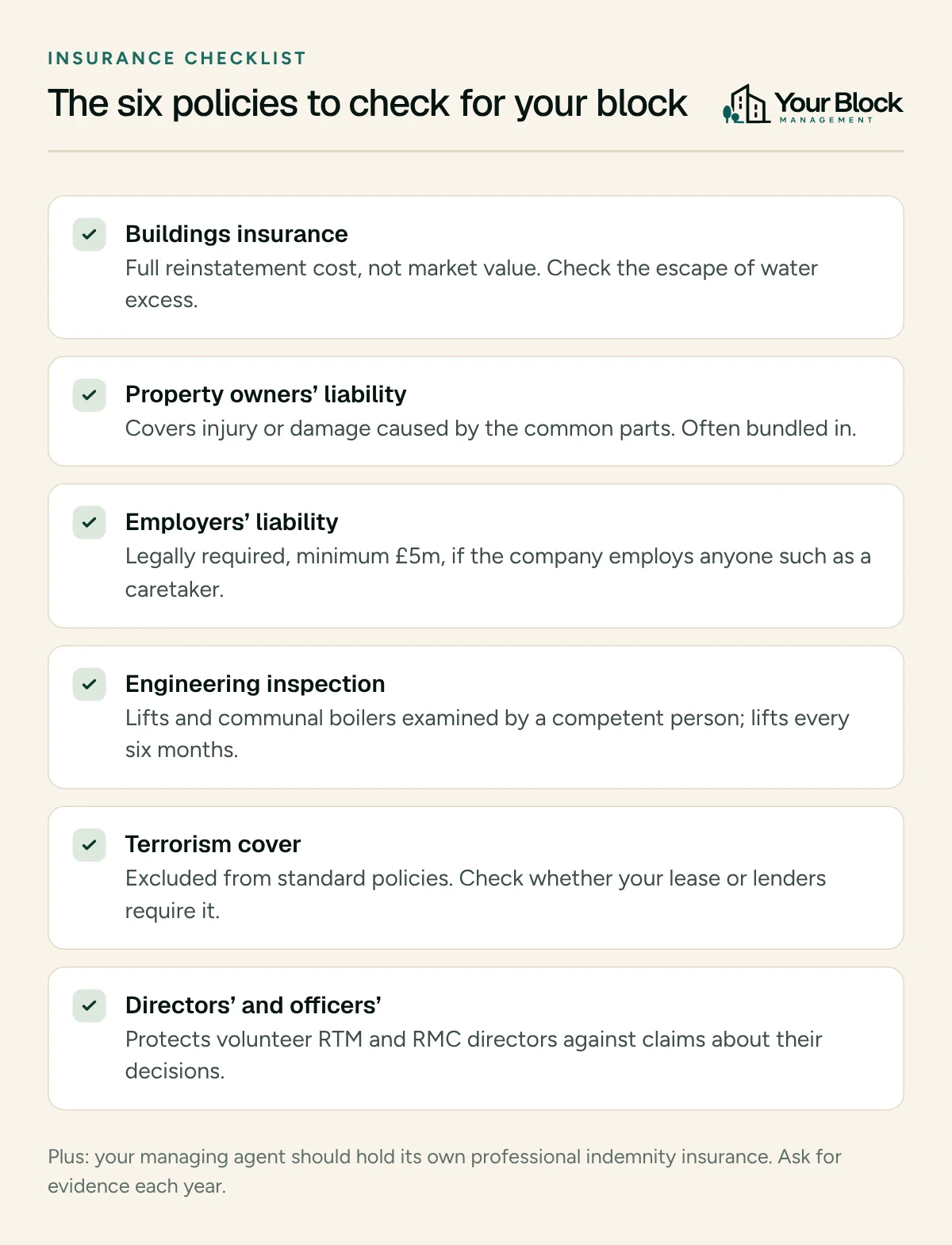
This is the big one, and usually the largest single line on the service charge after major works. It covers the structure and common parts against fire, flood, storm, escape of water, subsidence and similar perils. The policy should be on a reinstatement basis, meaning it pays to rebuild, not what the flats would sell for. Check the policy covers loss of rent or alternative accommodation for leaseholders if flats become uninhabitable, and look closely at the excess for escape of water claims, which are the most common claims in blocks and often carry a higher excess.
Property owners’ liability
Covers the landlord (or RTM or RMC company) if someone is injured or their property is damaged because of the common parts: a visitor slips on a wet stairwell, a loose roof tile hits a car. It is usually bundled into the buildings policy. Limits of £5 million or £10 million are common; ask what yours is.
Employers’ liability
Required by the Employers’ Liability (Compulsory Insurance) Act 1969 if the company that owns or manages the building employs anyone, for example a directly employed caretaker or cleaner. The minimum cover is £5 million. Most small RTM and RMC companies have no employees, because cleaners and gardeners are contractors, but check rather than assume. Some insurers include it in block policies anyway.
Engineering inspection and insurance
Passenger lifts, boilers serving communal heating and other pressure systems need periodic thorough examination by a competent person. Insurers usually arrange this through an engineering inspection contract, with passenger lifts examined every six months, in line with the Lifting Operations and Lifting Equipment Regulations 1998. Separate engineering insurance can cover breakdown and damage to the plant itself. A block with no lift and no communal boiler may not need it at all.
Terrorism cover
Standard property policies exclude terrorism. Cover is available as an add-on, often backed by the government-supported reinsurer Pool Re. Many leases and most mortgage lenders expect it for larger blocks; for a small block in a market town the premium is usually modest.
Directors’ and officers’ (D&O) liability
Protects the volunteer directors of an RTM or RMC company against claims that they acted wrongly in running the company, and usually funds legal defence costs. It is not compulsory, but asking neighbours to become unpaid directors without it is a hard sell. More on this below.
The managing agent’s own professional indemnity
This one is not the building’s policy. Your managing agent should carry professional indemnity (PI) insurance covering its own negligence, for instance missing a renewal date so the building goes uninsured. Ask for evidence of PI cover and the limit before appointing any agent, and every year after.
Who should arrange block management insurance?
Your lease decides. Almost every flat lease contains an insurance covenant saying who must insure the building, against what risks, and how the cost is recovered. In most blocks it works like this:
- Freeholder-managed blocks. The landlord insures the whole building and recovers the premium through the service charge. The managing agent usually handles the renewal, but the landlord is the policyholder.
- Right to Manage blocks. Insurance is one of the management functions that transfers to the RTM company on the acquisition date under section 96 of the Commonhold and Leasehold Reform Act 2002. The RTM company must have cover in place from day one, with the freeholder’s interest noted on the policy. Our guide to what an RTM company is and what it costs explains the wider takeover.
- Residents’ management company (RMC) blocks. Under a tripartite lease, the RMC is often the party obliged to insure. Read the lease: sometimes the freeholder keeps that obligation.
- Share of freehold. The leaseholder-owned freehold company insures, as landlord.
Individual flat owners then insure their own contents, and sometimes their own fixtures and improvements, separately. If a lease requires you to insure your own flat with an insurer the landlord nominates (rare for flats), you have a right to challenge that choice, covered below.
Whoever holds the obligation, the managing agent is the person most likely to arrange the policy in practice. A good agent tracks the renewal date months ahead, gathers claims history and asset information, approaches the market or a broker, and reports options to the board with costs and any commission disclosed. If you are a director weighing up what your agent should be doing here, our support for RTM and RMC directors page sets out how we split the work.
Getting the sum insured right: reinstatement cost valuations
The sum insured should be the full cost of rebuilding the block from scratch: demolition and site clearance, construction, professional fees and VAT where it cannot be recovered. It has nothing to do with the market value of the flats, and for many older blocks the rebuild cost is higher than people expect.
Underinsurance is dangerous because most policies contain an average clause. If the building is insured for less than its true reinstatement cost, the insurer pays only the same proportion of any claim.
No statute sets how often a reinstatement cost assessment must be done. Common practice is a full assessment by a chartered surveyor every three to five years, with the figure index-linked in between, and a fresh assessment after any significant alteration. If nobody can tell you when your building was last valued, that is the first thing to fix.
Insurance commission: what the rules say in 2026
Commission on block insurance has been one of the most contested issues in leasehold. Here is where the law actually stands at 15 October 2026.
In force now: FCA rules since 31 December 2023
Following its policy statement PS23/8, the Financial Conduct Authority treats leaseholders as customers when insurers and brokers design and distribute multi-occupancy buildings insurance. Firms must not have remuneration arrangements that lead to policies that are not in leaseholders’ interests. Insurers must provide information on the policy and its pricing, including commission, that landlords and agents can pass on, and must provide it directly to leaseholders on request. The FCA did not ban commission.
In force now: reasonableness
Under section 19 of the Landlord and Tenant Act 1985, insurance costs, like any service charge, are recoverable only to the extent they are reasonably incurred. A premium inflated by undisclosed commission, or a policy never tested against the market, can be challenged at the First-tier Tribunal.
Passed but not in force: LAFRA insurance provisions
The Leasehold and Freehold Reform Act 2024 contains provisions on permitted insurance remuneration, limiting what landlords and agents can charge leaseholders beyond the premium, and a new insurance information duty. As at October 2026 these have not been commenced. In its response of 15 July 2026 to the consultation on strengthening leaseholder protections, the Government said it would introduce a “transparent and fair permitted building insurance payment”, with the detail subject to a separate consultation, and expanded insurance information requirements with 12 months’ notice. Until those regulations are made and in force, commission is not banned, whatever you may read elsewhere.
What to ask your agent or freeholder now: Is any commission or fee paid to the landlord, the agent or anyone connected with them? How much, in pounds? What work is it paying for? Was the policy tested against the market, and with how many insurers? At Your Block we do not take commission on insurance, and we think that should be the norm, but every agent should at least answer those questions in writing.
Your rights to insurance information as a leaseholder
If your service charge includes insurance, the Schedule to the Landlord and Tenant Act 1985 (applied by section 30A) gives you firm rights:
- A written summary of the cover. Ask in writing and the landlord must provide, within 21 days, the sum insured, the insurer’s name and the risks covered (or a copy of the policy).
- To inspect the policy and proof of payment. Again within 21 days of a written request, with reasonable facilities to take copies.
- A request to the agent counts. Serving the request on the landlord’s named agent is treated as serving the landlord.
- It is an offence to ignore you. Failing to comply without reasonable excuse is a criminal offence carrying a fine of up to level 4 on the standard scale.
- Notifying the insurer yourself. If you think you have a claim under the building policy, you can notify the insurer directly in writing, and you get at least six months to do so.
- Challenging a nominated insurer. If your lease requires you to insure with an insurer the landlord nominates, you can apply to the tribunal if the cover is unsatisfactory or the premiums excessive.
Separately, under the FCA rules the insurer itself must give you policy and pricing information, including commission, on request. A recognised tenants’ association can also use the Schedule rights on members’ behalf.
Insurance for RTM and RMC directors
Directors of RTM and residents’ management companies are company directors with the same legal duties as any other. They can face claims from leaseholders, contractors or the freeholder, for example that the company failed to repair, mishandled a section 20 consultation or let insurance lapse. Most claims fail, but defending them costs money.
D&O cover typically pays defence costs and damages arising from the directors’ management decisions. Check what it excludes: fraud and deliberate wrongdoing are always excluded, and some policies exclude claims between members of the same company, which is exactly the kind of dispute that happens in blocks. Make sure the cost is a legitimate company expense under your articles and lease, and that the policy also covers former directors. Our guide to RTM company directors’ responsibilities explains what directors are signing up for.
Insurance also interacts with other duties. Insurers increasingly ask for an up-to-date fire risk assessment, evidence that actions from it are being closed off, and lift inspection reports. A board that cannot produce those may face higher premiums or restricted cover.
An annual insurance routine for directors and freeholders
Insurance problems almost always come from drift: a valuation that is ten years old, a renewal rolled over without a market test, a policy nobody has read. A simple yearly routine avoids most of them:
- Three months before renewal: confirm the reinstatement figure is current, update the asset list (lifts, boilers, door entry, solar panels), and gather the claims history.
- Two months before: test the market directly or through a broker, asking for commission to be disclosed in pounds.
- One month before: compare cover, excesses and exclusions, not just price, and record the decision and reasons in board minutes.
- At renewal: circulate a plain-English insurance summary to every leaseholder, including the excess they would bear on a claim and how to report one.
- During the year: log every claim and near-miss, and fix the cause of repeat escape of water claims before the insurer loads the excess.
A good managing agent should run this for you and show you the working. If you would like to see how Your Block tracks insurance, lift and fire safety dates for each building, our full block management service page explains it.
Frequently asked questions
Is block management insurance the same as buildings insurance?
Not quite. Buildings insurance is the main part, covering the structure and common parts. Block management insurance usually means the whole package a block needs: buildings cover plus property owners’ liability, and where relevant employers’ liability, engineering inspection for lifts and boilers, terrorism cover and directors’ and officers’ cover for the RTM or RMC board.
Can our RTM company choose its own buildings insurer?
Yes. Insurance is one of the management functions that passes to the RTM company on the acquisition date under section 96 of the Commonhold and Leasehold Reform Act 2002. The RTM company must arrange cover from that date and should note the freeholder’s interest on the policy. It still has to comply with any insurance requirements in the leases.
Has insurance commission been banned for blocks of flats?
No. As at October 2026 commission is not banned. FCA rules in force since 31 December 2023 require insurers to disclose it and to treat leaseholders fairly. The Leasehold and Freehold Reform Act 2024 provisions on permitted insurance remuneration have been passed but not commenced, and the Government has said the detail will be set out in a separate consultation.
How often should a block have a reinstatement cost valuation?
The law does not set a frequency. Common practice is a full assessment by a chartered surveyor every three to five years, with the figure index-linked each year in between, plus a new assessment after major alterations. An out-of-date valuation risks underinsurance, which can reduce every claim payout in proportion.
Who pays the excess on a buildings insurance claim?
It depends on the lease. Often the excess is treated as part of the cost of the claim and charged to the service charge, but some leases let the landlord recover it from the leaseholder whose flat caused the damage, for example a leak from a burst pipe. Check your lease and ask the agent to explain the policy before you need it.
Sources and further reading
- Landlord and Tenant Act 1985, Schedule (rights of tenants with respect to insurance)
- FCA update letter on multi-occupancy buildings insurance (February 2024)
- Commonhold and Leasehold Reform Act 2002, section 96
- Government response: Strengthening leaseholder protections over charges and services (July 2026)
- Employers’ Liability (Compulsory Insurance) Act 1969
This article is general information about the law in England, not legal advice. Leasehold law is changing, so check your lease and get professional advice for your own situation. Spotted something out of date? Tell us and we’ll fix it.