
Residential Block Management Companies: How to Shortlist, Compare and Choose
A practical buyer’s process for RTM and RMC boards and freeholders: the checks, the questions, the hidden fees and the contract clauses that matter.
 By Sam Charlesworth8 min read

The short version
- The RTM or RMC board, or the freeholder, appoints the agent; leaseholder associations can demand consultation under section 30B.
- Managing agents are not licensed yet, so check redress scheme membership, insurance and client money handling yourself.
- Compare total cost including extras such as section 20 fees, not just the per-flat headline fee.
- A management agreement longer than 12 months may need section 20 consultation before you sign.
- Insist on a handover clause with fixed timescales and no exit fee.
Choosing between residential block management companies is a procurement job, not a beauty parade. The decision belongs to whoever holds the management obligations, usually an RTM or RMC board or the freeholder. Write a short brief, shortlist three or four firms, send each the same questions, compare quotes line by line, check redress scheme membership and insurance, take references and read the management agreement before anyone signs.
This guide walks through that process step by step for blocks in England. It assumes you already know what a managing agent is for; if not, our guide to what a managing agent is supposed to do is the place to start, and our complete guide to block management covers the wider picture.
Who actually chooses the managing agent?
Before you contact anyone, be clear who has the power to appoint. A managing agent is a contractor working for whoever is responsible for managing the building under the leases.
- Freeholder-managed blocks. The freeholder chooses and appoints the agent. Leaseholders cannot appoint one directly, but a recognised tenants’ association can serve notice under section 30B of the Landlord and Tenant Act 1985 requiring the landlord to consult it about the agent: before appointing a new one, the landlord must give the association at least one month to comment.
- Right to Manage (RTM) companies. Once the RTM company has acquired management, its board appoints the agent. The freeholder has no say.
- Residents’ management companies (RMCs) and share of freehold companies. The board appoints, within whatever limits the company’s articles set. Some boards put the final choice to a members’ vote, which helps if the decision is contentious.
One thing worth knowing at the outset: there is currently no licence or mandatory qualification for leasehold managing agents in England. The Government announced on 29 September 2026 that agents will need a licence and qualifications under an independent regulator, but there is no legislation and no date yet. Until that happens, the checks below are your protection.
Step 1: write a brief before you speak to anyone
Agents can only quote accurately if they know what they are quoting for. A two-page brief also makes every proposal comparable. Include:
- The building: number of flats, any commercial units, number of blocks, height and storeys (whether it is over 11 metres or 18 metres changes the fire and building safety duties), lifts, communal heating, car parks, grounds.
- The money: current annual budget, reserve fund balance, any arrears, any planned major works.
- Current arrangements: who manages now, contract end date and notice period, existing contracts (cleaning, lift maintenance, fire alarm servicing) and when they end.
- Known problems: outstanding fire risk assessment actions, insurance claims, disputes, missing records.
- What you want: visit frequency, reporting, meeting attendance, out-of-hours cover, how you want residents kept informed.
Step 2: how to shortlist residential block management companies
Aim for three or four firms. More than that and the comparison becomes a part-time job. Good places to find candidates are recommendations from directors of nearby blocks, the member directories of professional bodies, and local searches. Distance matters more than people expect: an agent an hour away will visit less often and know fewer local contractors, which we explore in London versus local block management agents.
Before inviting anyone to quote, run five quick checks. Any firm that fails one should drop off the list.
| Check | What to look for | Why it matters |
|---|---|---|
| Redress scheme | Membership of The Property Ombudsman or the Property Redress Scheme, verified on the scheme’s own website | Compulsory for property management work in England since 2014; councils can fine non-members up to £5,000. It is also your route to independent complaint resolution. |
| Professional indemnity insurance | A current certificate and the limit of cover | Covers you if the agent’s negligence costs the building money, for example a lapsed insurance renewal. |
| Client money handling | Service charge funds held in a designated client account in trust, separate from the firm’s own money; any voluntary client money protection cover | Service charges are held on statutory trust under section 42 of the Landlord and Tenant Act 1987. Ask how they reconcile accounts and who can authorise payments. |
| Professional body membership | Membership of The Property Institute (TPI) or regulation by RICS | Voluntary, but it signals training, a code of conduct and a disciplinary process. |
| The RICS Code | A clear statement that they work to the RICS Service Charge Residential Management Code, 4th edition | The Code has been government-approved and in force since 7 April 2026. Tribunals take breaches into account. |
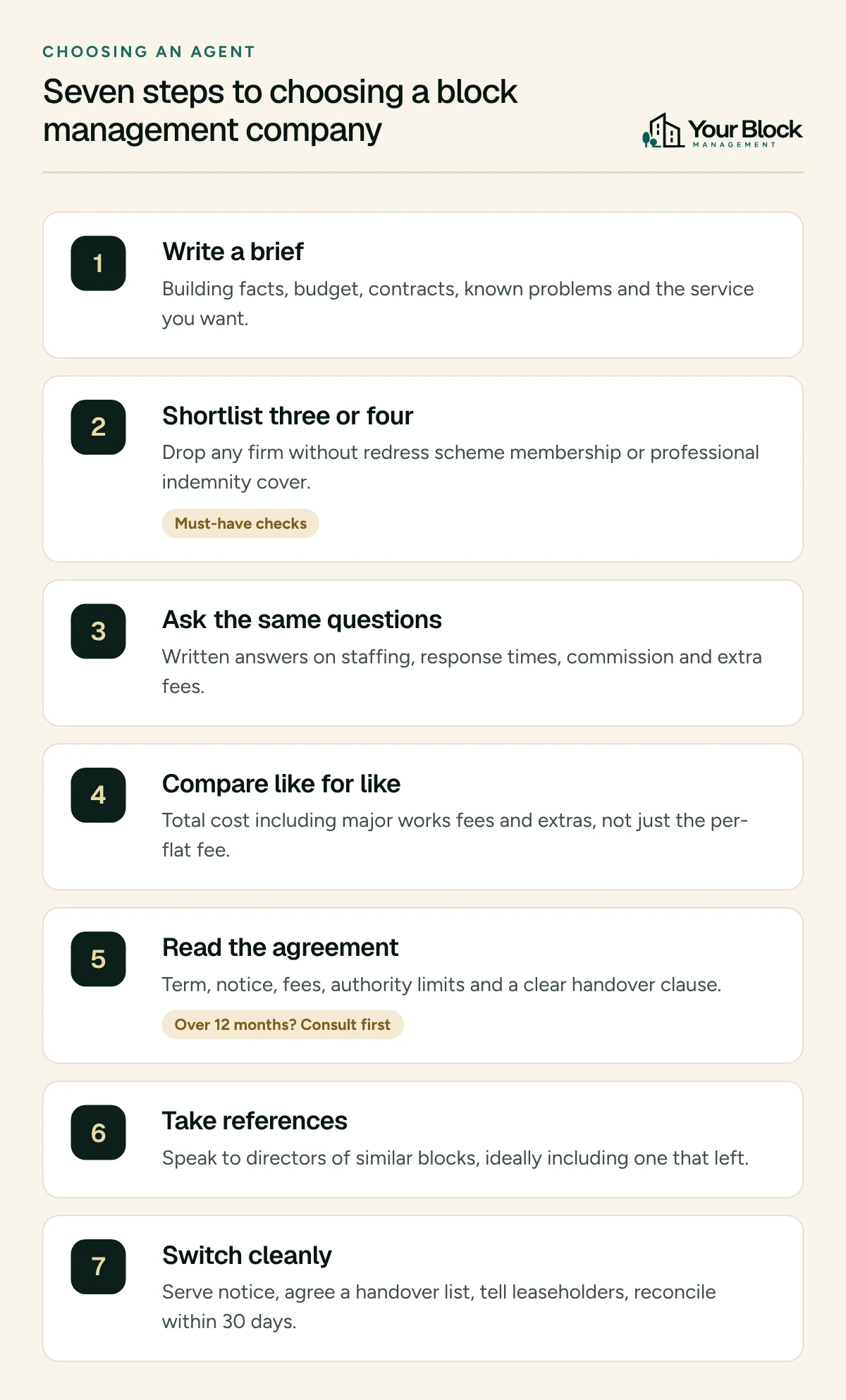
Step 3: questions to ask every agent
Send the same written questions to every shortlisted firm and ask for written answers. Then meet the person who would actually manage your building, not just the business development manager.
- Who will be our named property manager, and how many buildings and units do they look after?
- How often will they visit, and will we get a written report after each visit?
- What are your response times for emails, routine repairs and emergencies, and who answers the phone at 2am?
- How do residents report repairs and follow progress?
- Do you, or anyone connected with you, receive commission or any payment from insurers, brokers or contractors? If yes, how much, and is it disclosed?
- What do you charge on top of the management fee: section 20 major works fees, company secretarial work, AGM attendance, out-of-hours calls, sale packs for leaseholders?
- How quickly are year-end service charge accounts produced, and who prepares or reviews them?
- How do you track fire risk assessment actions, insurance renewal, lift inspections and other safety dates?
- What happens to our records and money if we end the contract?
- Can we speak to two current clients of a similar size, and one that has left you?
The quality of the answers tells you as much as the content. Vague replies to questions 5, 6 and 9 are worth noting. For a fuller list of what a good service looks like, use our block management service checklist.
Step 4: compare quotes like for like
Management fees are usually quoted per flat per year, plus VAT. The headline figure is only part of the cost. Two quotes that look far apart can end up close once extras are added, and sometimes the cheapest quote is the most expensive. Our guide to what you are actually paying for in block management goes deeper on fee structures.
Build a simple spreadsheet with a row for each item and a column per agent: core fee, major works fees, company secretarial, meeting attendance, out-of-hours charges, visit frequency, accounts preparation, insurance commission, contractor commission and charges made to individual leaseholders. Anything a firm will not price, mark as unknown and ask again.
Step 5: read the management agreement before you sign
The management agreement, sometimes called terms of engagement, is where good intentions become enforceable promises. Read it in full, and take advice if the building is large or the terms are unusual. Check in particular:
- Term. An agreement for more than 12 months is a qualifying long-term agreement under the section 20 rules. If any leaseholder would pay more than £100 towards it in an accounting period, you must consult leaseholders before signing, or recovery is capped at £100 per leaseholder per period. Our guide to section 20 consultation explains how it works.
- Notice period. Three months is common. Watch for long notice periods combined with automatic renewal.
- Termination for cause. You should be able to end the agreement promptly for serious breach, such as failing to account for money.
- Fees and reviews. How and when fees can rise, and a full schedule of extra charges.
- Handover clause. On termination, the agent must transfer all funds, accounts, records, contracts, keys and safety documents within a fixed period, with no termination or handover fee.
- Authority limits. How much the agent can spend without your approval, and what counts as an emergency.
- Commission. A clause requiring disclosure of all commissions and fees from third parties, or confirming none are taken.
Step 6: take references properly
References only help if you ask specific questions. Speak to directors, not just the firm’s nominated contact, and ask: How quickly does the property manager reply? Have year-end accounts arrived on time? Has a section 20 consultation run smoothly? Has anything gone badly wrong, and how did they handle it? Would you appoint them again? A reference from a block that left the firm, if they will give you one, is often the most honest of all. You can also check the tribunal decisions database for decisions naming the firm.
Step 7: switching once you have chosen
Once the board has decided, minute the decision and the reasons. Then:
- Serve notice on the outgoing agent in line with its contract, in writing, and diarise the end date.
- Sign the new agreement, having consulted under section 20 first if it is a qualifying long-term agreement.
- Agree a handover list: client account balances and statements, arrears ledger, reserve funds, insurance policy, fire risk assessment and safety records, contracts, leases, keys and fobs.
- Write to every leaseholder with the new agent’s details, the address for service of notices, and when payments should switch.
- Check after 30 days that every item on the handover list has arrived and every pound is reconciled.
Our FAQs on switching managing agent cover the common snags. If the outgoing agent drags its feet, or you are dealing with something worse than poor service, our guide to spotting good and bad block managing agents explains your options. And if Your Block is on your shortlist for a block in Suffolk or Essex, request a proposal and we will answer every question above in writing.
Frequently asked questions
Do block management companies need a licence in England?
Not yet. There is currently no licence or mandatory qualification for leasehold managing agents. The Government announced on 29 September 2026 that licensing, qualifications and an independent regulator will be introduced, but there is no legislation or date. Agents must already belong to a government-approved redress scheme, either The Property Ombudsman or the Property Redress Scheme.
How many managing agents should we get quotes from?
Three or four is usually enough. Fewer gives you little to compare; more creates a lot of work for volunteer directors. Send every firm the same written brief and questions so the answers are comparable, and meet the property manager who would actually run your building.
Can leaseholders choose the managing agent if the freeholder manages the block?
Not directly, because the agent works for the freeholder. A recognised tenants’ association can require the landlord to consult it about the agent under section 30B of the Landlord and Tenant Act 1985. To choose the agent yourselves, leaseholders would need to exercise the Right to Manage or buy the freehold.
What is a reasonable notice period in a management agreement?
Three months is common and generally workable. Be wary of long notice periods combined with automatic renewal, which can lock you in. The agreement should also let you terminate quickly for serious breach, and must set out how funds and records are handed over when it ends.
Does a new management agreement need section 20 consultation?
It does if the agreement is for more than 12 months and any leaseholder would contribute more than £100 towards it in an accounting period. Without consultation or tribunal dispensation, recovery is capped at £100 per leaseholder per period. Agreements of 12 months or less fall outside this rule.
Sources and further reading
- Landlord and Tenant Act 1985, section 30B (consultation about managing agents)
- Redress Schemes for Lettings Agency Work and Property Management Work Order 2014
- Service Charges (Consultation Requirements) (England) Regulations 2003, regulation 4
- SI 2026/298: approval of the RICS Service Charge Residential Management Code, 4th edition
This article is general information about the law in England, not legal advice. Leasehold law is changing, so check your lease and get professional advice for your own situation. Spotted something out of date? Tell us and we’ll fix it.