
Right to Manage Companies: 10 Lessons From Court Rulings and the Law (What Went Right and Wrong)
Ten lessons from published court and tribunal decisions and the 2002 Act, and what each one teaches RTM boards about setting up, serving notices and running a building.
 By Sam Charlesworth8 min read

The short version
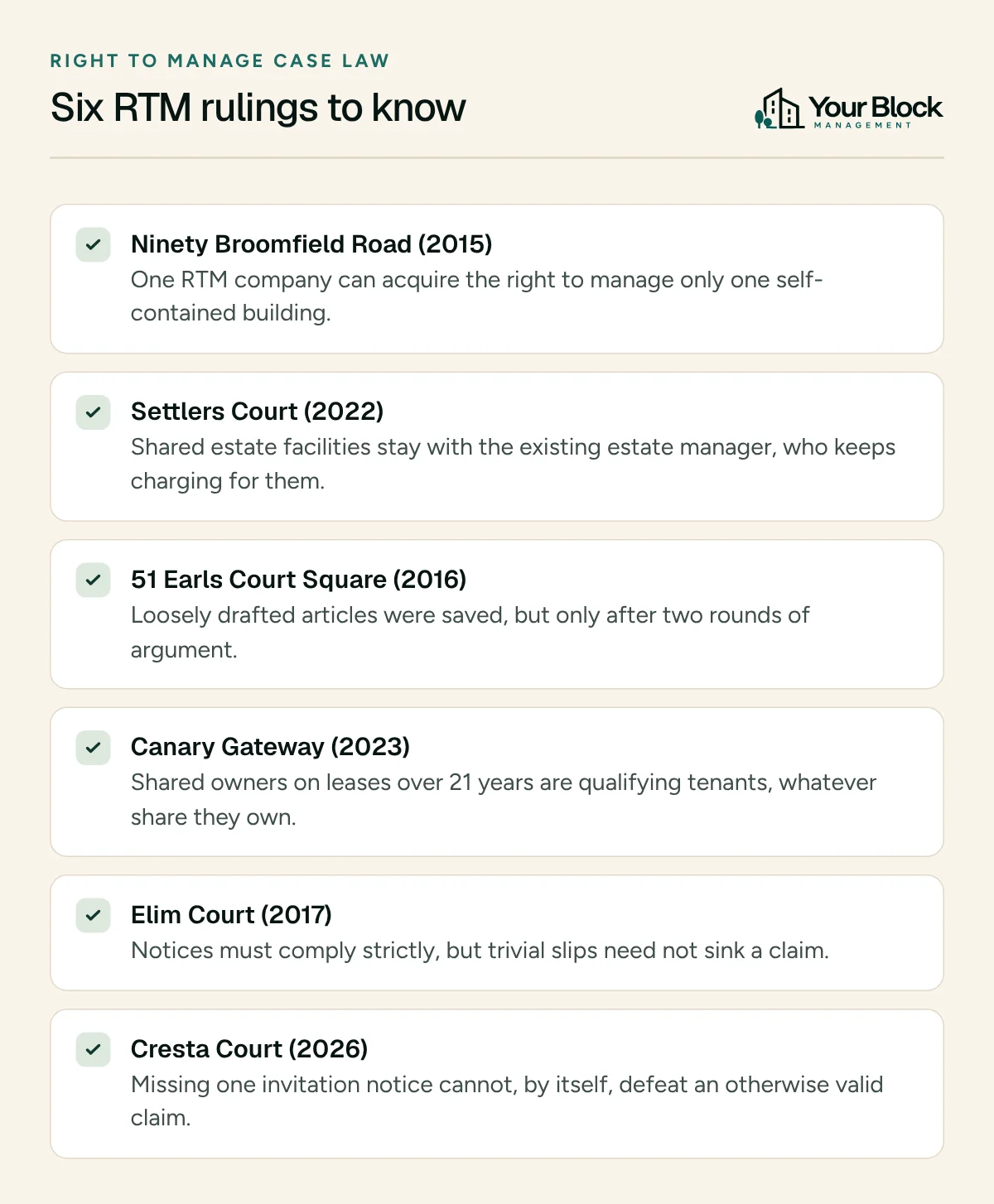
- One RTM company can take over only one self-contained building (Ninety Broomfield Road, 2015).
- Shared estate facilities stay with the estate manager after RTM (Settlers Court, Supreme Court 2022).
- Shared owners on leases over 21 years are qualifying tenants whatever share they hold (Canary Gateway, 2023).
- A missed invitation notice no longer defeats a claim (Cresta Court, Supreme Court 2026), but follow the rules.
- After takeover you carry full service charge duties, and strike-off ends the right to manage.
Right to manage companies succeed or fail on detail. The clearest lessons come from published court and tribunal decisions, where real blocks found out what the law actually requires: which buildings one RTM company can cover, what it takes over, how strictly the notices are read, and what happens once the company is running the building. Here are ten of those lessons, with the case behind each.
A word on sources. We can’t tell you private stories from blocks we haven’t worked with, and we won’t invent them. Every lesson below comes from a reported decision of the Court of Appeal, the Supreme Court or the Upper Tribunal, or from the Commonhold and Leasehold Reform Act 2002 (CLRA 2002) itself. Case summaries are simplified. The law described is for England as at October 2026; Wales differs in places.
Lessons from the start: setting up right to manage companies
1. One RTM company, one building
On estates with several blocks, it is tempting to form a single RTM company for the lot. In Triplerose Ltd v Ninety Broomfield Road RTM Co Ltd [2015] EWCA Civ 282, the Court of Appeal decided that an RTM company can acquire the right to manage only one self-contained building (or self-contained part of a building). A claim covering more than one is not valid.
What to do: form a separate RTM company for each block. If you want joined-up management, each company can appoint the same managing agent, or agree to share arrangements, once each has acquired its own right.
2. Your right to manage stops at the edge of the block
Settlers Court is one of ten blocks on the Virginia Quay estate in east London. After its RTM company took over in 2014, it claimed the estate’s shared gardens, accessways and river wall too. In FirstPort Property Services Ltd v Settlers Court RTM Co Ltd [2022] UKSC 1 (12 January 2022), the Supreme Court said no. The RTM company manages its building and property used only by that building. Facilities shared with other blocks stay with the existing estate manager, who can keep charging for them. The Court overruled the earlier Gala Unity v Ariadne Road decision that had pointed the other way.
What to do: before you vote to go ahead, list what the block shares with neighbours (car parks, bin stores, gardens, estate roads). Expect estate charges for those to continue after acquisition and build them into your budget.
3. Describe the premises clearly in your articles
The RTM company at 51 Earls Court Square defined “the Premises” in its articles as “Flat 1-13”. The freeholder argued that meant only the flats, not the whole building, so the company was not a valid RTM company. In Avon Ground Rents Ltd v 51 Earls Court Square RTM Co Ltd [2016] UKUT 22 (LC), the Upper Tribunal read the articles sensibly as referring to the whole building, and the company won. It still had to defend the point at two tribunals.
What to do: use the prescribed articles and give the building’s full address and description, matching the claim notice. Small drafting shortcuts invite arguments you don’t need. Our guide to the RTM company itself covers set-up and running costs.
Lessons from the notices
4. Map every qualifying tenant, including shared owners
Block A at Canary Gateway had 97 flats, 17 of them on shared ownership leases. The freeholder argued that shared owners who had not bought 100% were not qualifying tenants, so they should not have been counted or invited. In Avon Ground Rents Ltd v Canary Gateway (Block A) RTM Co Ltd [2023] EWCA Civ 616 (30 May 2023), the Court of Appeal held that a shared ownership lease granted for more than 21 years is a “long lease” under section 76, whatever share the owner holds.
What to do: build a flat-by-flat schedule from the Land Registry titles: lease term, owner, any head lease or underlease. That schedule decides who gets a notice, who counts towards the two-thirds test in section 72 and who counts towards membership. For the full qualifying rules, see whether your building passes the criteria.
5. A missed invitation is no longer fatal, but follow the rules anyway
Before a claim notice, every qualifying tenant who isn’t a member must get a notice of invitation to participate (section 78), and you must wait 14 days (section 79(2)). At Cresta Court one qualifying tenant, whose newly granted lease had not yet been registered, was not given an invitation notice. The Court of Appeal had treated that as fatal. In Avon Freeholds Ltd v Cresta Court E RTM Co Ltd [2026] UKSC 31 (27 August 2026), the Supreme Court disagreed: these are procedural requirements, not conditions of entitlement, so a landlord cannot defeat an otherwise valid claim by counter-notice on that ground alone.
What to do: treat this as a safety net, not a shortcut. The First-tier Tribunal can still make orders under section 107 where the rules are broken, and missing a neighbour is a poor start to running a building together.
6. Strict compliance matters, but trivial slips can survive
At Elim Court, a 40-flat block in Plymouth, the invitation notices offered no weekend inspection day for the articles, and the claim notice was not served on an intermediate landlord of one flat. In Elim Court RTM Co Ltd v Avon Freeholds Ltd [2017] EWCA Civ 89 (23 February 2017), the Court of Appeal held that both were real breaches, but neither invalidated the claim. The weekend point was “a trivial failure of compliance”, and the intermediate landlord had no management role. The court asked how important the missing step was to the scheme of the Act, not whether anyone was actually harmed.
What to do: get the dates, recipients and prescribed wording right first time. The cases show some errors are forgiven, but a contested claim costs months. This is where paying for a professional check earns its fee, as we explain in do you need a right to manage solicitor.
7. Count your members on the claim date, not the meeting date
Section 79(5) requires the company’s members to include qualifying tenants of at least half the flats on the date the claim notice is given. A flat sold the week before, or a member who never signed the membership form, can tip you below the line.
What to do: keep a signed register of members and re-check it against the flat schedule on the day you serve. Illustrative example: in a 14-flat block you need qualifying tenants of 7 flats as members. Aim for a margin, say 9 or 10, so one late sale doesn’t sink the claim.
Lessons from running the building
8. You inherit the landlord’s service charge duties in full
From the acquisition date, Schedule 7 to CLRA 2002 applies the service charge rules in the Landlord and Tenant Act 1985 to the RTM company. That includes the reasonableness test in section 19. Avon Ground Rents Ltd v Cowley [2019] EWCA Civ 1827 is not an RTM case, but it shows how that test bites on budgets. A landlord needed about £291,000 of courtyard repairs and asked for advance service charges while an NHBC warranty claim was pending. The Court of Appeal held that a reasonable on-account demand had to give credit for the likely third-party contribution.
What to do: when you budget for major works, deduct realistic insurance, warranty or grant contributions, and follow section 20 consultation where any leaseholder’s share will exceed £250. Volunteer status gives no exemption.
9. The freeholder still has a role, and the Act enforces it
The RTM company takes over “management functions”: services, repairs, maintenance, improvements, insurance and management (section 96). It cannot forfeit a lease. Before granting consent for an assignment, subletting or structural alteration it must give the landlord 30 days’ notice (14 days for other consents) under section 98. Under section 101 it must monitor leaseholders’ covenants and report breaches to the landlord within three months of becoming aware of them. Since 3 March 2025, these obligations can be enforced in the tribunal (Leasehold and Freehold Reform Act 2024, sections 51 and 52).
What to do: put a consents and breaches log on every board agenda. It is dull, and it is exactly the kind of record a freeholder will ask to see.
10. Keep the company alive, or lose the right
Section 105 says the right to manage ends if the RTM company is struck off the register, wound up or goes into administration. Missing Companies House filings for long enough can lead to strike-off, and the building’s management would then fall back to the landlord. Directors move, lose interest or sell up, and filings slip.
What to do: diarise the confirmation statement and annual accounts, keep at least two active directors, and plan for succession. Read what RTM directors are signing up for before anyone volunteers.
What the cases say about costs
Several of the older cases were expensive partly because, until 3 March 2025, an RTM company generally had to pay the freeholder’s reasonable costs of the claim. Section 50 of the Leasehold and Freehold Reform Act 2024 changed that. Under the new section 87A of CLRA 2002, the company and its members are generally not liable for other parties’ costs, with limited exceptions, including where a claim fails or is withdrawn and the company acted unreasonably (section 87B). A freeholder now has less to gain from fighting technical points, and the Cresta Court ruling narrows them further. That does not make sloppy notices safe: your own time and fees still count.
The pattern behind the right and wrong
Read together, the decisions point the same way. Blocks that did well were clear about what their building was, who their qualifying tenants were and what they were taking on, and they ran the company like a landlord from day one. The disputes started where those basics were assumed rather than checked: the shared estate nobody had mapped, the shared owners nobody had counted, the articles drafted in a hurry.
The hard part for most boards comes after the acquisition date, with budgets, consultation, consents and filings, year after year. That is the gap a good managing agent fills while the directors keep control of decisions. At Your Block we support RTM and RMC boards with meeting packs and compliance reminders, and every resident gets a portal login to follow repairs and spending. For the bigger picture, start with our guide to how right to manage works.
Frequently asked questions
Can one RTM company manage several blocks on the same estate?
No. The Court of Appeal decided in Triplerose v Ninety Broomfield Road (2015) that an RTM company can acquire the right to manage only one self-contained building or part. Each block needs its own RTM company. The separate companies can then appoint the same managing agent or agree shared arrangements to keep management joined up.
Does right to manage give us control of shared estate gardens and car parks?
Not if they are shared with other blocks. The Supreme Court held in FirstPort v Settlers Court (2022) that the right covers the building and property used only by that building. Shared estate facilities stay with the existing estate manager, which can continue to charge all the estate’s leaseholders, including yours, for them.
What happens if we forget to send an invitation notice to one leaseholder?
Since the Supreme Court’s Cresta Court decision in August 2026, that omission alone does not let the landlord defeat an otherwise valid claim by counter-notice. The requirement still applies, and the First-tier Tribunal can make orders under section 107 of CLRA 2002 where it is breached, so send every notice and keep proof of service.
Do shared ownership leaseholders count for right to manage?
Yes, if their lease was granted for more than 21 years. The Court of Appeal held in Canary Gateway (Block A) (2023) that such a lease is a long lease whatever share the owner has bought. They must receive invitation notices and they count towards the two-thirds and membership tests.
Can an RTM company lose the right to manage?
Yes. Under section 105 of CLRA 2002 the right ends if the company is struck off, wound up, goes into administration or enters certain insolvency arrangements, or if a tribunal-appointed manager takes over. Keeping Companies House filings up to date and having active directors are the simplest protections.
Sources and further reading
- Avon Freeholds Ltd v Cresta Court E RTM Co Ltd [2026] UKSC 31 (Lamb Chambers summary)
- FirstPort Property Services Ltd v Settlers Court RTM Co Ltd [2022] UKSC 1
- Avon Ground Rents Ltd v Canary Gateway (Block A) RTM Co Ltd [2023] EWCA Civ 616
- Elim Court RTM Co Ltd v Avon Freeholds Ltd [2017] EWCA Civ 89
- Commonhold and Leasehold Reform Act 2002, Part 2 Chapter 1 (Right to manage)
This article is general information about the law in England, not legal advice. Leasehold law is changing, so check your lease and get professional advice for your own situation. Spotted something out of date? Tell us and we’ll fix it.