
Right to Manage Company Directors Responsibilities: What You're Signing Up For
Before you volunteer for the board: the legal duties, paperwork, safety obligations and personal risks that come with being an RTM director.
 By Sam Charlesworth8 min read

The short version
- RTM directors owe the seven Companies Act duties in sections 171 to 177 to the company.
- If the company is struck off for not filing, the right to manage ends automatically.
- The company takes on the landlord’s repair, insurance and service charge obligations, including section 20.
- Fire safety is the biggest personal risk: directors can be prosecuted for the company’s offences.
- A managing agent can do the work, but the board remains responsible; get D&O cover.
The right to manage company directors responsibilities you take on fall into two layers. As company directors, you owe seven duties under the Companies Act 2006 and must keep filings up to date. As the building’s managers, you answer for the landlord’s lease obligations, service charge law, section 20 consultation and fire safety. A managing agent can do the work, but the responsibility stays with the board.
This guide sets out what you are signing up for before you agree to be an RTM director in England: the legal duties, the paperwork, the money, the safety obligations and your personal exposure. For the company’s structure and membership, see our guide to the RTM company.
Who can be an RTM director, and how you are appointed
Under the prescribed RTM articles (the RTM Companies (Model Articles) (England) Regulations 2009), anyone willing and legally permitted to act can be appointed. Appointment is by ordinary resolution of the members or by the existing directors. You must be at least 16, not disqualified, and not subject to a bankruptcy order; the articles end your appointment if one is made. Since 18 November 2025, every new director must verify their identity with Companies House before appointment.
The articles set a board quorum of two, so a one-person board cannot make decisions in a meeting. Directors are unpaid unless members approve pay in a general meeting, although reasonable expenses can be reimbursed. If your block is still at the claim stage, our guide on whether you need right to manage solicitors covers the notices.
Your duties under the Companies Act 2006 (sections 171 to 177)
These general duties are owed to the company. Here is what each means for an RTM board:
- Act within powers (s171). Follow the articles and use powers only for their proper purpose. Managing the building is the company’s object. Lending money to a member is not what it is for.
- Promote the success of the company (s172). For an RTM company, “success” means managing the premises properly for the members as a whole, not favouring your own floor or flat.
- Exercise independent judgment (s173). You can take advice from an agent, surveyor or solicitor, but the decision is yours. Don’t simply rubber-stamp.
- Exercise reasonable care, skill and diligence (s174). You are judged by what can reasonably be expected of someone in your role, and by any extra knowledge you actually have. A director who is a chartered surveyor is held to a higher standard on building matters.
- Avoid conflicts of interest (s175). See below for how this plays out on a residents’ board.
- Do not accept benefits from third parties (s176). No gifts or hospitality from contractors, brokers or agents that could compromise you.
- Declare interests in proposed transactions (s177). If you or someone connected to you stands to gain from a contract, say so before the board decides.
Conflicts of interest on a residents’ board
On an RTM board, conflicts are everyday events, not exotic ones. Typical examples:
- a director’s relative quotes for the decorating contract;
- a director’s own flat is the one with the leak, and the board must decide whether it is a communal repair;
- a director is in service charge arrears;
- a director lets out their flat and the board is setting a subletting policy.
Declare the interest (section 177), minute it, and step out of the vote. Article 19 of the prescribed articles says an interested director is not counted in the quorum or vote on that decision. If declaring leaves the board without a quorum, members can deal with it at a general meeting.
Statutory filings and records
The company must stay in good standing with Companies House. If it is struck off, the right to manage ends automatically under section 105 of the Commonhold and Leasehold Reform Act 2002 (CLRA 2002). The essentials:
- Confirmation statement at least every 12 months (£50 online). It cannot be filed until every director has verified their identity.
- Annual accounts within nine months of the year end (section 442 Companies Act 2006). Penalties start at £150 and reach £1,500 for a private company, doubling if late two years running.
- Changes of directors or registered office reported to Companies House, normally within 14 days.
- Registers and minutes: keep the register of members current as flats are sold, and keep written records of every board decision for at least 10 years, as the articles require.
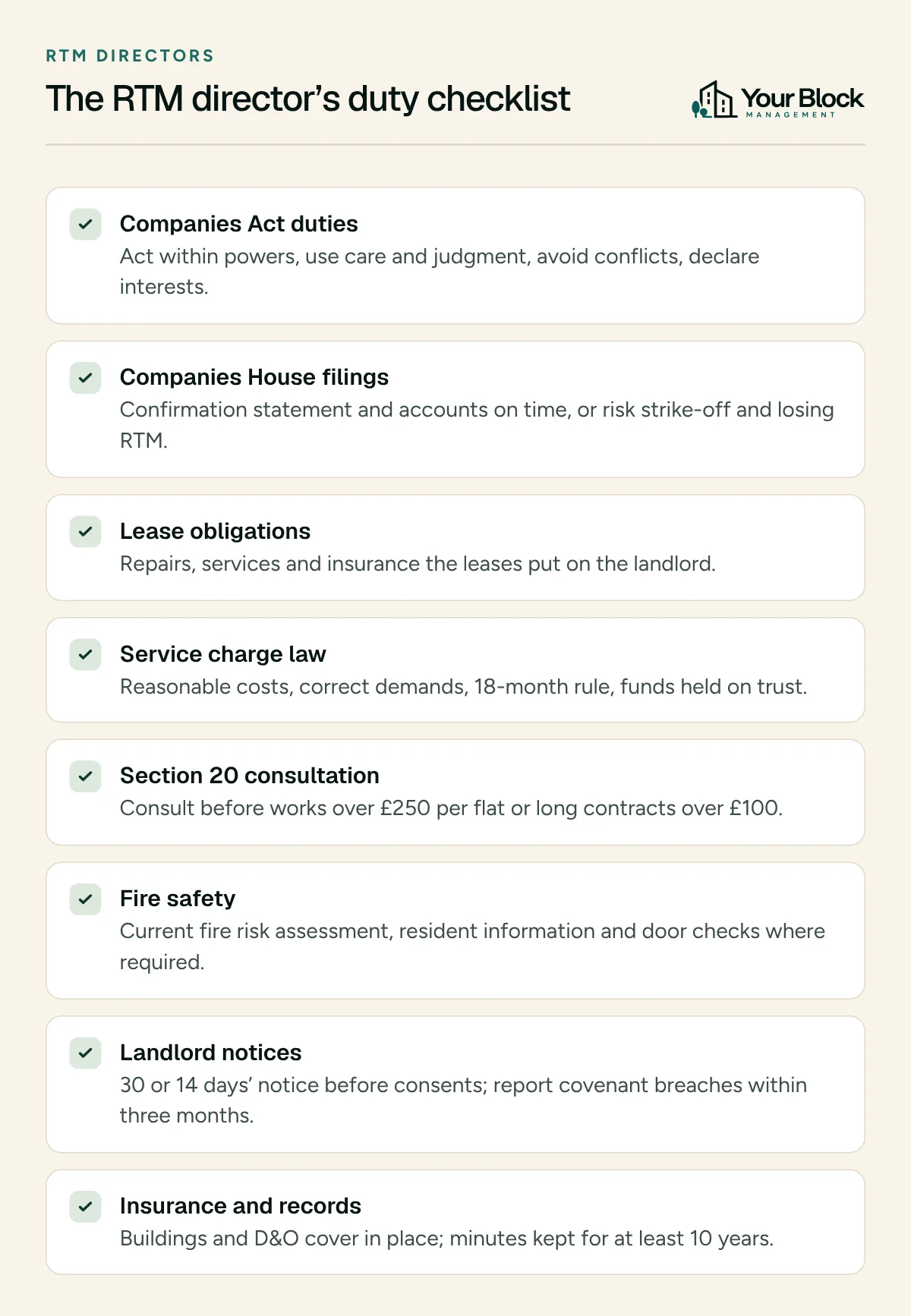
Right to manage company directors responsibilities at a glance
Before going into the detail, here is the whole job on one page. The sections around it explain each item in detail.
The landlord obligations the RTM company takes on
On the acquisition date, the landlord’s management functions under the leases (services, repairs, maintenance, improvements, insurance and management) become the RTM company’s (section 96). Those obligations are owed to the leaseholders and to the landlord (section 97(1)). Schedule 7 then applies key statutes to the company as if it were the landlord:
- Service charge law (sections 18 to 30, Landlord and Tenant Act 1985): costs must be reasonably incurred (s19), demands must come with the prescribed summary of rights (s21B), and costs not demanded within 18 months are generally lost (s20B).
- Trust money: service charges are held on statutory trust (section 42, Landlord and Tenant Act 1987).
- Demands must include the required name and address information (sections 47 and 48, Landlord and Tenant Act 1987).
- Insurance information: leaseholders can ask the company for a summary of the cover (section 30A, Landlord and Tenant Act 1985).
- Duty of care under section 4 of the Defective Premises Act 1972, where the company has repairing obligations.
Two further RTM-specific duties catch new boards out:
- Consents: before granting approval for an assignment, subletting, charge, structural alteration or change of use, the company must give the landlord 30 days’ notice; for other approvals, 14 days (section 98).
- Monitoring covenants: the company must keep under review whether leaseholders are complying with their lease covenants. It must report breaches to the landlord within three months of becoming aware of them, unless the breach has been remedied or the landlord has said it does not need to know (section 101).
Section 20 consultation for major works
If any one leaseholder’s share of a set of works would exceed £250, or their share of a contract lasting over 12 months would exceed £100 in an accounting period, the company must consult under section 20 of the Landlord and Tenant Act 1985 and the 2003 regulations. Get it wrong without tribunal dispensation and the company can only recover £250 per flat for the works, leaving it to find the rest.
Illustrative example: a 10-flat block replaces its roof for £40,000, so £4,000 per flat. Skip consultation, and the company may only be able to recover £2,500 in total (10 × £250), leaving a £37,500 gap. Our guide to section 20 consultation explains each stage.
Fire and building safety
LEASE’s guidance says an RTM company is a “responsible person” under the Regulatory Reform (Fire Safety) Order 2005. As a board, you must make sure that:
- there is a suitable and sufficient fire risk assessment covering the common parts. Since the Fire Safety Act 2021 it must also cover the structure, external walls and flat entrance doors. It must be recorded in writing and reviewed regularly;
- residents are given fire safety instructions and information about fire doors (all blocks with two or more flats);
- in buildings over 11 metres, communal fire doors are checked quarterly and flat entrance doors annually on a best-endeavours basis;
- you cooperate with any other responsible person, such as the owner of a ground-floor shop.
This is the area of greatest personal exposure. Under article 32(8) of the Order, where the company commits an offence with a director’s consent or connivance, or through their neglect, the director is also guilty. Buildings of 18 metres or 7 storeys and above carry extra duties under the Building Safety Act 2022. If yours is one, get specialist professional advice before the acquisition date.
Money: insurance, client funds and arrears
- Bank accounts: hold service charge money in a separate, designated account, never mixed with company or personal money. Require two signatories for larger payments.
- Buildings insurance: where the leases put insurance on the landlord, that duty is now the company’s. Make sure cover starts on the acquisition date. Ask brokers to disclose any commission; FCA rules require insurers to provide that information.
- Company insurance: directors’ and officers’ (D&O) cover, public liability, and employers’ liability if the company employs anyone. Our guide to right to manage insurance covers the policies.
- Arrears: the company can sue for unpaid service charges, but it cannot forfeit a lease (section 100(3)). Agree a written arrears policy so decisions are consistent and not personal.
Personal liability and D&O cover
A limited company protects directors from most of its debts. You are not personally liable for the roof bill just because you are a director. The exceptions are what matter:
- Breach of duty: the company can claim against a director who breaches the section 171 to 177 duties.
- Criminal offences: fire safety offences where the director consented, connived or was neglectful (article 32(8)).
- Wrongful trading: carrying on when you knew, or should have concluded, that insolvency could not be avoided (section 214, Insolvency Act 1986).
- Personal commitments: anything you sign in your own name rather than the company’s, or personally guarantee.
Section 233 of the Companies Act 2006 allows the company to buy insurance for its directors, and the RTM articles expressly allow it. D&O cover typically pays legal defence costs and damages for claims alleging wrongful acts. Read the exclusions: criminal fines and deliberate wrongdoing are commonly excluded. Ask the broker in writing whether fire safety prosecutions and regulatory investigations are covered.
Time commitment, and how a managing agent shares the load
Expect a burst of work around takeover, then regular board meetings, a budget cycle, an AGM and occasional peaks for major works or a problem neighbour. Self-managing directors also handle contractors, demands and emergencies.
A managing agent takes the operational work: collecting service charges, instructing contractors, running section 20 consultations, keeping compliance dates and preparing accounts. LEASE is clear that directors remain ultimately responsible even when they use an agent. So choose one that reports clearly and lets you check what is happening. At Your Block we support RTM and RMC boards by drafting agendas and meeting packs and tracking fire, insurance and safety dates with reminders. Every resident gets a portal login to report repairs and follow progress. You can see what full block management includes.
Still deciding whether to go ahead? Our right to manage pros and cons and the full right to manage guide will help your block decide with its eyes open.
Frequently asked questions
Are RTM company directors personally liable?
Not for the company’s ordinary debts, because the company has limited liability. Directors can be personally liable for breaching their Companies Act duties, for fire safety offences committed with their consent, connivance or neglect, for wrongful trading, and for anything they sign or guarantee personally. D&O insurance covers some of these risks but usually not criminal fines.
Do RTM directors have to be leaseholders in the building?
The prescribed RTM articles let anyone willing and legally permitted be appointed, by members or by the board, so a director does not have to be a member. In practice most directors are resident leaseholders. Some boards co-opt someone with useful skills. Every director must be at least 16 and must verify their identity with Companies House.
How much time does being an RTM director take?
It varies with the building and whether there is a managing agent. Expect more work around takeover, then regular board meetings, a yearly budget and AGM, and peaks for major works, insurance renewals or disputes. Self-managing boards also handle contractors, demands and emergencies, which takes much more time.
Can an RTM director resign?
Yes, by notifying the company. The resignation takes effect on its terms, and the change must be reported to Companies House. Make sure the board still has at least two directors, because the prescribed articles set a quorum of two. Remaining directors can appoint a replacement or call a general meeting so members can.
Sources and further reading
- Companies Act 2006, Part 10 Chapter 2 (general duties of directors)
- Commonhold and Leasehold Reform Act 2002, Schedule 7 (statutory provisions applied to RTM companies)
- Regulatory Reform (Fire Safety) Order 2005, article 32 (offences)
- LEASE: Fire safety for resident directors
- GOV.UK: Verifying your identity for Companies House
This article is general information about the law in England, not legal advice. Leasehold law is changing, so check your lease and get professional advice for your own situation. Spotted something out of date? Tell us and we’ll fix it.