What Is Right to Manage? The 5-Minute Guide That Could Save Your Block Thousands
The plain-English version: what the right to manage is, what you gain and keep, why claims are cheaper since 2025, and the six steps.
 By Sam Charlesworth7 min read
The short version
- Right to manage moves management of your block to a leaseholder-run company.
- You need no proof of fault and pay no premium to the freeholder.
- The freeholder keeps ownership and ground rent; your lease does not change.
- Since 3 March 2025 RTM companies generally no longer pay the freeholder’s claim costs.
- An undisputed claim usually takes five to seven months from start to takeover.
What is right to manage? It is a legal right that lets leaseholders of flats in England take over the management of their building from the freeholder. You form a company, serve formal notices and, on a set date, the company takes charge of repairs, insurance, service charges and the managing agent. You do not need to prove the freeholder did anything wrong, and nobody pays a price.
That is the short answer. This five-minute guide covers what the right to manage gives you, what it does not, how it could save your block money, and the steps at a glance. Each section links to a deeper guide when you are ready for the detail.
What is right to manage, in plain English?
The right to manage (usually shortened to RTM) was created by the Commonhold and Leasehold Reform Act 2002 (CLRA 2002). Before it existed, leaseholders unhappy with how their block was run had two main options: persuade the freeholder to change things, or go to a tribunal and prove serious failings. RTM added a third option that needs neither.
Think of your lease as having two sides. The ownership side says who owns the building and collects the ground rent. The management side says who repairs it, insures it, cleans it and sets the service charge. RTM moves the management side to a company the leaseholders control. The ownership side stays with the freeholder.
Three ideas sit at the heart of it:
- No fault. You do not have to show that the freeholder or their agent has been slow, expensive or careless. If your building qualifies and you follow the process, the freeholder cannot block it.
- No price. Unlike buying the freehold, there is no valuation and no premium to pay.
- A company does it, not individuals. The leaseholders who take part form an RTM company, a private company limited by guarantee whose rules are set by law. Its volunteer directors make the decisions.
What right to manage gives you, and what it doesn’t
This is the part most people get wrong, so it is worth being precise.
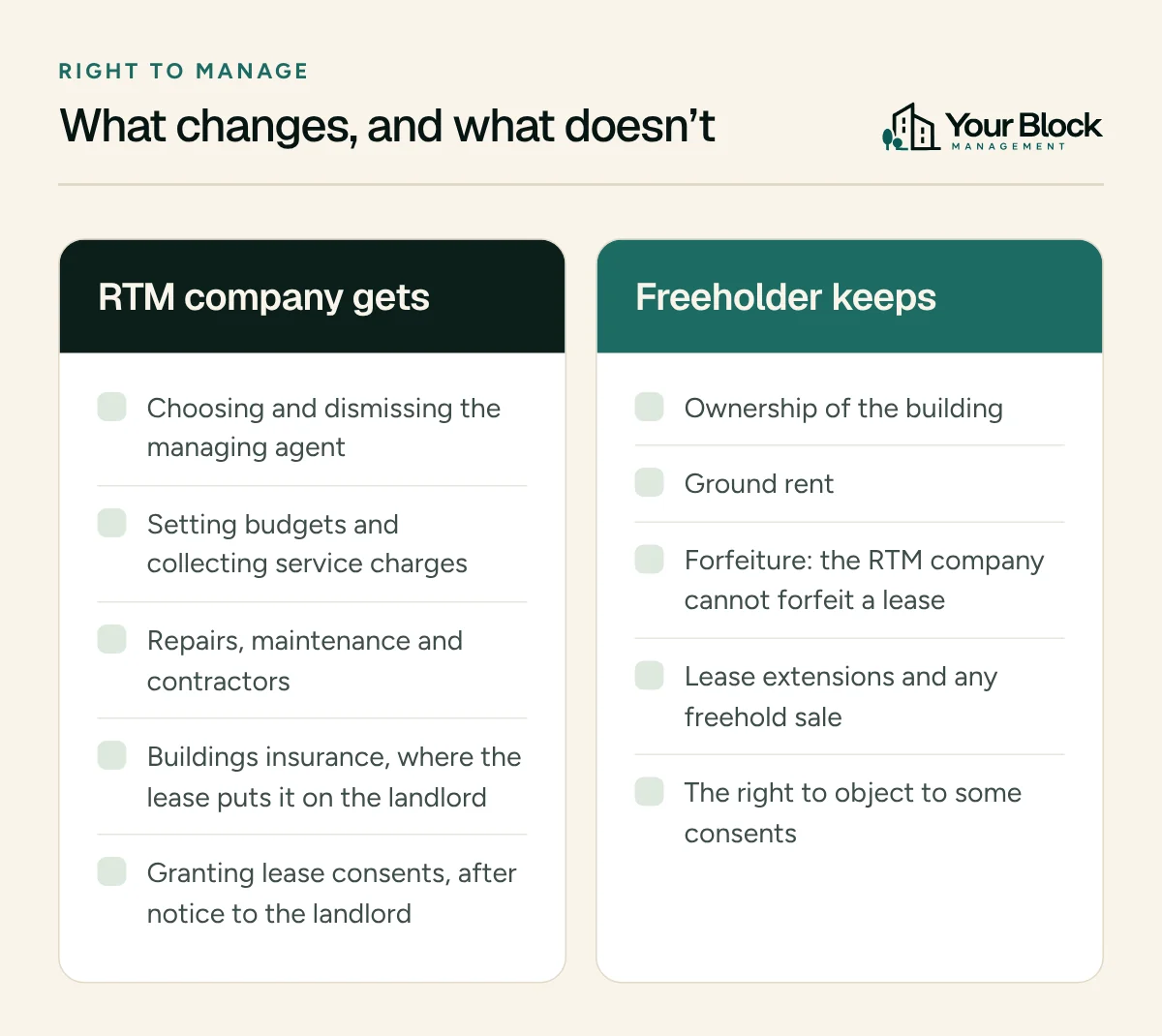
You get control of management. Under section 96 of CLRA 2002, the landlord’s management functions under the leases pass to the RTM company. Those are functions to do with services, repairs, maintenance, improvements, insurance and management. In practice the company can:
- choose, and sack, the managing agent, or manage the building itself;
- set the budget and collect service charges;
- pick contractors and arrange the buildings insurance, where the lease puts insurance on the landlord;
- deal with consents under the lease, after giving the landlord notice.
You do not get ownership. RTM is not enfranchisement (the legal term for leaseholders buying the freehold). After RTM:
- the freeholder still owns the building and still collects ground rent;
- your lease is unchanged: the same length, the same service charge share, the same rules;
- the RTM company cannot forfeit a lease (section 100(3));
- a short lease still needs extending separately, and onerous ground rent is not fixed.
Duties come with the control. Once in charge, the RTM company must follow service charge law, including section 20 consultation for major works, and becomes responsible for fire safety in the common parts. Read what RTM directors are signing up for before anyone volunteers.
Right to manage compared with the other options
| Option | Do you need to prove fault? | Do you pay a premium? | Who ends up in control? |
|---|---|---|---|
| Ask the freeholder to change agent | No | No | Still the freeholder |
| Right to manage | No | No | The leaseholders’ RTM company |
| Tribunal-appointed manager | Yes, broadly | No | A manager answerable to the tribunal |
| Buy the freehold together | No | Yes | The leaseholders, as owners |
If you are torn between managing and owning, our guide on right to manage or buying the freehold compares the two properly.
How right to manage could save your block money
RTM does not guarantee lower bills. Your building still needs insuring, repairing and cleaning. But it can save money in three ways.
1. The claim itself is cheaper than it used to be
Before 3 March 2025, an RTM company had to pay the freeholder’s reasonable costs of dealing with the claim. That rule has gone. Under the new section 87A of CLRA 2002 (inserted by the Leasehold and Freehold Reform Act 2024), the RTM company and its members are generally not liable for anyone else’s costs arising from the claim. The exceptions are narrow. They include costs a court or tribunal orders under its own powers, and a tribunal order where a claim is withdrawn or fails and the company acted unreasonably (section 87B). Separately, section 20J of the Landlord and Tenant Act 1985 stops the freeholder recovering its RTM costs through your service charge.
2. No premium, unlike buying the freehold
Buying the freehold means paying a price set by valuation, plus both sides’ professional costs. RTM has no price at all. Your own costs remain: forming the company, any help with the notices, and running costs such as insurance for directors and annual accounts. Our guide to right to manage solicitors explains what professional help costs and when it is worth it.
3. You decide what gets spent
With control of the budget, the board can shop around for the agent, the contractors and the insurance. It can also ask hard questions about commission. Since 31 December 2023, FCA rules have required insurers to provide information about policy pricing, including commission. Commission has not been banned, but you can now see it and choose.
Illustrative example only: if a 12-flat block trimmed £100 a flat a year from its running costs, that would be £1,200 a year, or £12,000 over ten years. Whether your block can do that depends entirely on what it pays now and what it needs.
Does your building qualify?
In short, the building must be self-contained, contain at least two flats held by long leaseholders (broadly, leases originally granted for more than 21 years), and long leaseholders must hold at least two-thirds of the flats. Some buildings are excluded: those with more than 50% non-residential floor space, small conversions with a resident freeholder, and blocks where a council is the landlord. On the day you claim, owners of at least half the flats must be members of the RTM company. Our right to manage qualifying criteria self-test walks through every rule and the tricky cases.
The right to manage steps at a glance
- Check you qualify and count how many owners will join.
- Form the RTM company at Companies House using the articles prescribed by law. By convention its name ends “RTM Company Limited”.
- Invite every other qualifying leaseholder to join with a notice of invitation to participate, then wait at least 14 days.
- Serve the claim notice on the freeholder and other parties, with a copy to every qualifying leaseholder. It gives at least one month for a reply and an acquisition date at least three months after that.
- Wait for the counter-notice. If the freeholder disputes the claim, the company has two months to apply to the First-tier Tribunal.
- Take over on the acquisition date. Management passes to the company, and unspent service charge money must be paid over.
The legal minimum is about four and a half months from invitation notices to takeover. Five to seven months is more realistic for a claim nobody disputes. In August 2026 the Supreme Court’s Cresta Court decision confirmed that a missed invitation notice or a short 14-day wait does not, on its own, sink an otherwise valid claim. The full process, with every deadline, is in our complete right to manage guide.
Is right to manage right for your block?
RTM works best when enough neighbours want change and two or three are willing to serve as directors for several years. It suits blocks where the problem is the management: cost, responsiveness or transparency. It is the wrong tool if the real problem is a short lease or high ground rent. The honest pros and cons of right to manage will help you decide.
Many RTM companies appoint a managing agent so that directors make decisions rather than chase contractors. At Your Block we work with RTM and RMC boards in Suffolk and Essex, and every resident gets a portal login to report repairs, see budgets against actual spending and take part in informal polls, which are kept separate from the company’s formal votes. The rules in this guide are the law in England as at October 2026. The Government’s draft Commonhold and Leasehold Reform Bill has not yet been introduced to Parliament, so check for changes before you serve notices.
Frequently asked questions
Is right to manage the same as buying the freehold?
No. Right to manage transfers only the management of the building to a leaseholder-run company. The freeholder still owns the building and collects ground rent, and nobody pays a premium. Buying the freehold, called collective enfranchisement, makes the leaseholders the owners but involves paying a price set by valuation.
Can the freeholder stop right to manage?
Not if the building qualifies and the claim is made properly. Right to manage is a no-fault right, so the freeholder does not have to agree. The freeholder can dispute the claim by counter-notice, in which case the RTM company can ask the First-tier Tribunal to decide whether it is entitled to manage.
Do all leaseholders have to join the RTM company?
No. Members must include the qualifying tenants of at least half of all the flats on the day the claim notice is served, or both if there are only two. Leaseholders who do not join are still managed by the RTM company and still pay their service charge to it after the takeover.
Does right to manage reduce service charges?
Not automatically. The building still has to be insured, repaired and managed. Right to manage gives leaseholders control over who provides those services and at what price, which can lead to savings. It also brings duties, and the company must follow the same service charge rules as a landlord.
Do we still have to pay the freeholder’s legal costs?
Generally not for claims since 3 March 2025. Section 87A of the Commonhold and Leasehold Reform Act 2002 says the RTM company and its members are not liable for other people’s costs of a claim, with narrow exceptions, such as where a claim fails and the tribunal finds the company acted unreasonably.
Sources and further reading
- Commonhold and Leasehold Reform Act 2002, Part 2 Chapter 1 (right to manage)
- Commonhold and Leasehold Reform Act 2002, section 87A (costs: general)
- Commonhold and Leasehold Reform Act 2002, section 96 (management functions)
- The Leasehold and Freehold Reform Act 2024 (Commencement No. 3) Regulations 2025, SI 2025/131
This article is general information about the law in England, not legal advice. Leasehold law is changing, so check your lease and get professional advice for your own situation. Spotted something out of date? Tell us and we’ll fix it.