
Section 20 Consultation: How It Works and Why Skipping It Could Cap Your Bill at £250
What happens when consultation is skipped or botched: the £250 cap, dispensation under section 20ZA, the Daejan test, and how boards and freeholders avoid the risk.
 By Sam Charlesworth7 min read

The short version
- Without proper consultation or dispensation, recovery is capped at £250 per leaseholder for works, £100 a year for long-term contracts.
- The First-tier Tribunal can dispense with consultation under section 20ZA, before or after the works.
- Since Daejan v Benson, the key question is whether leaseholders suffered real prejudice from the failure.
- Dispensation is often granted on terms, such as reducing the bill or paying leaseholders’ reasonable costs.
- RTM and RMC boards are the landlord for section 20 purposes and carry the risk of getting it wrong.
Section 20 consultation is the legal process a landlord must follow before charging leaseholders more than £250 each for major works, or more than £100 a year each under a contract lasting over 12 months. Skip it or get it wrong, and each leaseholder’s contribution is capped at those amounts unless the First-tier Tribunal grants dispensation. Since 2013, that decision turns on one question: were leaseholders actually prejudiced?
This guide focuses on the consequences: the cap, dispensation, the leading case and how tribunals approach it. It is written for leaseholders and for the people who must run consultation properly, including RTM and RMC directors and freeholders. England only.
How section 20 consultation works, briefly
Section 20 of the Landlord and Tenant Act 1985 and the Service Charges (Consultation Requirements) (England) Regulations 2003 set out the steps. For most private blocks, major works consultation has up to three stages: a notice of intention, a statement of estimates and, where needed, a notice of reasons, with two 30-day windows for leaseholders’ observations. The detail of each notice is in our guide to the three stages of section 20 notices, and whether a job needs consultation at all is covered in when section 20 works need consultation.
“Landlord” means whoever can enforce the service charge. If you are a director of an RTM company, an RMC or a share of freehold company, that is your company, and the duty to consult is yours.
What happens if section 20 consultation is skipped?
Section 20(1) says that where the consultation requirements apply, each leaseholder’s contribution is limited to the “appropriate amount” unless the requirements have been complied with or dispensed with by the tribunal. The appropriate amounts are:
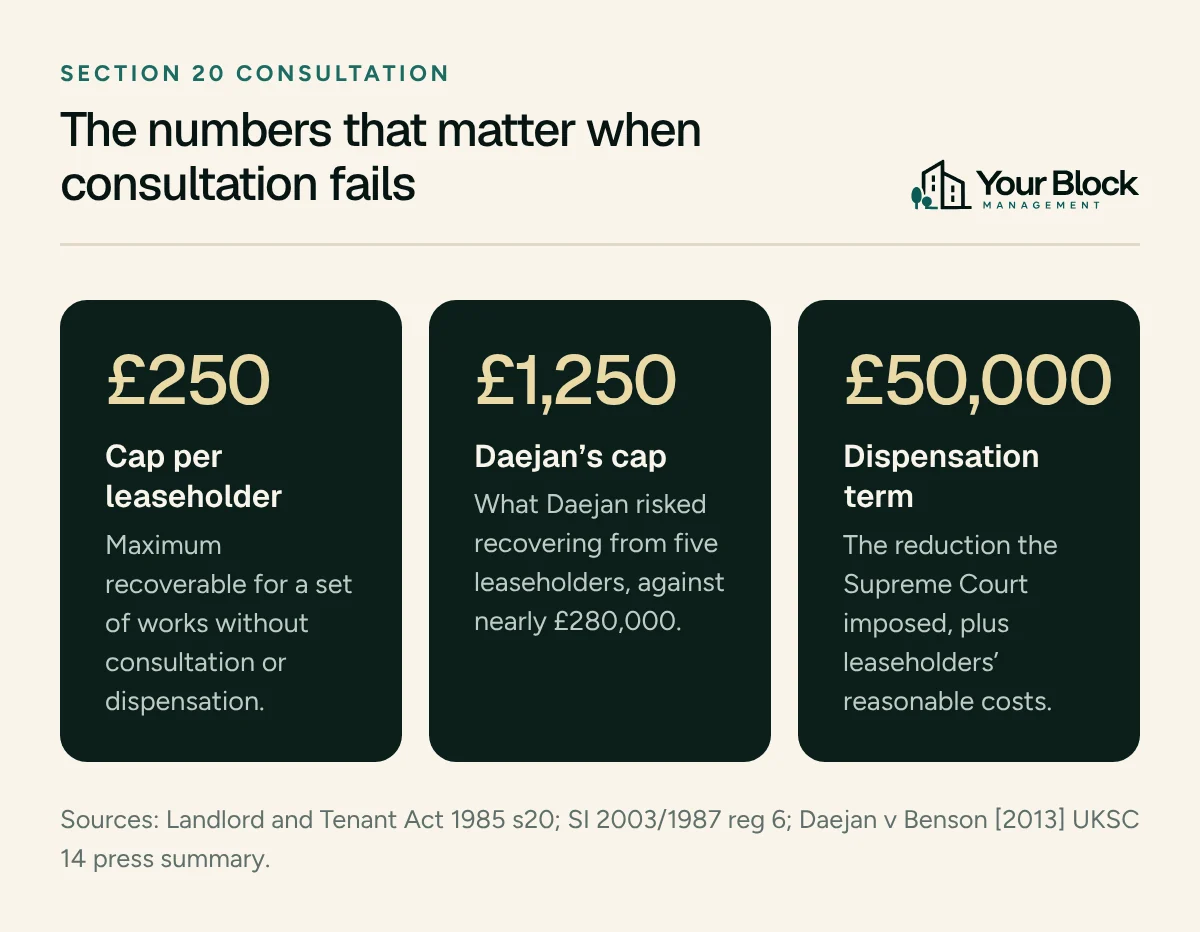
- £250 per leaseholder for a set of qualifying works (regulation 6).
- £100 per leaseholder per accounting period for a qualifying long-term agreement (regulation 4).
Illustrative example: a 12-flat block needs a £96,000 roof (including VAT), split equally. Each leaseholder’s share is £8,000. If the landlord fails to consult and doesn’t get dispensation, it can recover only £250 from each, £3,000 in total. The other £93,000 can’t be charged to the leaseholders through the service charge.
For a commercial freeholder, that is a loss it has to absorb. For an RTM company or RMC, it can be far more serious: these companies usually have no money other than what leaseholders pay, yet the contractor still has to be paid. That is why boards need to treat consultation as a core duty, not paperwork. Our support for RTM and RMC directors is built around this kind of risk.
Dispensation under section 20ZA
Section 20ZA lets the First-tier Tribunal (Property Chamber) dispense with all or any of the consultation requirements if it is “satisfied that it is reasonable to dispense”. Key points:
- Timing is flexible. Landlords can apply before works start, during them, or after they are finished.
- Urgency is a common reason. LEASE gives examples such as urgent safety repairs, works where all leaseholders already agree, and specialist work only a few contractors can do.
- It is not a reasonableness ruling. Dispensation removes the cap. It does not decide that the cost was reasonable, and leaseholders can still challenge that separately under sections 19 and 27A.
Daejan v Benson: the case that set the test
Daejan Investments Ltd v Benson [2013] UKSC 14 is the Supreme Court decision every tribunal now applies. The facts, from the court’s own press summary:
- Daejan owned Queens Mansions, a block of seven flats. Five were held by the leaseholders opposing the application.
- It ran the first stages of consultation but then failed to comply with a later requirement before awarding the contract.
- It wanted to recover just under £280,000. Without dispensation, it could recover only £1,250 from those five leaseholders (£250 each).
- During the proceedings it offered to reduce the leaseholders’ liability by £50,000.
- The lower tribunals refused dispensation, treating the breach as serious. The Supreme Court allowed Daejan’s appeal by a majority of 3 to 2 and granted dispensation on two conditions: the £50,000 reduction, and Daejan paying the leaseholders’ reasonable costs.
The principles that came out of it
- Purpose first. The requirements exist to protect leaseholders from paying for inappropriate works, or paying more than is appropriate. Consultation is a means to that end.
- Real prejudice is the key question. The tribunal asks whether the failure caused leaseholders relevant prejudice, and if so what.
- Seriousness alone isn’t the test. How badly the landlord breached the rules, or how culpable it was, does not by itself decide the outcome.
- The burden is shared. The legal burden stays with the landlord, but leaseholders must identify what they would have said or done differently. Once they show a credible case of prejudice, the landlord must rebut it, and the tribunal should be sympathetic to the leaseholders.
- Dispensation can come with terms. Typically a reduction to compensate for prejudice, and payment of leaseholders’ reasonable costs of investigating it.
How tribunals approach dispensation now
In practice, the first question is: what would the leaseholders have done if properly consulted, and what difference would it have made? LEASE gives examples of relevant prejudice, such as paying more because leaseholders couldn’t nominate a cheaper contractor, or getting poorer-quality work because their comments were ignored.
That leads to three broad outcomes:
- No prejudice shown: dispensation is usually granted, often with a condition about leaseholders’ costs.
- Some prejudice shown: dispensation is granted on terms that compensate leaseholders, such as reducing the recoverable cost.
- Serious prejudice that can’t be compensated: dispensation may be refused, and the cap applies.
Tribunals also look closely at what the leaseholders actually knew. If residents were kept informed, saw competitive quotes and had a real chance to comment informally, it is harder to show that a missed formal step changed anything. If they were kept in the dark and the price looks high, the opposite is true.
For leaseholders, the practical lesson is that evidence wins. A comparable quote, a contractor you would have nominated, a survey suggesting a cheaper repair: these are what show prejudice. For landlords and boards, the lesson is that dispensation is not free. Even a successful application costs time, professional fees and, often, the leaseholders’ costs as well.
Where section 20 consultation usually goes wrong
Most failures are avoidable. The ones that come up again and again are:
- Not testing the threshold properly: forgetting VAT, or dividing by the number of flats when shares are unequal.
- Missing a long-term agreement: a multi-year cleaning, lift or management contract signed without consultation.
- Splitting a job to keep each part under £250.
- Signing the contract early, before the second 30-day period has ended.
- No independent estimate, or ignoring a leaseholder’s nominated contractor.
- Not summarising and answering observations in the statement of estimates.
- Forgetting the reasons notice within 21 days, when the chosen contractor wasn’t the cheapest or a nominee.
- Scope creep: carrying out materially different works from those consulted on.
Running section 20 consultation properly: a playbook for boards and freeholders
- Plan ahead. A planned maintenance programme means most works can be consulted on calmly, not in a crisis.
- Get a proper specification so estimates are like for like and observations are meaningful.
- Set a timetable that respects both 30-day periods and leaves time to obtain estimates.
- Keep an audit trail: copies of notices, proof of service, observations received and your responses.
- Talk to residents outside the formal notices, so the first time they hear about a £5,000 bill isn’t a letter.
- If it’s genuinely urgent, make safe, tell everyone, get competitive prices where you can and apply for dispensation promptly.
At Your Block, consultation stages, deadlines and resident observations are tracked in one place and visible to residents through the portal, which is part of our full block management service.
If you’re a leaseholder and consultation was skipped
- Raise it in writing with the landlord or agent, saying which requirement was missed.
- Consider paying under protest rather than withholding. Under section 27A, payment alone is not an admission that the charge is payable.
- If a dispensation application is made, respond. Explain what you would have said and how you lost out, with evidence.
- Ask for a section 20C order if you end up at the tribunal, so the landlord’s legal costs aren’t added to the service charge.
Our guide to your rights to object, nominate and challenge covers the tribunal route in detail. If a notice has just arrived, start with what to do in the first 48 hours, or with our plain-English explainer if the whole subject is new.
Frequently asked questions
Can a landlord apply for dispensation after the works are finished?
Yes. Section 20ZA allows the First-tier Tribunal to dispense with the consultation requirements before or after the works. Retrospective applications are common where a landlord realises it got a stage wrong. The tribunal applies the same test: whether leaseholders suffered real prejudice and, if so, what terms would compensate them.
Who pays the costs of a dispensation application?
The landlord pays its own costs of applying. Following Daejan v Benson, the tribunal can make dispensation conditional on the landlord paying the leaseholders’ reasonable costs of investigating prejudice. Leaseholders can also ask for a section 20C order to stop the landlord recovering its legal costs through the service charge.
Does dispensation mean the cost is reasonable?
No. Dispensation only removes the £250 or £100 cap. Leaseholders can still challenge whether the cost was reasonably incurred, or whether the work was of a reasonable standard, under sections 19 and 27A of the Landlord and Tenant Act 1985. The two questions are separate, and a tribunal can deal with both in the same proceedings.
Are RTM and RMC directors personally liable if consultation fails?
The duty to consult sits with the company as landlord, and the cap limits what the company can recover. Whether directors face any personal exposure depends on the facts and on company law duties, so boards should take advice. The practical point is that a capped recovery can leave the company short of money to pay its contractor.
Sources and further reading
This article is general information about the law in England, not legal advice. Leasehold law is changing, so check your lease and get professional advice for your own situation. Spotted something out of date? Tell us and we’ll fix it.