Section 20 Notice Landed on Your Mat? What It Means and What to Do Next
It isn’t a bill, but the clock is already running. Here’s how to read it, what to diarise, what to ask for and how to reply in writing.

The short version
- A section 20 notice is consultation, not a bill. It opens a 30-day window for written observations.
- The 30 days run from the date of the notice, not the day you open it. Diarise the end date now.
- Ask for the full specification, the reasons for the works and how your share is calculated.
- Reply in writing, keep proof of sending, and nominate a contractor if you know a good one.
- Start budgeting now: the demand usually follows the contract, and payment plans are easier to agree early.
A section 20 notice is your landlord’s formal warning that it plans major works, or a long-term contract, that will cost at least one leaseholder more than £250 (or more than £100 a year under a long-term contract). It is not a bill. It opens a 30-day window for you to comment and, at the first stage, to nominate a contractor. Use that window: diarise the deadline, ask for the paperwork and reply in writing.
This guide is the practical version: what to do in the first 48 hours, how to read the notice line by line, what to ask for, how to word your reply (there’s a template below) and how to plan for the cost. It covers the law in England only.
What a section 20 notice actually is
The notice comes from section 20 of the Landlord and Tenant Act 1985 and the Service Charges (Consultation Requirements) (England) Regulations 2003. Together they say that before a landlord can charge leaseholders more than £250 each for a set of works (or more than £100 a year each under a contract lasting over 12 months), it must consult them. If it doesn’t, and the tribunal doesn’t excuse it, its recovery is capped.
“Landlord” here includes anyone with the right to collect your service charge: a freeholder, a managing agent acting for them, a right to manage (RTM) company or a residents’ management company (RMC) run by your neighbours. If the term is new to you, our plain-English explainer what is a section 20 notice starts from scratch. This post assumes one is already in your hand.
Your first 48 hours: five things to do
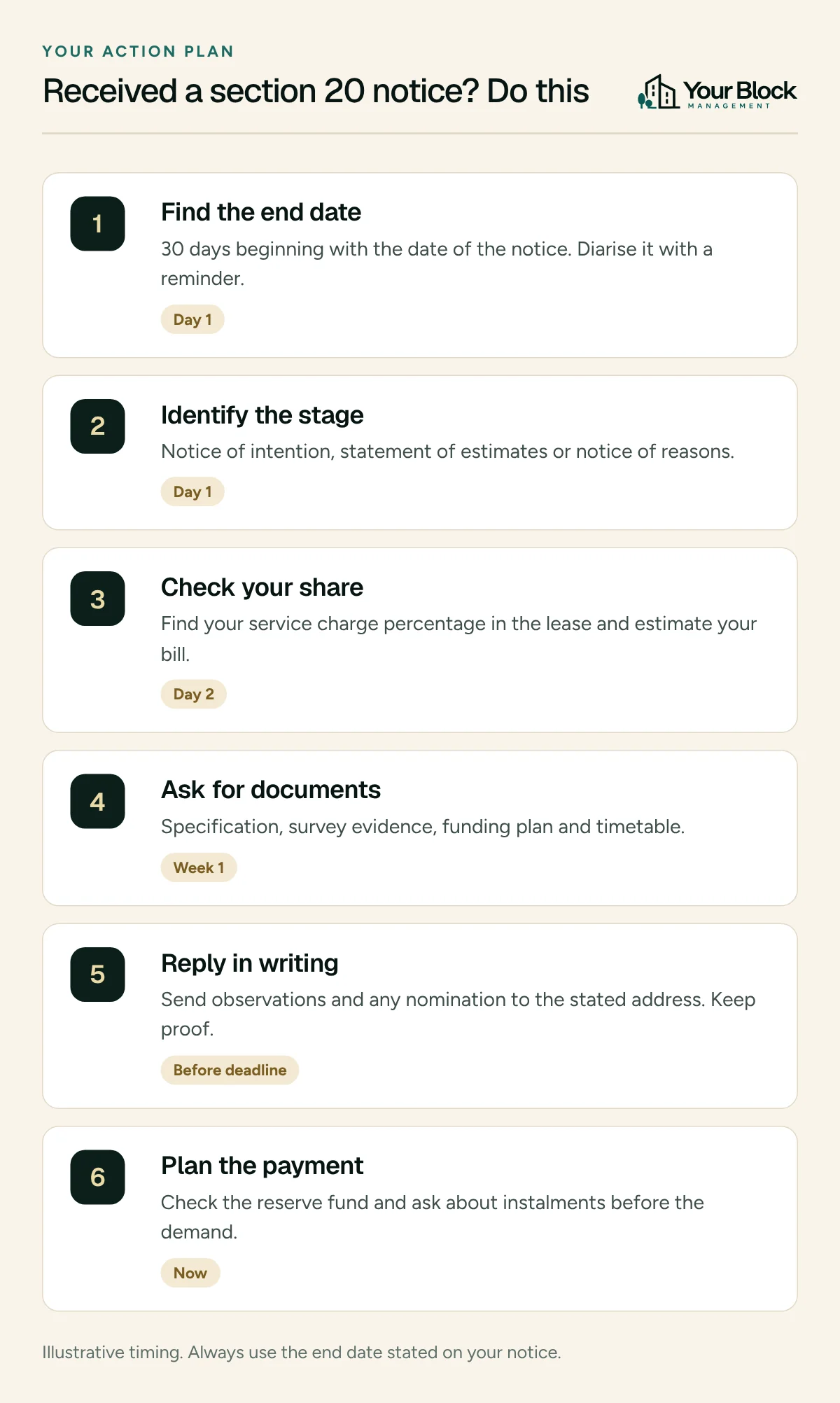
- Find the date of the notice and the end date. The notice must state when the consultation period ends. Write it in your calendar with a reminder a week before.
- Work out which stage you are at. The title usually tells you: “notice of intention”, “statement of estimates” or “notice of reasons”. What you can do depends on the stage.
- Find the address for observations. The notice must give one. That is where your written reply has to go, by the deadline.
- Check your lease for your share. Look for the service charge percentage or the method of apportionment for your flat. Without it you can’t estimate your bill.
- Talk to your neighbours. Ask whether others received it, whether there is a recognised tenants’ association, and whether anyone knows a contractor worth nominating. A joint response carries weight, but each leaseholder can respond individually too.
How to read a section 20 notice, line by line
Which stage is it?
For most private blocks there are up to three documents. Our guide to the three stages of section 20 notices covers the legal content of each in detail. In short:
| Stage | What it tells you | What you can do |
|---|---|---|
| 1. Notice of intention | What the works are and why they are needed. Usually no price yet. | Comment on the need and scope; nominate a contractor. |
| 2. Statement of estimates | At least two estimates, a summary of comments received and the landlord’s responses. | Inspect all the estimates; comment on cost and choice. |
| 3. Notice of reasons | Why the landlord chose a contractor who was neither your nominee nor the cheapest. | Note the reasons; keep them for any later challenge. |
If your building is under a long-term agreement, or the landlord is a public body that advertises contracts, the notice may follow a different route. It should say which.
The description of works and the reasons
A stage 1 notice must describe the works in general terms, or tell you where and when you can inspect a description, and give the landlord’s reasons for thinking they are necessary. Vague reasons (“general maintenance”) are a signal to ask questions. Where inspection is offered, the place and hours must be reasonable and inspection free. If copies can’t be taken there, the landlord must give you a free copy on request.
The deadline, worked out
The regulations define the period as 30 days beginning with the date of the notice. Illustrative example: a notice dated 3 November has a period that ends on 2 December, because 3 November counts as day one. The notice itself should state the end date, so use that. LEASE notes that a tribunal has treated a posted notice as dated two working days after posting, but don’t rely on extra days: aim to reply at least a few days early.
Your likely share
Stage 1 rarely gives a price, but you can still plan. Illustrative example: a 14-flat block, a roof estimated at £84,000 including VAT, equal shares. That’s £6,000 per flat. If your lease gives you 9% instead, your share would be £7,560. VAT is included when estimates are compared against the £250 threshold, so expect to pay it too. Our guide to which section 20 works need consultation explains the £250 test with more examples.
What to ask for before you respond
You will write a better response if you have the facts. Send a short, polite request straight away (by email and to the address for observations) for:
- The full specification or schedule of works, not just the summary in the notice.
- The evidence behind the reasons: a surveyor’s report, condition survey, fire risk assessment action or photos showing the defect.
- How your share will be calculated, with the lease clause relied on.
- How the works will be funded: whether any reserve fund will be used first, and how much is in it.
- The likely timetable, including when demands will be issued.
- Whether any of it is covered elsewhere, for example by a buildings insurance claim, a warranty or a previous contractor’s guarantee.
- Building safety protections: if your building is at least 11 metres or five storeys and the works relate to safety defects, ask whether the Building Safety Act 2022 leaseholder protections apply. For qualifying leaseholders, cladding remediation costs nothing and other relevant defects are capped.
You have a firm legal right to inspect the description of the works and, later, all the estimates. Some of the other items go beyond what the regulations require, but a well-run landlord or agent will share them. If a request is refused, keep the refusal: it may matter later.
How to respond to a section 20 notice in writing
Your reply is called “observations”. The landlord must have regard to observations received within the period. That is a duty to consider them, not to follow them, but at stage 2 the landlord must also summarise what was said and respond. Your letter becomes part of the record.
Good observations are short, specific and evidence-based. Comment on the need for the works, the scope, the timing, the specification, value for money and anything that looks missing. If you know a reliable, insured contractor, nominate them at stage 1 with full contact details, and check they are willing to quote. Our guide to your right to object, nominate and challenge explains when the landlord must seek a quote from your nominee.
Template: observations on a notice of intention
Adapt this to your building. Delete anything that doesn’t apply.
To: [name and address for observations given in the notice]
Re: Notice of intention dated [date], [building name], Flat [number]
I am the leaseholder of Flat [number]. These are my written observations under the Service Charges (Consultation Requirements) (England) Regulations 2003, made within the relevant period.
- Need for the works: please provide the survey or report that supports the reasons given.
- Scope: [for example, please confirm whether the rear elevation is included and why].
- Specification: please provide the full specification or schedule of works.
- Funding: please confirm how much of the reserve fund will be applied.
- Nomination: I nominate [contractor name, address, phone, email] to provide an estimate.
Please acknowledge receipt and confirm these observations will be summarised and answered in any statement of estimates.
[Name, date]
Send it by email and by a trackable post method if the lease requires notices on paper, and keep copies. If you respond at stage 2 as well, focus on the estimates: like-for-like comparisons, gaps between quotes, provisional sums and contingencies, and whether supervision fees are reasonable.
Budgeting and paying for major works
The notice is the earliest warning you will get, so treat it as the start of your budgeting. When you will actually be billed depends on your lease. Many leases allow on-account demands once a contract is agreed; others only after costs are incurred.
When the demand arrives, check that it comes with the prescribed summary of tenants’ rights and obligations (section 21B of the 1985 Act; without it you can withhold payment until it is served) and the landlord’s name and address (section 47 of the Landlord and Tenant Act 1987). Costs incurred more than 18 months before a demand generally can’t be recovered unless you were told in writing within that time that you would have to contribute (section 20B).
If the bill will be hard to pay:
- Ask for an instalment plan early. It isn’t a legal right, but landlords and agents are far more flexible before arrears exist.
- Check the reserve fund. A healthy one may cover part of the cost.
- Talk to your lender if you need to borrow, and leave time for valuation.
- If you dispute the charge, pay under protest and say so in writing. Under section 27A, paying is not, by itself, an admission that the charge is payable.
Non-payment of service charges can lead to arrears action, so withholding is risky without advice. Our guide to where your service charge goes and how to check it covers reading the bill.
When to get help, and what happens if consultation goes wrong
The Leasehold Advisory Service (LEASE) gives free initial advice in England. If the landlord skips a stage or gets it badly wrong, recovery can be capped at £250 per leaseholder unless the First-tier Tribunal grants dispensation. The tribunal focuses on whether leaseholders were actually prejudiced, so missing paperwork does not automatically mean you pay less. We explain how that works in our guide to what happens when section 20 consultation is skipped.
Major works go more smoothly when residents can see what is happening. At Your Block, every resident gets a portal login where major works notices, estimates, progress updates and questions sit in one place, with the agent’s answers on the record. If you are unhappy with how your building’s works are being handled, our FAQs on switching managing agent explain what is involved.
Frequently asked questions
Do I have to reply to a section 20 notice?
No. Replying is optional and the works can go ahead whether or not you respond. But your written observations must be considered, and at the estimates stage the landlord must summarise and answer them. A clear written response also creates a record that can help if you later challenge the cost at the First-tier Tribunal.
Can I stop the works by objecting?
Not usually. Consultation gives you a voice, not a veto. The landlord must consider your observations but can still proceed. If works are unnecessary or overpriced, your remedy is to challenge the service charge as unreasonable under sections 19 and 27A of the Landlord and Tenant Act 1985.
When will I actually have to pay?
That depends on your lease. Some leases allow the landlord to demand an on-account payment once the contract is agreed, others only after the costs are incurred. Any demand must come with the prescribed summary of rights and obligations and the landlord’s name and address.
I’m a tenant renting a flat. Does the notice affect me?
Section 20 notices go to leaseholders, the people who pay the service charge under a long lease. If you rent from a leaseholder, the notice is for your landlord. Pass it on promptly if it is delivered to your flat, as the deadline runs from the date of the notice.
What if I received the notice late or not at all?
Tell the landlord or agent in writing straight away and ask for the deadline to be extended for you. Check the lease’s clause on how notices are served. If notices were not properly given, that may be relevant later, but the tribunal will look at whether you were actually prejudiced.
Sources and further reading
This article is general information about the law in England, not legal advice. Leasehold law is changing, so check your lease and get professional advice for your own situation. Spotted something out of date? Tell us and we’ll fix it.