
S20 Notice Explained: Your Right to Object, Nominate and Challenge
Consultation gives you a voice, not a veto. Here’s how to use every right it gives you, and what to do when talking isn’t enough.
 By Sam Charlesworth7 min read

The short version
- Your written observations must be considered, and at the estimates stage summarised and answered.
- You can nominate a contractor at stage 1, and the landlord must try to get a quote from them.
- You can inspect the works description and every estimate obtained, free of charge.
- The First-tier Tribunal can decide whether costs are payable and reasonable, before or after the works.
- Ask for a section 20C order so the landlord’s tribunal costs don’t land on your service charge.
An S20 notice gives you, as a leaseholder, specific rights: to object in writing, to nominate a contractor, to inspect the works description and every estimate, and to be told why a contractor was chosen. If the cost still looks wrong, you can ask the First-tier Tribunal to decide whether it is payable and reasonable. The right to object is a right to be heard, not a veto.
This guide sets out each right, how to use it well, and what to do when talking isn’t enough. It covers the standard process for private blocks in England. If the notice is new to you, start with what a section 20 notice is, or what to do in the first 48 hours.
Your rights under an S20 notice at a glance
Under section 20 of the Landlord and Tenant Act 1985 and Schedule 4, Part 2 of the Service Charges (Consultation Requirements) (England) Regulations 2003, and the wider service charge rules, you have the rights summarised below. Each is explained in the sections that follow.
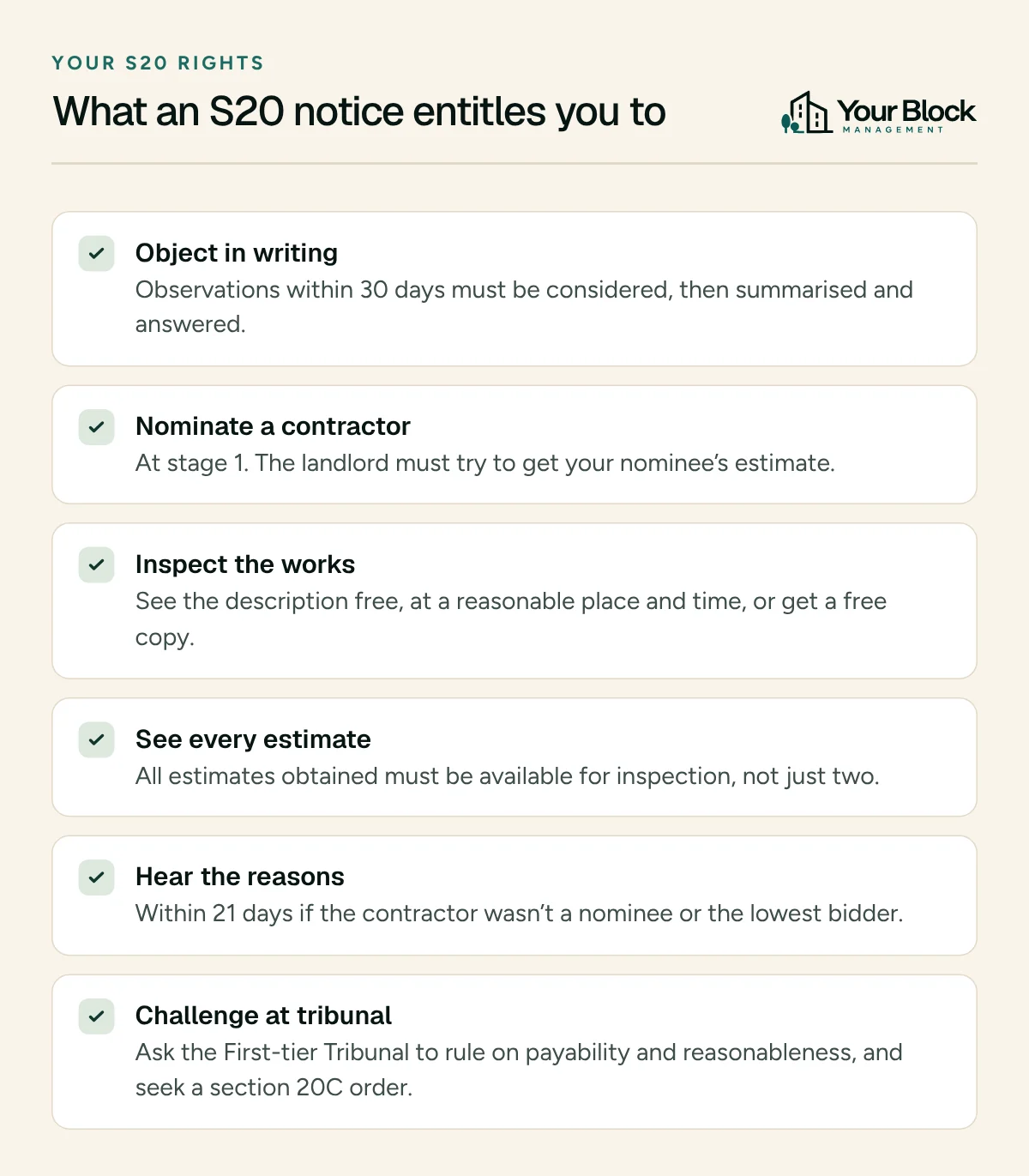
The right to object: making observations that count
Your “objection” is formally called an observation. The law gives it real, if limited, force:
- At stage 1 (notice of intention) and stage 2 (statement of estimates), the landlord must have regard to observations received within the 30-day period.
- The stage 2 statement must summarise the stage 1 observations and respond to them.
- If the contract goes to someone who wasn’t a nominee or the lowest estimator, the reasons notice must summarise and respond to stage 2 observations.
So your comments go on the record and must be answered. What they can’t do is stop the works. The landlord can consider your view and still proceed. That record matters, though: if the cost is later challenged, or the landlord asks the tribunal for dispensation, your observations show what you raised and when.
Weak versus strong observations
| Weak | Strong |
|---|---|
| “I object to these works. They are too expensive.” | “Estimate A prices scaffolding at £14,000; Estimate B at £8,500 for the same elevations. Please explain the difference before choosing.” |
| “The roof doesn’t need replacing.” | “The 2024 survey recommended repair of the north slope only. Please provide the evidence that full replacement is now needed.” |
| “I can’t afford this.” | “Please confirm how much of the reserve fund will be applied, and whether payment by instalments will be offered.” |
| “Why wasn’t I told sooner?” | “Please confirm whether these works form part of the planned maintenance programme and why they were not budgeted for.” |
These examples are illustrative. The pattern is: be specific, ask for evidence, propose an alternative, and keep a copy.
The right to nominate a contractor
The stage 1 notice must invite each leaseholder, and any recognised tenants’ association (RTA), to propose a person from whom the landlord should try to obtain an estimate. Nominations must be made within the 30-day period.
When the landlord must seek a quote from your nominee
- The RTA nominates: the landlord must try to get an estimate from that person.
- Only one leaseholder nominates: the landlord must try to get an estimate from that person.
- Several leaseholders nominate different people: the landlord approaches the person with the most nominations. If there’s a tie, one of the tied names. Otherwise, any nominee.
- Several nominations from both leaseholders and an RTA: at least one estimate from each side, from different people.
If an estimate is obtained from a nominee, it must be included in the statement of estimates. The duty is to try, so if your nominee doesn’t respond or won’t quote, the landlord hasn’t broken the rules.
How to make your nomination count
- Coordinate with neighbours. Where there are several nominations, the most-nominated contractor gets approached. Agreeing on one name makes it far more likely to be used.
- Pick a contractor who can do the job: right trade, right scale, insured, and willing to price a full specification.
- Give full contact details and tell the contractor to expect contact.
- Avoid conflicts. Nominating a relative or your own business invites questions.
There is no right to nominate in every case. Where a public body must advertise the contract by public notice, or the works are being done under an existing long-term agreement, nominations aren’t part of the process. You can still comment. Our guide to the three stages of section 20 notices explains the different routes.
The right to see the documents
During consultation you are entitled to:
- Inspect the description of the works at a reasonable place and time, free of charge. If copies can’t be taken there, the landlord must give you a free copy on request.
- Inspect all the estimates obtained, not just the two summarised in the statement.
- Be told the landlord’s reasons for its choice of contractor, where a reasons notice is required, within 21 days of the contract.
After costs are incurred, sections 21 and 22 of the 1985 Act (as currently in force) let you request a written summary of costs and then inspect the accounts, receipts and other supporting documents. New information rights in the Leasehold and Freehold Reform Act 2024 are not yet in force.
You can also simply ask for other useful material: the specification, the survey that justified the works, the tender report, and the contract administrator’s fee basis. There may be no specific statutory right to every item, but refusals are worth recording.
Challenging an S20 notice’s costs at the First-tier Tribunal
Section 27A of the 1985 Act lets you ask the First-tier Tribunal (Property Chamber) to decide whether a service charge is payable, by whom, to whom, how much, and when. Crucially, you can apply about costs not yet incurred, so you don’t have to wait for the works to finish.
Grounds you can raise
- Not reasonably incurred (section 19): the works weren’t needed, the scope was excessive, or the price was out of line with the market.
- Not a reasonable standard (section 19): the work was defective or incomplete.
- Not allowed by the lease: for example an improvement the lease doesn’t let the landlord charge for.
- Consultation not complied with: your contribution is capped at £250 unless the tribunal grants dispensation.
- Too late: costs incurred more than 18 months before the demand, without the required written warning (section 20B).
Practical points
- Don’t agree or admit the charge if you intend to dispute it. The tribunal can’t decide a matter you have agreed or admitted, although payment on its own is not an admission. Paying under protest, in writing, is often the safer course.
- Gather evidence: your observations, the landlord’s responses, alternative quotes and expert opinion if the sums justify it.
- Act together. Several leaseholders can apply jointly, sharing effort and cost.
- Get advice first. LEASE offers free initial advice in England.
If the problem is that consultation was skipped altogether, the landlord will usually apply for dispensation. How the tribunal weighs that, and how to show prejudice, is covered in our guide to the consequences of skipping section 20 consultation.
Protecting yourself from the landlord’s legal costs
Many leases let the landlord recover its legal costs through the service charge, or from an individual leaseholder as an administration charge. Two protections exist:
- Section 20C of the 1985 Act: the tribunal can order that the landlord’s costs of the proceedings are not to be added to the service charge.
- Paragraph 5A of Schedule 11 to the Commonhold and Leasehold Reform Act 2002: the tribunal can reduce or extinguish your liability to pay litigation costs as an administration charge.
Ask for both in your application. Without them, you could win the argument and still help pay for the landlord’s side of it.
When your rights aren’t enough
If every major works project turns into a fight, the problem may be how the building is run rather than any one notice. Leaseholders who qualify can take over management through the right to manage, and RTM or RMC boards can change their managing agent. Our guide to which section 20 works need consultation is a useful check on whether your current agent is getting the basics right.
At Your Block we publish consultation notices, estimates and our responses to residents’ observations in the resident portal, so nobody has to fight for the paperwork. If you are thinking about a change, our FAQs on switching managing agent explain the process, and you can request a proposal for your building.
Frequently asked questions
Can leaseholders block major works by objecting to an S20 notice?
No. Section 20 consultation gives leaseholders the right to be heard, not a veto. The landlord must consider observations and, at the estimates stage, summarise and respond to them, but can still go ahead. If the works are unnecessary or overpriced, the remedy is a challenge to the service charge at the First-tier Tribunal.
What if the landlord ignores my nominated contractor?
If you nominated in time and the rules required the landlord to approach your nominee, it must try to obtain an estimate and include it in the statement of estimates. If it didn’t, raise this in writing straight away. It is a breach of the consultation requirements and relevant evidence of prejudice in any dispensation application.
Can I go to the tribunal before the works start?
Yes. Section 27A of the Landlord and Tenant Act 1985 allows the First-tier Tribunal to decide whether costs would be payable if incurred. That can be useful where the scope or price looks clearly wrong, though tribunals deal with many cases after the event too. Take advice first, as each case turns on its facts.
Is there a deadline for challenging section 20 costs?
There is no single short deadline in section 27A, but delay weakens a case and the tribunal can’t decide a charge you have agreed or admitted. Raise concerns during consultation, pay under protest if you pay, and act promptly once the final costs are known.
Sources and further reading
This article is general information about the law in England, not legal advice. Leasehold law is changing, so check your lease and get professional advice for your own situation. Spotted something out of date? Tell us and we’ll fix it.