Block Management UK: The 2026 Guide to How Your Building Should Be Run
The law, the people and the yearly rhythm of a properly run block of flats in England, plus what is really changing for leaseholders and managing agents.

The short version
- In England, block management is governed by your lease, the Landlord and Tenant Acts 1985 and 1987, and the RICS Code.
- The RICS Code 4th edition has applied since 7 April 2026 and tribunals take it into account.
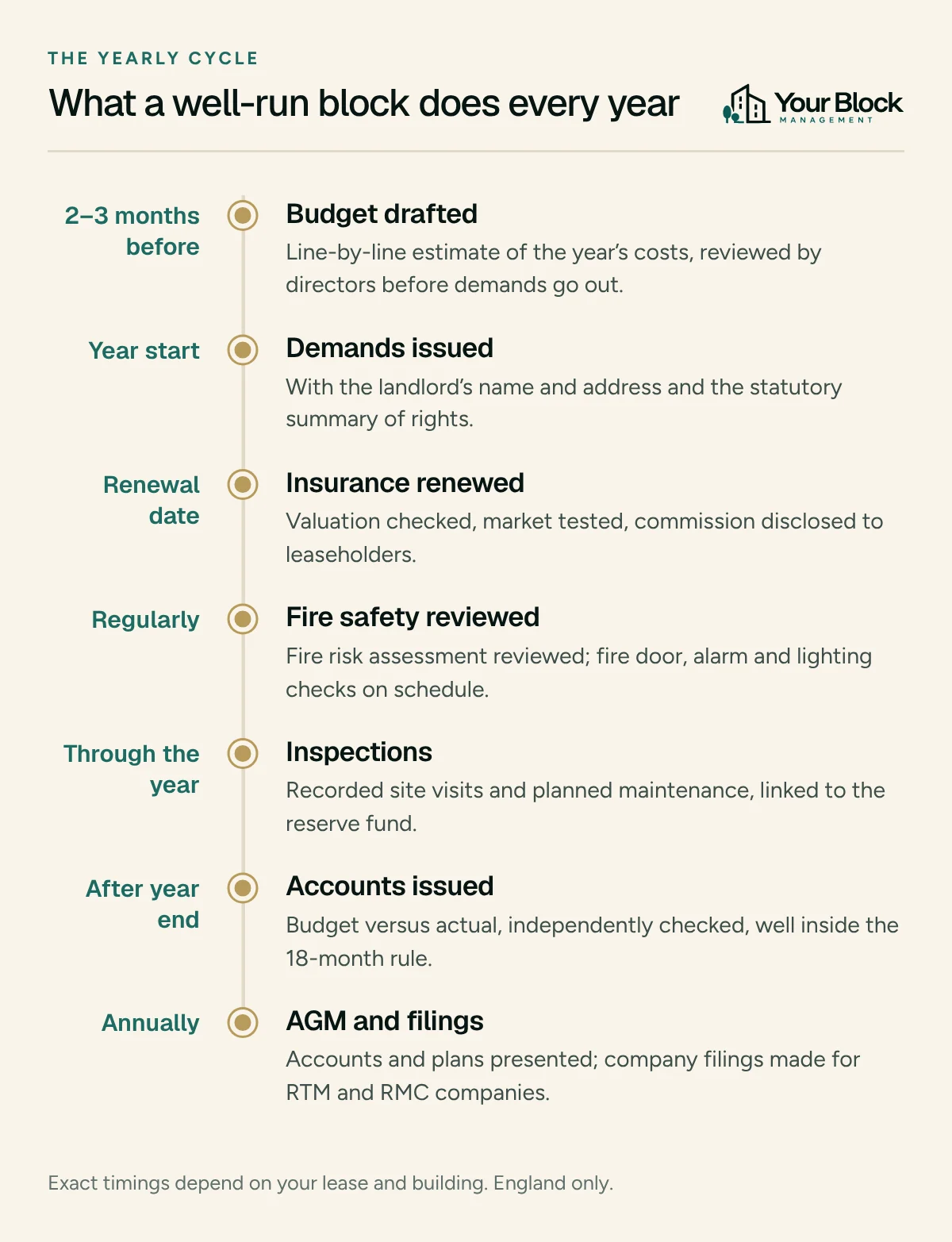
- A well-run block follows a yearly cycle: budget, demands, insurance, fire safety, inspections, accounts and AGM.
- Managing agent licensing was announced in September 2026 but has no legislation or start date yet.
- Most of the Leasehold and Freehold Reform Act 2024 is still not in force.
Block management UK rules differ between England, Wales, Scotland and Northern Ireland, but in England it means running the shared parts of a block of flats: setting and collecting the service charge, insuring the building, keeping communal areas safe and repaired, and meeting fire and building safety duties. Your lease sets the rules, statute protects you, and someone named has to be accountable.
This guide covers the law that governs your building, who does what, the yearly cycle every well-run block follows, and the reforms that are coming. It covers England only, as at October 2026. New to all this? Start with what block management is, in plain English.
What block management covers (and what it doesn’t)
A block of flats has two kinds of space. Your flat, usually called your demise, is yours to look after. Everything shared, the common parts, is managed collectively: the roof, structure and external walls, stairs and hallways, lifts, communal doors and entry systems, bin stores, car parks and gardens, plus the buildings insurance and the safety systems.
Block management is the work of looking after that shared side. In practice it falls into five areas:
- Money: preparing budgets, issuing service charge demands, paying contractors, holding reserve funds and producing year-end accounts.
- Maintenance: routine inspections, reactive repairs, cleaning and gardening contracts, planned maintenance and major works.
- Compliance: fire risk assessments, fire door checks, lift inspections, electrical and water safety, and building safety duties for taller blocks.
- Insurance: arranging buildings and liability cover, handling claims and telling leaseholders what they are paying for.
- Administration and people: lease enforcement, resident communication, sale packs, company records for RTM and RMC companies, and complaints.
What it does not cover: anything inside your flat that your lease makes your responsibility, such as your boiler, kitchen or internal decorations. Where the line falls between your flat and the building is set by your lease, not by custom. Our guide to who pays for what in a block of flats walks through windows, roofs, pipes and balconies.
The legal framework for block management in England
There is no single “block management act”. Instead, several layers sit on top of each other, and a good manager works within all of them.
1. Your lease
The lease is the starting point. It says what the landlord must repair and insure, what you must pay towards, how the service charge is split between flats, when the accounting year runs, whether a reserve fund can be collected and what you may or may not do in your flat. Statute generally adds protections on top of the lease rather than replacing it.
2. Service charge law
Sections 18 to 30 of the Landlord and Tenant Act 1985 protect leaseholders who pay variable service charges. The headline rules are:
- Section 19: costs are recoverable only if reasonably incurred, and works must be of a reasonable standard.
- Section 20: before major works where any one leaseholder would pay more than £250, or a contract lasting over 12 months costing any leaseholder more than £100 a year, the landlord must consult. Our guide to what to do when a section 20 notice arrives explains the stages.
- Section 20B: costs incurred more than 18 months before they are demanded generally cannot be recovered, unless you were told in writing within that time.
- Section 21B: every demand must come with the prescribed summary of your rights and obligations, or you can withhold payment until it does.
- Sections 21 and 22: you can ask for a written summary of costs and then inspect the accounts and receipts behind it.
- Section 27A: the First-tier Tribunal (Property Chamber) can decide whether a charge is payable and how much.
The Landlord and Tenant Act 1987 adds that service charge money is held on trust (section 42), and that demands must give the landlord’s name and address (section 47) and an address in England and Wales for notices (section 48).
3. The RICS Code, 4th edition
The RICS Service Charge Residential Management Code, 4th edition, was approved by the Secretary of State under SI 2026/298 and has applied since 7 April 2026, replacing the 3rd edition. It covers landlords, managing agents, RMCs, RTM companies and self-managed blocks. Breaching it is not an offence in itself, but courts and tribunals take it into account. The new edition puts more weight on terms of engagement, client money, building safety, reserve funds and planned maintenance.
4. Redress for managing agents
Since 2014, any business doing property management work in England, including block management, must belong to a government-approved redress scheme: The Property Ombudsman or the Property Redress Scheme. Councils can fine non-members up to £5,000. There is currently no licence or compulsory qualification for managing agents, although that is set to change (see below).
5. Fire and building safety
The Regulatory Reform (Fire Safety) Order 2005 requires a written fire risk assessment of the common parts, kept under regular review. Since the Fire Safety Act 2021 it expressly covers the structure, external walls and flat entrance doors. The Fire Safety (England) Regulations 2022 require fire safety information for residents in every block with two or more flats, plus quarterly communal fire door checks in blocks over 11 metres.
The Building Safety Act 2022 adds a heavier regime for higher-risk buildings (at least 18 metres or 7 storeys with 2+ homes), which must be registered with the Building Safety Regulator. It also gives qualifying leaseholders in buildings of 11 metres or 5 storeys and above protection from most historic safety defect costs.
Who’s who in a block of flats
Most confusion in block management comes from not knowing who holds which role. These are the parties you will meet:
| Party | What they are | What they are responsible for |
|---|---|---|
| Freeholder (landlord) | Owns the building and grants the leases. Can be an individual, an investment company or the leaseholders themselves. | Usually repairs, insurance and services, as set out in the lease, unless management has passed to an RTM company. |
| RTM company | A company formed by leaseholders under the Commonhold and Leasehold Reform Act 2002 to take over management without buying the freehold. | The landlord’s management functions from the acquisition date. The freeholder keeps ownership. |
| Residents’ management company (RMC) | A company, usually owned by the leaseholders, either named in the lease or owning the freehold. | Whatever the lease gives it, typically maintenance, insurance and the service charge. |
| Managing agent | A firm appointed by the freeholder, RTM or RMC to do the day-to-day work. | Acts on behalf of its client under a management agreement. It is not the landlord. |
| Leaseholders | The owners of each flat on a long lease. | Paying service charges, keeping their flat in repair and keeping to the lease. |
| Tenants and occupiers | People renting from a leaseholder. | Their landlord is the flat owner, not the freeholder. They must still follow the building’s rules. |
The Right to Manage route has become easier: since 3 March 2025 a building can qualify with up to 50% non-residential floor space (previously 25%), and leaseholders generally no longer pay the landlord’s costs of the claim. Our guide to how leaseholders are using Right to Manage covers the process.
The annual cycle of a well-run block
Good block management is rhythmic. The same events come round every year, and the best sign of a well-run block is that none of them arrive as a surprise. Exact dates depend on your lease and your building, but the cycle looks like this:
Budget
Two to three months before the service charge year starts, the manager should draft a budget line by line: insurance, cleaning, gardening, communal electricity, lift and fire equipment contracts, repairs, professional fees and the reserve fund contribution. RTM and RMC directors should see and question the draft before it is issued. Section 19 says advance payments must be no more than is reasonable, so “last year plus 10%” is not a method.
Demands
Demands go out on the dates your lease sets, often yearly or half-yearly. Each must include the landlord’s name and address and the statutory summary of rights. A demand missing either can be withheld until it is corrected.
Insurance renewal
At renewal, the manager should check the rebuild valuation is current, test the market, and tell leaseholders what any broker or agent earns from the policy. Since the FCA’s rules took effect on 31 December 2023, leaseholders are treated as customers and can ask the insurer directly for pricing and commission information. Our guide to block management insurance covers cover levels and who should arrange it.
Fire risk assessment and safety checks
The law says the fire risk assessment must be reviewed regularly and whenever something significant changes. It does not set a fixed frequency, but annual review is common practice. Around it sit the routine checks: quarterly communal fire door inspections in blocks over 11 metres, “best endeavours” annual checks of flat entrance doors in those blocks, and the testing of alarms, emergency lighting and lifts.
Inspections and planned maintenance
Regular site visits, with a written record and photos, catch the slipped tile before it becomes a ceiling leak. A planned maintenance schedule, ideally linked to a reserve fund, lets the block save for the roof, redecoration and lift replacement rather than hitting everyone with a sudden bill.
Year-end accounts
After the year closes, the manager prepares accounts comparing budget with actual spending, usually checked or certified by an independent accountant. Surpluses and deficits are dealt with as the lease says. Late accounts are a warning sign, not least because of the 18-month rule in section 20B.
AGM and company filings
Where the leaseholders own an RTM company or RMC, it has company law duties too: a confirmation statement to Companies House at least once every 12 months and annual accounts, which a private company must file within nine months of its year end. Private companies are not required by statute to hold an AGM, but many articles require one and most blocks benefit from it. It is the natural point to present the accounts, the coming budget and the planned works.
What good block management feels like day to day
Between those fixed points, block management is mostly about responsiveness and records. A good manager acknowledges reports quickly, triages anything urgent, gets quotes from more than one contractor, keeps residents told what is happening and can produce the paperwork when asked. Emergencies such as a flood, a failed entry door or a fire alarm fault should reach a person, not just an inbox.
At Your Block we think residents should be able to see this work, not just be told about it. That is why every resident, owners and tenants alike, gets a login to our resident portal to report repairs with photos, track progress and compare the budget with what has actually been spent. If you want a fuller test of your current manager, use our good block management service checklist.
Who pays for block management?
Everything above is paid for through the service charge. That includes the managing agent’s fee, which is only one line in the budget. Hamptons’ 2025 Service Charge Index put the average service charge for flats in England and Wales at £2,405 a year, up 4.6% on the year before. Your share of each cost is set by your lease, often as a percentage or fraction of the total.
The difference between what the agent charges for its time and what the building costs to run matters more than most people realise. Our guide to what you are actually paying for in block management breaks down the management fee against the service charge and shows how to judge whether you are getting value.
Block management UK reforms: what’s changing in 2026 and beyond
A great deal has been announced, and much less has actually changed. Here is the honest position as at mid-October 2026.
Already in force
- The RICS Code 4th edition from 7 April 2026.
- From the Leasehold and Freehold Reform Act 2024, only a handful of provisions: the 50% non-residential limit and costs changes for Right to Manage (3 March 2025), and the removal of the two-year ownership wait before a lease extension or freehold purchase claim (31 January 2025).
Passed but not switched on
Most of the 2024 Act is not yet in force. That includes the new service charge transparency regime, limits on insurance remuneration, marriage value abolition and redress for freeholders. In July 2026 the Government confirmed its plans: a standard service charge demand form with an annual budget, a prescribed annual report, standardised accounts and a published schedule of administration charges with 28 days’ notice of new ones. It expects to lay the regulations later in 2026, give landlords 12 months’ notice for most measures, and says leaseholders “should start to see changes during 2027”.
Proposed
- Managing agent regulation: on 29 September 2026 the Government announced that managing agents will need a licence and qualifications, overseen by an independent regulator able to revoke licences. There is no legislation and no date yet.
- Caps on leasehold fees: powers to cap permission, administration and document fees were announced at the same time, with details to go to consultation.
- The Commonhold and Leasehold Reform Bill: published in draft in January 2026 and expected to be introduced before Christmas 2026. Among other things it proposes a £250 cap on ground rent in existing leases and making commonhold the default for new flats.
- Cladding: a Remediation of Unsafe Cladding Bill was reported as introduced on 14 October 2026, proposing a legal duty to remediate.
None of the proposed changes affects what your lease or the current law requires today. A good manager will prepare for them, but should not tell you they already apply.
When block management goes wrong: where to turn
If something is not right, escalate in this order:
- Put it in writing to the manager, with dates, photos and the lease clause if you know it. Ask for the complaints procedure.
- Tell the directors if your block has an RTM company or RMC. They are the agent’s client and can instruct it.
- Use the redress scheme. Once the agent’s own procedure is exhausted, The Property Ombudsman or Property Redress Scheme can investigate. Social landlords’ leaseholders go to the Housing Ombudsman instead.
- Take charges to the tribunal. The First-tier Tribunal decides disputes over service charges, section 20 dispensation and Right to Manage.
- Get free advice from LEASE, the government-funded Leasehold Advisory Service.
And if the problem is the agent itself, boards can usually change it under the notice terms of the management agreement, while leaseholders under an absent freeholder can consider Right to Manage. Our block management services page sets out how Your Block approaches each part of the cycle above.
Frequently asked questions
Is block management regulated in the UK?
Partly. In England, managing agents must belong to a government-approved redress scheme and must follow service charge law, and tribunals take the RICS Code into account. There is no licence or compulsory qualification yet. The Government announced licensing and an independent regulator in September 2026, but no legislation or start date has been set.
Who is responsible for block management, the freeholder or the managing agent?
Legal responsibility sits with whoever the lease or statute makes responsible: usually the freeholder, or an RTM company or residents’ management company. A managing agent does the work on their behalf under a management agreement. The agent answers to its client, which is why residents in RTM and RMC blocks can push for change through their directors.
Does the law in Wales and Scotland differ?
Yes. This guide covers England. Wales shares much of the same leasehold legislation but has some different rules and its own approach to building safety. Scotland has no leasehold flats in the same sense and uses a separate system of property factors with its own code and tribunal.
How often should a block of flats have a fire risk assessment?
The Fire Safety Order requires the assessment to be reviewed regularly and whenever there is reason to think it is no longer valid, for example after works or a change in use. It does not set a fixed interval. Annual review is common practice, and higher-risk or more complex buildings may need closer attention.
Do RTM and RMC companies have to hold an AGM?
Private companies are not required by statute to hold an AGM, but many company articles require one, so check yours. Either way, the company must file a confirmation statement at least every 12 months and annual accounts within nine months of its year end. An annual meeting is also the easiest way to agree budgets and works.
Sources and further reading
- Landlord and Tenant Act 1985, section 19
- The Approval of Code of Management Practice (Residential Management) (Service Charges) (England) Order 2026 (SI 2026/298)
- Redress Schemes for Lettings Agency Work and Property Management Work Order 2014
- Government response: Strengthening leaseholder protections over charges and services
- Hamptons 2025 Service Charge Index
This article is general information about the law in England, not legal advice. Leasehold law is changing, so check your lease and get professional advice for your own situation. Spotted something out of date? Tell us and we’ll fix it.