
Service Charge: Where Every Pound of Yours Goes (And How to Check)
A line-by-line look at what your service charge pays for, how your share is worked out, and the legal rights that let you check every figure.

The short version
- A service charge pays for insurance, repairs, cleaning, management and reserves. It isn’t ground rent and it’s held on trust.
- Insurance and the reserve fund are often the two biggest lines in a small block’s budget.
- You can demand a cost summary (s21) and then inspect invoices and receipts (s22) for free.
- Costs billed more than 18 months after they were incurred are usually irrecoverable (s20B).
- Standard demand forms and annual reports were announced in July 2026 but are not yet law.
A service charge is the money you pay as a leaseholder towards running, insuring, repairing and managing your building and its shared parts. Your lease decides what can go on the bill and what share you pay; the law adds rules on reasonableness, consultation and paperwork. Below is where each pound typically goes, and exactly how to check yours.
This guide covers England. Wales is similar in places but not identical, and Scotland has a different system altogether.
What is a service charge (and what isn’t it)?
In leasehold law, a service charge is an amount you pay, on top of any rent, for services, repairs, maintenance, improvements, insurance or the landlord’s costs of management, where the amount varies with the costs actually incurred. That is close to the wording of section 18 of the Landlord and Tenant Act 1985, and it matters, because the protections in sections 18 to 30 of that Act apply to these variable charges.
Three things it is not:
- Ground rent. Ground rent is a payment to the freeholder simply for the lease itself. You get no service for it and it isn’t held on trust. Our guide to ground rent and how the law has changed covers it properly.
- A restaurant or hotel service charge. That’s a discretionary extra on a bill. Nothing to do with your flat, although it’s what a lot of search results assume you mean.
- Anyone’s income. Service charge money is held on a statutory trust under section 42 of the Landlord and Tenant Act 1987. It is there for the purposes set out in the lease, not to boost a freeholder’s or agent’s profit.
Who sends the bill varies. It might be a freeholder, a residents’ management company (RMC), a right to manage (RTM) company, or a managing agent acting for one of them. If you’re not sure how those pieces fit together, start with our guide to how block management works.
Where your money goes: a typical service charge budget for a small block
Every building is different, but most budgets for a small, low-rise block use the same handful of headings. Here is an illustrative annual budget for a fictional 12-flat, three-storey block in Essex with no lift, a small garden and a communal fire alarm. The figures are invented to show typical proportions. They are not quotes.
| Budget line | Annual cost | Share |
|---|---|---|
| Buildings insurance | £8,400 | 28% |
| Reserve fund contribution | £6,000 | 20% |
| Management fee (incl. VAT) | £4,320 | 14.4% |
| Repairs and maintenance | £3,240 | 10.8% |
| Cleaning of common parts | £2,880 | 9.6% |
| Gardening and grounds | £1,560 | 5.2% |
| Fire safety (risk assessment review, alarm and emergency lighting servicing) | £1,440 | 4.8% |
| Communal electricity | £1,200 | 4% |
| Accountancy | £720 | 2.4% |
| Bank charges and sundries | £240 | 0.8% |
| Total | £30,000 | 100% |
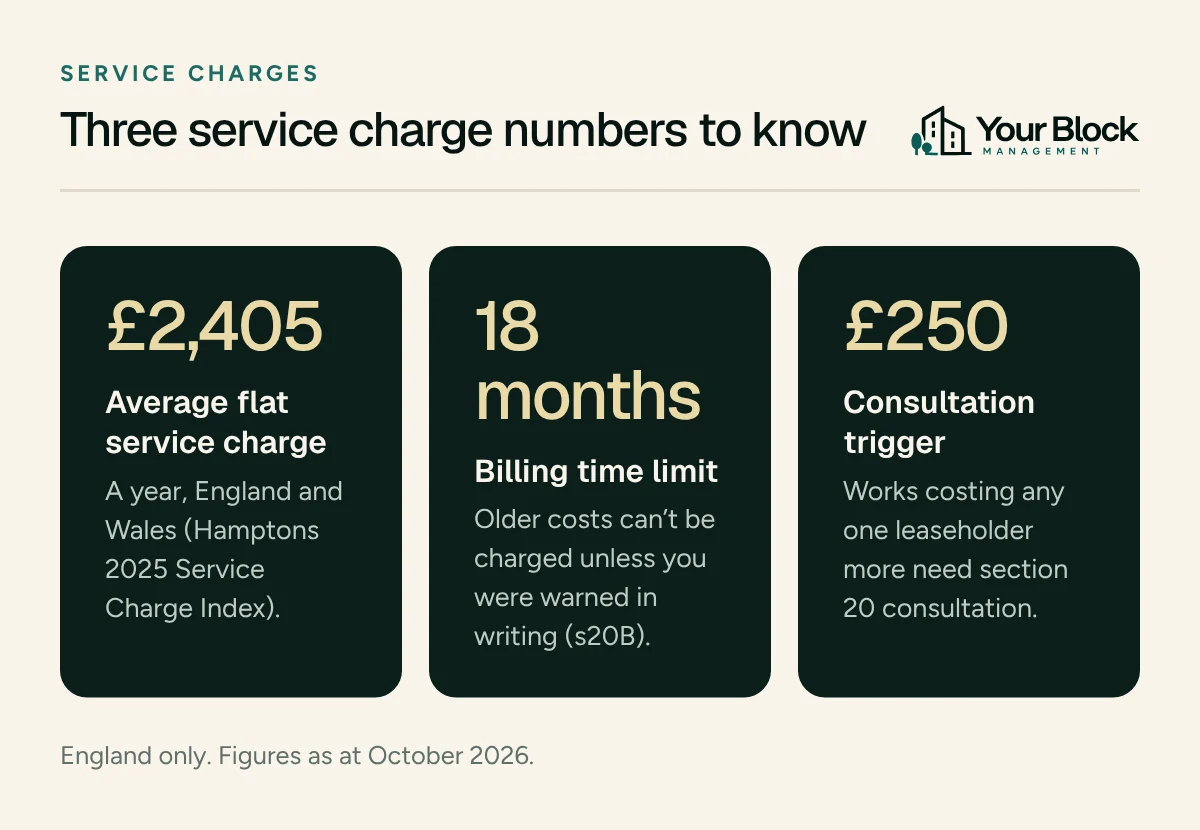
On that budget, a flat paying an equal one-twelfth share would contribute £2,500 a year, about £208 a month. That sits close to the national average: Hamptons’ 2025 Service Charge Index put the average for flats in England and Wales at £2,405 a year, up 4.6% on the previous year. That is one agency’s analysis rather than official data, and no Suffolk or Essex average is published.
Two patterns are worth knowing. Insurance is usually the single biggest line, so it’s the first thing to look at when a bill jumps. And the reserve fund is often the line people resent most, right up until the roof needs replacing.
Reserve funds: paying now for the roof later
A reserve fund (often called a sinking fund) is money set aside for big, predictable costs: roof replacement, external redecoration, a new door entry system, lift renewal. It can only be collected if your lease allows it, so check the service charge clauses first.
The maths is simple. If our 12-flat block needs a £60,000 roof in ten years and has no reserve, each flat faces a £5,000 bill in one go. Saving £6,000 a year spreads that to £500 a year per flat. The work would still need section 20 consultation when the time comes, because each leaseholder’s contribution would be well over £250.
Reserve money is trust money too. The 4th edition of the RICS Service Charge Residential Management Code, approved by the Government and in force since 7 April 2026, gives more guidance on reserve funds and planned maintenance than the old code did. For how much a block should be putting aside, see why your block needs a sinking fund.
How your share is worked out (apportionment)
Apportionment is the method for dividing the total between the flats. Your lease sets it, and it usually takes one of these forms:
- Fixed percentages. For example 6.5% for each one-bed, 8.5% for each two-bed and 11.5% for each three-bed. On our £30,000 budget that’s £1,950, £2,550 and £3,450 a year.
- Equal shares. Simple and common in small blocks where the flats are similar.
- A “fair proportion”. Leaves the landlord or agent to decide reasonably, which is a frequent source of argument.
- Schedules. Larger developments split costs into schedules (the building, the estate, the car park, the lift). You pay only into the schedules that apply to your flat.
Check that the percentages across the block add up to 100%. If they don’t, either someone is overpaying or the landlord is absorbing a shortfall, and it’s worth raising early.
Service charge demands, the summary of rights and the year-end accounts
Most leases work on a budget-then-reconcile cycle. You pay on account in advance, often half-yearly or quarterly, based on the budget. After the year end, the actual spending is reconciled.
What a valid demand must include
- The summary of rights and obligations. Under section 21B of the 1985 Act, a demand must be accompanied by the prescribed summary. If it isn’t, you can withhold that payment until it is served.
- The landlord’s name and address, under section 47 of the Landlord and Tenant Act 1987. You must also have been given an address in England or Wales where notices can be served on the landlord (section 48).
- A figure you can trace back to the budget and to your lease percentage.
The year-end reconciliation
The year-end accounts compare budget with actual spend. If spending came in under budget, you’ll usually receive a credit, or the surplus goes to reserve if the lease says so. If it overran, you’ll get a balancing charge. A well-run block sends the accounts without being asked; if yours haven’t arrived months after the year end, ask for them in writing.
At Your Block we show residents the budget against actual spending throughout the year on the resident portal, so the year-end figures shouldn’t come as a surprise.
How to check your service charge: sections 21 and 22
You don’t have to take the figures on trust. These rights are in force as at October 2026:
- Ask for a summary of costs (section 21). Write to the landlord or agent asking for a written summary of the costs for the last accounting period. They must provide it within one month of your request, or within six months of the end of that period, whichever is later. Where the charges are paid by tenants of more than four dwellings, the summary must be certified by a qualified accountant.
- Inspect the paperwork (section 22). Within six months of receiving the summary, you can require reasonable facilities to inspect the accounts, receipts and other supporting documents. They must be available within one month of your request, for two months. Inspection is free; copies can carry a reasonable charge.
- Ask about the insurance (section 30A). You can request a summary of the buildings insurance cover and inspect the policy.
Failing to comply with sections 21 or 22 without reasonable excuse is a criminal offence under section 25, which is why a polite written request usually gets results.
What to look for when you inspect
- Invoices that match the figures in the accounts, addressed to your building rather than a neighbouring one.
- Repeat call-outs for the same fault, which can point to poor workmanship.
- Contracts lasting more than a year without any consultation.
- Commission or fees paid to the landlord or agent on insurance or contracts. Since 31 December 2023, FCA rules require insurers to provide information about the policy and its cost, including commission, and to give it directly to leaseholders on request.
The 18-month rule and your other protections
- Reasonableness (section 19). Costs count only to the extent they were reasonably incurred, and work or services must be of a reasonable standard. Advance payments must be no more than is reasonable.
- Consultation (section 20). Before major works costing any leaseholder more than £250, or a contract of more than 12 months costing anyone more than £100 in an accounting period, the landlord must consult or get dispensation from the tribunal. Otherwise recovery is capped at those amounts.
- The 18-month rule (section 20B). A cost incurred more than 18 months before you were billed for it can’t be recovered, unless within those 18 months you were told in writing that the cost had been incurred and that you would be asked to contribute. The High Court has said that notice must state a figure.
- The tribunal (section 27A). The First-tier Tribunal (Property Chamber) can decide whether a service charge is payable, and if so how much and when. Paying a bill is not, by itself, agreeing that it’s correct.
If something looks wrong, don’t simply stop paying: that can put your lease at risk. Our guide to service charge disputes walks through seven common scenarios and how each one is resolved, and what a managing agent is supposed to do for you sets out what good management looks like.
What’s changing: service charge reforms announced in July 2026
None of what follows is law yet. The Leasehold and Freehold Reform Act 2024 contains new service charge transparency rules in Part 4, but none of them is in force. On 15 July 2026 the Government published its response to the 2025 consultation on leaseholder protections and set out what it intends to bring in through regulations:
- a standard service charge demand form, with the first demand accompanied by a budget under set headings;
- a prescribed annual report, including a declaration of relationships with third parties such as managing agents;
- a standard framework for service charge accounts;
- a published schedule of administration charges, with 28 days’ notice of new ones;
- court or tribunal approval before litigation costs can be put through the service charge.
The Government says the regulations will be laid later in 2026, private landlords will get 12 months’ notice for most measures, and leaseholders “should start to see changes during 2027”. Until then, sections 18 to 30 of the 1985 Act are your toolkit. If your block would like this level of openness now rather than in 2027, see what full block management with Your Block includes.
Frequently asked questions
Is a service charge the same as ground rent?
No. Ground rent is a payment to the freeholder for the lease itself and buys no services. A service charge pays for the actual costs of running the building, such as insurance, repairs, cleaning and management, and the money is held on trust. Different legal rules apply to each, and the demands should be separate.
Can my service charge go up without warning?
Your lease usually allows the budget to change each year, so increases are possible. But costs must be reasonably incurred, major works over £250 per leaseholder need consultation, and costs older than 18 months generally can’t be added unless you were warned in writing. Ask for the budget breakdown and compare it with last year’s accounts.
Can I stop paying if I think my service charge is too high?
Withholding is risky. Unpaid service charges can lead to court action, costs and, in serious cases, forfeiture proceedings against your lease. The safer route is to pay under protest, ask for the cost summary and invoices, complain in writing, and if needed apply to the First-tier Tribunal, which can rule on what is payable even after you have paid.
Do tenants renting a flat pay the service charge?
Usually not directly. The leaseholder (the flat owner) is liable under the lease, and a landlord letting the flat normally factors the cost into the rent. Tenants can still report repairs and use any resident portal the managing agent offers, but the bill goes to the owner.
How do I find out what my service charge covers?
Read the service charge clauses and schedules in your lease, which list what the landlord must provide and what you must pay for. Then ask for the current budget and the last year-end accounts. If something on the bill is not covered by the lease, it is not payable as a service charge, however reasonable it looks.
Sources and further reading
- Landlord and Tenant Act 1985, section 19 (reasonableness)
- Landlord and Tenant Act 1985, section 20B (18-month rule)
- Landlord and Tenant Act 1985, section 22 (inspection of accounts)
- Government response: Strengthening leaseholder protections over charges and services (15 July 2026)
- Hamptons 2025 Service Charge Index
This article is general information about the law in England, not legal advice. Leasehold law is changing, so check your lease and get professional advice for your own situation. Spotted something out of date? Tell us and we’ll fix it.