What Is a Section 20 Notice? The Leaseholder’s Survival Guide
A plain-English guide for flat owners: what the notice is, why the law exists, who sends it, what the jargon means, and the myths to ignore.
The short version
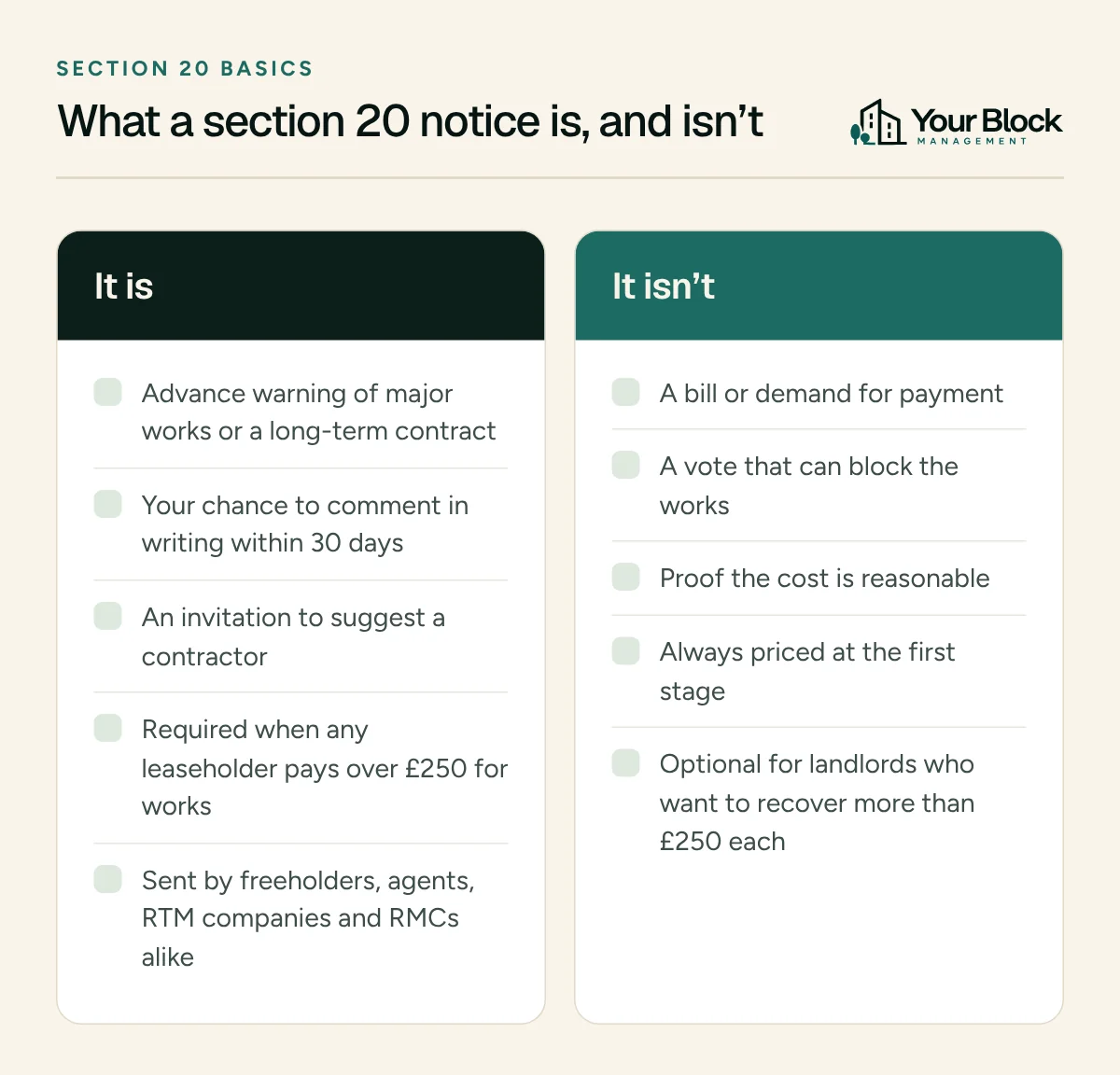
- A section 20 notice tells leaseholders about planned major works or long-term contracts before they are charged.
- It is required when any one leaseholder would pay more than £250 for works, or £100 a year for contracts.
- It is a consultation, not a bill and not a vote. You can comment and suggest a contractor.
- Freeholders, managing agents, RTM companies, RMCs, councils and housing associations can all send one.
- If the landlord skips it, recovery can be capped at £250 each unless a tribunal excuses it.
What is a section 20 notice? It is a letter your landlord or management company must send before carrying out major works, or signing a long-term contract, that will cost any one leaseholder more than £250 for works (or £100 a year for a contract). It tells you what is planned and invites your comments. It is a consultation, not a bill.
If you own a leasehold flat in England, sooner or later one will arrive. This guide explains it from the ground up, in plain English, with a glossary and the most common myths. When you are ready to act on one, our practical guide covers what to do when a section 20 notice lands.
What is a section 20 notice, in one sentence?
“We are planning to spend a significant amount of the building’s money; here is what and why; tell us what you think and, if you like, suggest a contractor.”
That’s it. The name comes from section 20 of the Landlord and Tenant Act 1985. The detailed rules are in a separate set of regulations from 2003, which set out exactly what each notice must say and how long you get to reply. The process is known as “section 20 consultation”, and the notices themselves are sometimes shortened to “S20 notices”.
Why does the law exist?
Leaseholders usually pay for the upkeep of their building through a service charge, but someone else decides what work is done and who does it. Without rules, a landlord could pick an expensive contractor, or one it has links with, and simply send the bill.
Section 20 gives leaseholders a say before the money is committed. The Supreme Court summed up its purpose in 2013: to protect leaseholders from paying for inappropriate works, or paying more than is appropriate. Consultation is the mechanism; value for money is the point.
Who sends a section 20 notice?
Whoever has the right to collect your service charge. That can be:
- Your freeholder, often through a managing agent who sends it on their behalf.
- A right to manage (RTM) company, if the leaseholders have taken over management.
- A residents’ management company (RMC), which may be run by you and your neighbours.
- A share of freehold company, where the flat owners own the freehold together. The rules still apply.
- A council or housing association, if you bought from one.
It goes to every leaseholder who will contribute, and to any recognised tenants’ association. If you rent your flat from a leaseholder, the notice is meant for your landlord, not you.
What does a section 20 notice look like?
There is no official form, so notices vary in layout, but a first-stage notice usually fits on one or two pages and includes:
- A heading such as “Notice of intention to carry out works”, with the building’s name and address.
- Who it is to: “to all leaseholders of…” and, if there is one, the recognised tenants’ association.
- A description of the works, or where and when you can look at a fuller description for free.
- The reasons the landlord thinks the works are needed.
- An invitation to send written comments and to suggest a contractor.
- An address and a closing date for your comments.
- A name and signature, often a managing agent signing for the landlord.
It may arrive by post or, if your lease allows, by email. Some agents also post a copy in the communal hallway, but that alone may not be enough: each leaseholder should receive their own. If you sublet your flat, make sure your notices go to an address where you will actually see them, because the clock starts from the date on the notice, not the day you read it.
When is a section 20 notice needed?
Two situations:
- Major works where any one leaseholder’s share will be more than £250, including VAT. Typical examples are roof replacement, external redecoration, new windows, a lift overhaul or fire safety works.
- Long-term agreements lasting more than 12 months, where any one leaseholder will pay more than £100 in a year. Examples include a multi-year cleaning or lift maintenance contract.
Illustrative example: in a 10-flat block with equal shares, a £3,600 job (including VAT) costs each flat £360. That is over £250, so the landlord must consult. A £2,400 job (£240 each) wouldn’t need it. Our guide to which section 20 works need consultation covers the grey areas, such as unequal shares and splitting jobs.
What happens after a section 20 notice arrives?
For most private blocks there are up to three steps, each with its own notice:
- Notice of intention. Describes the works and why they are needed. You get 30 days to send comments and suggest a contractor.
- Statement of estimates. Shows at least two quotes, one from a firm with no connection to the landlord, plus a summary of comments received and the landlord’s replies. Another 30 days for comments.
- Notice of reasons. Only if the landlord chooses a contractor who is neither the cheapest nor the one leaseholders suggested. It explains why, within 21 days of signing the contract.
Then the works happen and, at some point (your lease decides when), you get a bill. Our guide to the three stages of section 20 notices sets out what each must contain and how to spot a defective one.
Section 20 jargon in plain English
| Term | What it means |
|---|---|
| Leaseholder (the law says “tenant”) | You, if you own a flat on a long lease. The legislation calls you a tenant even though you own your home. |
| Landlord | Whoever can enforce the service charge: freeholder, RTM company, RMC or similar. |
| Qualifying works | Works that cost any one leaseholder more than £250. Informally, “major works”. |
| Qualifying long-term agreement (QLTA) | A contract for more than 12 months that costs any one leaseholder over £100 a year. |
| Observations | Your written comments. The landlord must consider them. |
| Nomination | Suggesting a contractor the landlord should ask for a quote. |
| Relevant period | The 30 days you get to respond, beginning with the date of the notice. |
| Estimate | A contractor’s quote. At least two are required. |
| Recognised tenants’ association (RTA) | A residents’ group formally recognised by the landlord or certified. It is consulted alongside individuals. |
| Dispensation | Permission from the tribunal to skip some or all of the consultation steps. |
| First-tier Tribunal (Property Chamber) | The independent body that decides service charge disputes in England. |
Section 20 myths and facts
Myth: “It’s a bill, so I need to pay now.”
Fact: it is advance notice and a request for your views. Payment comes later, by a separate demand, and only when your lease allows.
Myth: “If enough of us object, the works can’t go ahead.”
Fact: consultation is not a vote. The landlord must consider your comments but can still proceed. If the works are unnecessary or overpriced, the remedy is to challenge the cost afterwards (or in advance) at the tribunal.
Myth: “The notice has to say how much it will cost.”
Fact: not at the first step. The quotes come in the second notice.
Myth: “£250 means the whole job must cost under £250.”
Fact: the £250 is per leaseholder. A £2,000 job can need consultation in a small block.
Myth: “If the landlord gets the notice wrong, I pay nothing.”
Fact: if consultation isn’t done properly, the landlord can’t recover more than £250 from each leaseholder, unless the tribunal grants dispensation. The tribunal asks whether leaseholders actually lost out because of the failure. If they didn’t, dispensation is often granted. See what happens when consultation is skipped.
Myth: “Section 20 only applies to big freeholders.”
Fact: it applies to RTM companies, RMCs and share of freehold companies too, even when the directors are your neighbours.
Myth: “The £250 limit is changing because of leasehold reform.”
Fact: as at October 2026, it hasn’t. The Government consulted on reforming major works rules in 2025 and says it will respond separately. Until a change is made in law, £250 and £100 still apply.
What should you do now?
If a notice hasn’t arrived yet, find your lease and check your service charge percentage, so you can estimate your share of any future works. If one has arrived, diarise the deadline, read it carefully and reply in writing. Our guide to your rights to object, nominate and challenge explains what you can insist on.
Good managing agents make the process easy to follow. At Your Block, every resident can see major works notices, quotes and progress in the resident portal, and ask questions that are answered on the record. If you have questions about how that works, our portal FAQs cover the basics.
Frequently asked questions
Is a section 20 notice a legal requirement?
Yes, if the landlord wants to recover more than £250 from any leaseholder for a set of works, or more than £100 a year under a contract lasting over 12 months. The requirement comes from section 20 of the Landlord and Tenant Act 1985. Without consultation or tribunal dispensation, recovery is capped at those amounts.
Does section 20 apply in Wales and Scotland?
This guide covers England. Wales has its own version of the consultation regulations, and Scotland has an entirely different system of property factors and title deeds. If your flat is outside England, check the rules that apply there before relying on this guide.
Do I have to reply to a section 20 notice?
No, but it is worth doing. The landlord must consider written observations received within the 30-day period and, at the estimates stage, summarise and answer them. A reply creates a record that can help you later if the cost is challenged at the tribunal.
Who can help me understand a section 20 notice?
The Leasehold Advisory Service (LEASE) gives free initial advice to leaseholders in England. Your managing agent should also answer reasonable questions about the works. For a dispute, a solicitor or surveyor experienced in leasehold can advise on whether to challenge at the First-tier Tribunal.
Sources and further reading
This article is general information about the law in England, not legal advice. Leasehold law is changing, so check your lease and get professional advice for your own situation. Spotted something out of date? Tell us and we’ll fix it.