Section 20 Works: When Major Works Need Consultation (And When They Don’t)
The test is not the size of the job but the size of the biggest share. Worked examples, the splitting trap, emergencies and long-term contracts.

The short version
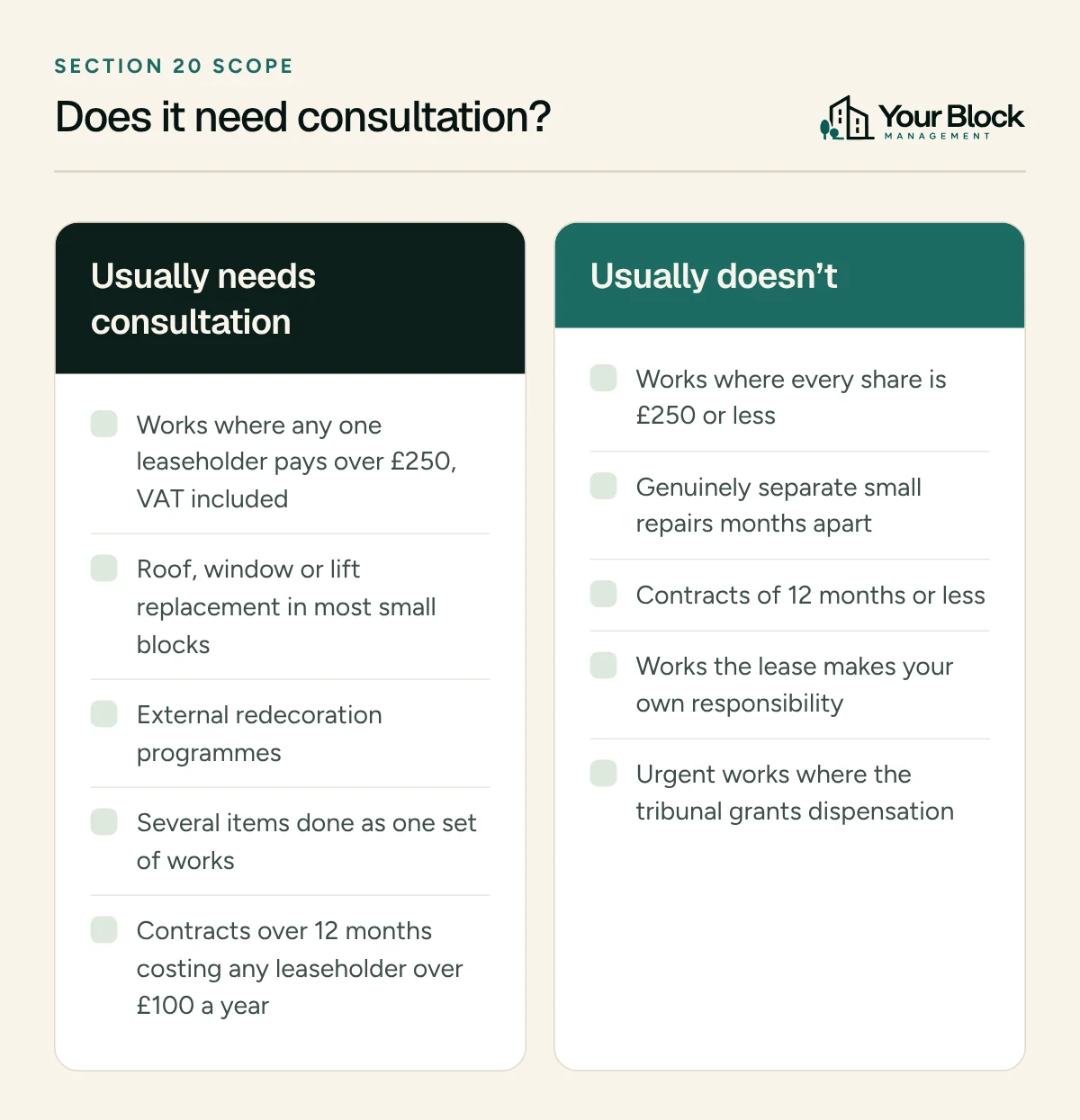
- Section 20 works are any works on the building or other premises costing one leaseholder more than £250.
- The test uses the largest individual share, including VAT, not the total cost of the job.
- Splitting one job into smaller pieces to dodge consultation is risky; tribunals look at the reality.
- Emergency works aren’t exempt. The route is a dispensation application to the First-tier Tribunal.
- Contracts over 12 months need consultation if any leaseholder pays more than £100 in an accounting period.
Section 20 works (the law calls them “qualifying works”) are works on a building or other premises that will cost any one leaseholder more than £250, including VAT. Above that line, the landlord, RTM company or RMC must consult before charging. Below it, it needn’t. The test looks at the largest individual share, not the size of the job, so a modest repair can still trigger it.
This guide is about scope: what counts, how to run the numbers, and the grey areas that catch boards and agents out. If you need the stages and notice contents, see our guide to the three stages of section 20 notices. It covers the law in England only.
What counts as section 20 works?
Section 20ZA of the Landlord and Tenant Act 1985 defines qualifying works simply as “works on a building or any other premises”. That is deliberately wide. It covers:
- Repairs: roofs, gutters, brickwork, windows the landlord is responsible for, drainage, structural work.
- Redecoration: external painting cycles and internal communal decoration.
- Replacement of plant: lifts, door entry systems, fire alarm panels, communal boilers.
- Safety works: fire door replacement, compartmentation, emergency lighting upgrades.
- Works to other premises: car parks, bin stores, boundary walls, estate roads and grounds, where the cost passes through the service charge.
- Improvements, if the lease allows their cost to be charged.
The label “major works” is informal. Consultation is triggered by the money, not by how big the job feels. A £2,000 communal carpet in a four-flat house conversion is section 20 works; a £20,000 job split equally across 100 flats is not.
It also doesn’t matter how the work is paid for day to day. If the cost ends up in the service charge, including where it is first met from a reserve fund that leaseholders paid into, assume it needs testing against the threshold.
The £250 test: how to tell whether section 20 works need consultation
Regulation 6 of the Service Charges (Consultation Requirements) (England) Regulations 2003 sets the threshold: consultation is required where the works would result in the relevant contribution of any leaseholder being more than £250. Three points follow.
- It is per leaseholder. A £3,000 job can need consultation in a small block and not in a large one.
- It is the biggest share that counts. Where shares are unequal, test against the flat paying the largest percentage. LEASE gives the same guidance.
- VAT is included. Regulation 2 says estimates include VAT where it applies. Since leaseholders pay it, a quote of £240 plus VAT per flat is really £288.
Worked examples (illustrative)
| Block and job | Cost inc. VAT | Largest share | Largest contribution | Consult? |
|---|---|---|---|---|
| 6 flats, gutter repairs, equal shares | £1,200 | 1/6 | £200 | No |
| 6 flats, gutter and fascia repairs, equal shares | £1,800 | 1/6 | £300 | Yes |
| 20 flats, door entry upgrade, equal shares | £4,800 | 5% | £240 | No |
| Same 20 flats, but penthouse pays 8% | £4,800 | 8% | £384 | Yes |
| 30 flats, £7,000 + VAT redecoration, equal shares | £8,400 | 1/30 | £280 | Yes |
The last two rows are where boards get caught. The penthouse example shows why you must check the lease schedule rather than divide by the number of flats. The redecoration example shows VAT tipping a job over the line.
Where a figure is close to £250, consult. Running the process costs time; getting it wrong can cost the building the difference between £250 and the real share for every flat, unless the tribunal grants dispensation. Our guide to what happens if section 20 consultation is skipped explains that risk.
Can you split works to stay under £250?
This is the most common temptation, and the riskiest. In Phillips v Francis [2014] EWCA Civ 1395, the Court of Appeal held that the threshold applies to each set of qualifying works, not to everything spent in a year. But whether several items form one set of works is a question of fact, judged with common sense.
Factors a tribunal is likely to weigh include whether the items:
- were planned or specified together, or come from the same survey;
- are being done by the same contractor, under one contract or at the same time;
- share scaffolding, access or site set-up;
- relate to the same part of the building or the same defect.
Replacing a roof’s north slope in March and its south slope in May, with the same roofer and the same scaffold, looks like one set of works. Clearing gutters in spring and repairing an unrelated door closer in autumn does not. If you are splitting a job for a genuine operational reason, write that reason down at the time.
Emergency and urgent works
There is no emergency exemption. If a roof is leaking into a top-floor flat or a fire alarm panel has failed, the landlord must still either consult or obtain dispensation from the First-tier Tribunal under section 20ZA. Dispensation can be sought before the works, during them or afterwards.
Good practice for urgent works:
- Make safe first, and keep the make-safe cost separate where it is genuinely separate.
- Tell leaseholders straight away what has happened, what is being done and why consultation isn’t possible.
- Get more than one price where time allows, and keep the evidence.
- Apply for dispensation promptly, with photos, reports and the timeline.
Leaseholders who were kept informed and saw competitive pricing will struggle to show they were prejudiced, which is what the tribunal looks for.
Long-term agreements: the £100 rule
A separate threshold applies to qualifying long-term agreements (QLTAs): contracts entered into by or for the landlord for a term of more than 12 months. Consultation is required if any leaseholder’s contribution under the agreement would exceed £100 in any accounting period (regulation 4).
Examples that can be caught include multi-year contracts for cleaning, gardening, lift maintenance, fire alarm servicing, door entry maintenance and, commonly, a managing agent’s appointment for more than a year. Some agreements are excluded by regulation 3, including contracts of employment, agreements between companies in the same group, and agreements made when the building had no leaseholders, for five years or less.
A 12-month contract is not a QLTA because it isn’t for more than 12 months. Contracts that roll on or have unusual term clauses raise technical questions, so check them before signing. Works ordered under an existing QLTA have their own one-notice consultation route.
Repairs versus improvements
Consultation applies to both. The harder question is whether you can be charged for an improvement at all, and that is answered by your lease, not by section 20. Many leases allow the landlord to recover the cost of repairing and maintaining the building but say nothing about improving it.
Replacing worn-out single glazing with double glazing is the classic grey area: if the old windows needed replacing anyway, the modern equivalent may count as repair. Adding CCTV where there was none is more clearly an improvement. Consultation never makes a cost payable that the lease doesn’t allow, and an unreasonable cost can still be challenged under section 19 even after perfect consultation.
What section 20 doesn’t cover
- Works below the threshold, assessed set by set.
- Contracts of 12 months or less. These are not QLTAs.
- Works inside your own flat that the lease makes your responsibility.
- Ordinary running costs that aren’t works, such as electricity bills under a short supply agreement.
- Costs not charged through the service charge, for example works the freeholder pays for itself, or an insurer pays for in full.
“Not covered by section 20” is not the same as “not challengeable”. Every service charge cost must still be reasonably incurred and the work of a reasonable standard.
A checklist for RTM and RMC directors
If you sit on a board, the duty to consult is yours, because your company is the landlord for these purposes. Before committing to any job:
- Get the lease percentages and test the largest share, including VAT.
- Ask whether this job is part of a wider programme that could be seen as one set of works.
- Check whether any contract runs for more than 12 months and could be a QLTA.
- If close to a threshold, consult.
- If urgent, make safe, tell everyone, and apply for dispensation without delay.
A planned maintenance programme makes all of this easier, because works are anticipated and consulted on in good time. At Your Block we build those programmes with boards and handle the consultation paperwork for them; see our support for RTM and RMC directors and what our full block management service includes. Leaseholders who want to know what to do with a notice once it arrives should read our practical guide to section 20 notices, the beginner’s explainer, and our guide to leaseholder rights to object and challenge.
Frequently asked questions
Is the £250 limit per flat or for the whole building?
Per leaseholder. Consultation is required if the works would cost any single leaseholder more than £250, including VAT. If shares are unequal, test against the largest share. A £2,000 job can need consultation in a six-flat block but not in a block of twenty with equal shares.
Do professional fees count towards the £250?
Fees for surveyors and contract administrators on a set of works are usually passed on through the service charge. Whether they count towards the £250 test can depend on the facts, so a cautious landlord includes them when testing the threshold. If you are unsure whether to consult, take advice first: consulting unnecessarily costs far less than failing to consult.
Has the £250 threshold changed?
No. As at October 2026 the thresholds remain £250 per leaseholder for qualifying works and £100 per leaseholder per accounting period for long-term agreements. The Government consulted on reforming major works rules in 2025 and has said it will respond separately, but no change has been made.
Do housing associations and councils have to consult?
Yes. Section 20 applies to social landlords as well as private ones. Where a council or housing association must advertise a large contract publicly, a different consultation route applies and leaseholders can’t nominate contractors, though they can still comment. Leaseholders of councils and housing associations can also take complaints to the Housing Ombudsman.
Sources and further reading
This article is general information about the law in England, not legal advice. Leasehold law is changing, so check your lease and get professional advice for your own situation. Spotted something out of date? Tell us and we’ll fix it.