
Section 20 Notices: The 3 Stages Explained (And How to Spot an Invalid One)
Notice of intention, statement of estimates, notice of reasons: what the law says each one must contain, and the defects that can make a notice invalid.

The short version
- Most private blocks follow three stages: notice of intention, statement of estimates, and sometimes a notice of reasons.
- Stages 1 and 2 each give leaseholders 30 days, beginning with the date of the notice, to send observations.
- At least two estimates are required, one from a contractor wholly unconnected with the landlord.
- Long-term agreements, works under them and public-notice works follow different schedules with different contents.
- A defective notice can cap recovery at £250 per leaseholder, but the tribunal can grant dispensation.
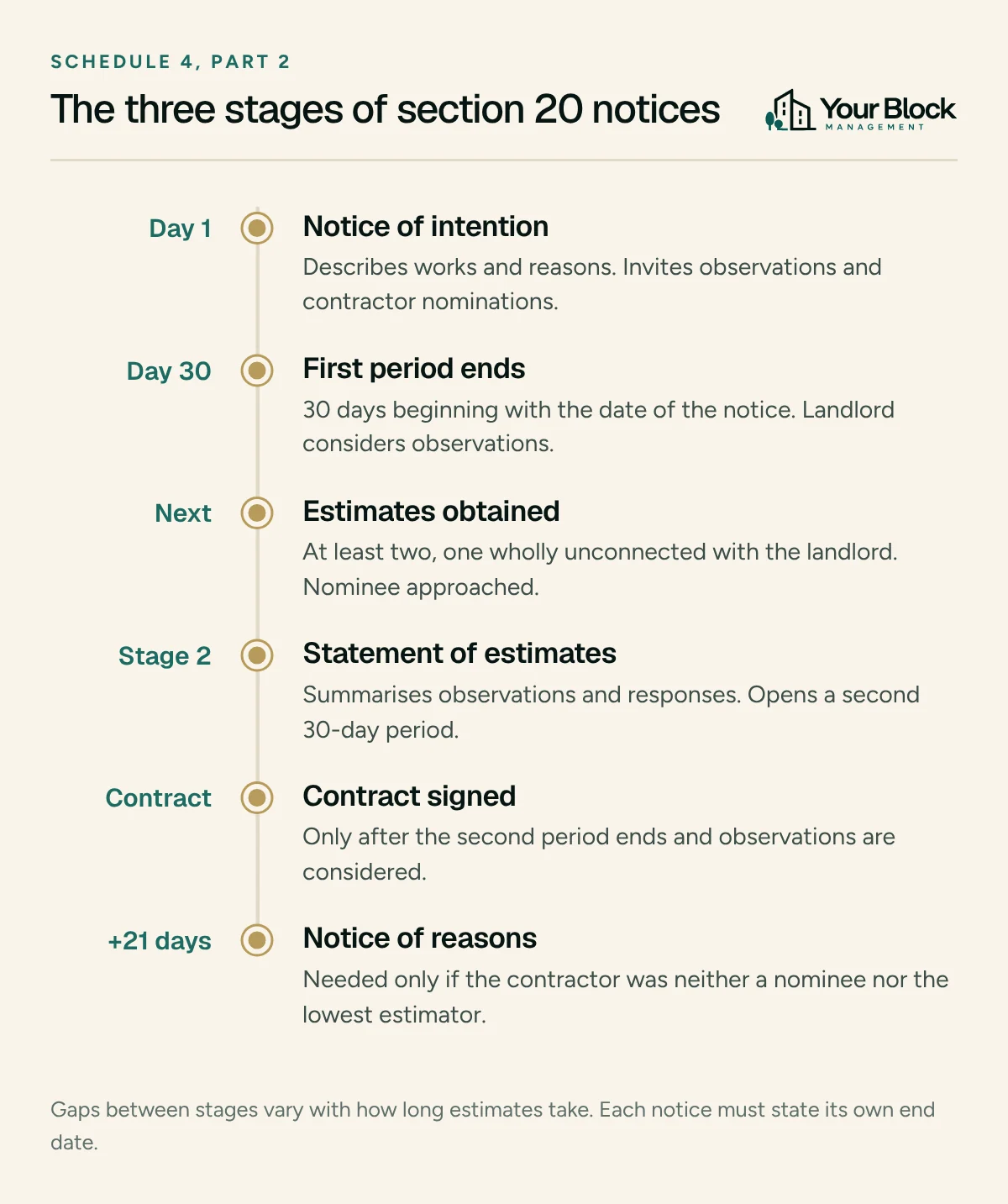
For most private blocks in England, section 20 notices come in three stages: a notice of intention, a statement of estimates and, in some cases, a notice of the landlord’s reasons. Schedule 4, Part 2 of the Service Charges (Consultation Requirements) (England) Regulations 2003 sets out what each must contain. Miss a required element and the landlord risks being capped at £250 per leaseholder unless the tribunal grants dispensation.
This guide goes through each stage in turn, then gives you a 12-point checklist for spotting a defective notice. If you have just received one and want to know what to do this week, start with our practical guide to what to do when a section 20 notice lands.
Which section 20 notices apply to your building?
The three-stage process is the usual route, but the regulations contain several. The right one depends on what is being consulted on and who the landlord is. A notice that follows the wrong schedule is a red flag.
| Situation | Schedule | Key differences |
|---|---|---|
| Major works, private landlord, no long-term agreement | Sch 4, Part 2 | The three stages in this guide. Leaseholders can nominate contractors. |
| Major works where the landlord must advertise by public notice (public bodies on large contracts) | Sch 4, Part 1 | No nominations. A “landlord’s contract statement” names the chosen contractor. |
| Entering a long-term agreement (over 12 months) with no public notice | Sch 1 | Notice of intention with nominations, then at least two “proposals”, then reasons within 21 days if needed. |
| Long-term agreement requiring public notice | Sch 2 | No nominations. Leaseholders can still comment. |
| Works carried out under an existing long-term agreement | Sch 3 | A single notice stating the estimated total cost. No nominations. Written response to observations within 21 days. |
Whether consultation is needed at all is a separate question: it turns on the £250-per-leaseholder test for works and £100 per year for long-term agreements. We cover that in when section 20 works need consultation. The rest of this guide covers the standard Schedule 4, Part 2 route.
Stage 1: the notice of intention
The notice of intention must be given in writing to each leaseholder liable to contribute and to any recognised tenants’ association (RTA) for the building. It must:
- Describe the proposed works in general terms, or say where and when a description can be inspected.
- State the landlord’s reasons for considering the works necessary.
- Invite written observations on the proposed works.
- Give the address to which observations must be sent, state that they must be delivered within the relevant period, and give the date that period ends.
- Invite each leaseholder and the RTA to nominate a person from whom the landlord should try to obtain an estimate.
The relevant period is 30 days beginning with the date of the notice. If the description is available for inspection, the place and hours must be reasonable and inspection must be free. If copies can’t be taken there, the landlord must provide a free copy on request. The landlord must then have regard to any observations received in time.
Note what stage 1 does not need: a price. Many leaseholders expect a cost at this point and assume a notice without one is defective. It isn’t.
Stage 2: the statement of estimates
After the first period ends, the landlord obtains estimates. This is where most of the detail sits.
Nominated contractors
If a contractor was nominated in time, the landlord must try to obtain an estimate from them. The rules on which nominee to approach are:
- Nomination by the RTA: the landlord must try to get an estimate from that person, whether or not leaseholders also nominate.
- A single nomination by one leaseholder: try to get an estimate from that person.
- Several leaseholder nominations: approach the person with the most nominations; if there’s a tie, one of the tied names; otherwise any nominee.
- Several nominations from both leaseholders and the RTA: at least one estimate from a leaseholder nominee and one from an RTA nominee, from different people.
The duty is to try. If a nominee won’t quote, that isn’t the landlord’s failure.
What the statement must contain
- At least two estimates, setting out the estimated cost of each.
- At least one estimate from a person wholly unconnected with the landlord. The regulations treat shared directors or managers, and close relatives, as connections.
- Any estimate obtained from a nominee must be one of those included.
- A summary of observations received at stage 1, with the landlord’s response to them.
- All estimates made available for inspection, not just the two in the statement.
The statement is supplied free to each leaseholder and the RTA, with a notice that says where and when the estimates can be inspected, invites observations on them, and gives the address and the end of a second 30-day period. The landlord must have regard to those observations too.
Stage 3: the notice of landlord’s reasons
Within 21 days of entering into the contract, the landlord must give each leaseholder and the RTA a written notice that states its reasons for awarding the contract (or says where and when they can be inspected), and summarises and responds to any observations on the estimates.
This stage applies only if the contract went to someone who was neither a nominated contractor nor the lowest estimator. If the landlord chose the cheapest quote or your nominee, no reasons notice is needed, which is why many consultations end at stage 2.
How to spot an invalid section 20 notice: a 12-point checklist
Use this list against the notices you received. A “no” doesn’t automatically mean you pay less (see the next section), but it is worth raising in writing straight away.
- Right route? Does the notice follow the schedule that fits the situation (see the table above)?
- Served on everyone? Was it given to every contributing leaseholder and any RTA, in the way your lease requires?
- Works described? Is there a description, or a reasonable place and time to inspect one free of charge?
- Reasons given? Does the stage 1 notice say why the works are necessary?
- Nominations invited? Did stage 1 invite leaseholders and the RTA to propose a contractor?
- Address and end date stated? Does each notice give an address for observations and the date the period ends?
- Full 30 days? Does each period run for 30 days beginning with the date of the notice, and did the landlord wait for it to end?
- Two estimates, one independent? Does the stage 2 statement include at least two, one from a contractor wholly unconnected with the landlord?
- Nominee approached? If you nominated in time, did the landlord try to get that estimate, and is it included?
- Observations answered? Does the statement summarise stage 1 observations and respond to them?
- All estimates inspectable? Can you inspect every estimate obtained, not just the chosen ones?
- Reasons within 21 days? If the contract went to someone other than a nominee or the lowest bidder, did a reasons notice follow within 21 days of signing?
Two more problems come up often. First, scope creep: if the works carried out are materially different from those consulted on, the consultation may not cover them. Second, signing before stage 2 closes: a contract entered into before leaseholders have had their 30 days on the estimates undermines the whole point of that stage.
Does an invalid notice mean you don’t have to pay?
Not necessarily. If the requirements aren’t met, section 20 limits each leaseholder’s contribution to £250 for the works unless the First-tier Tribunal grants dispensation under section 20ZA. Since the Supreme Court’s decision in Daejan Investments Ltd v Benson [2013] UKSC 14, the tribunal focuses on whether leaseholders suffered real prejudice from the failure, and dispensation is often granted, sometimes on terms. The defects in the checklist are your evidence; what you lost as a result is your argument. Our guide to the consequences of skipping section 20 consultation covers dispensation in depth.
What to do if you think a notice is defective
- Raise it in writing during the consultation, quoting the missing element. A landlord who fixes the problem early is better for everyone than a dispute later.
- Keep everything: envelopes, emails, dates of receipt, and any refusals to show you estimates.
- Still send observations on the substance. Being able to show what you would have said is central to proving prejudice later.
- Get advice before withholding payment. LEASE offers free initial advice, and the tribunal can decide payability under section 27A.
Our guide to your rights to object, nominate and challenge sets out the tribunal route step by step, and the beginner’s guide to section 20 notices explains the jargon.
If you sit on an RTM or RMC board, your company is the “landlord” for these purposes, and the duty to get every stage right sits with you. Your Block drafts and tracks consultation notices for volunteer directors, and residents can follow each stage and its deadlines in the resident portal.
Frequently asked questions
How long does the full section 20 process take?
There are two 30-day observation periods, plus however long it takes to obtain estimates in between, so the standard route takes at least two months and often longer. The reasons notice, if one is needed, follows within 21 days of signing the contract. Urgent works that can’t wait are dealt with through a dispensation application instead.
Does a notice of intention have to include the cost?
No. Under Schedule 4, Part 2 the notice of intention describes the works and the reasons for them but doesn’t have to price them. Costs appear in the statement of estimates. Works under an existing long-term agreement are different: that notice must state the total estimated expenditure.
What does wholly unconnected with the landlord mean?
At least one of the estimates in the stage 2 statement must come from a contractor with no connection to the landlord. The regulations treat links such as shared directors or managers, or close family relationships, as connections. If you suspect a link, ask the landlord to confirm in writing.
Can a landlord restart consultation if a notice was wrong?
Yes. A landlord who spots a defect can serve fresh notices and run the stages again, which is often the cleanest fix before a contract is signed. Alternatively it can apply to the First-tier Tribunal for dispensation, before or after the works.
Sources and further reading
This article is general information about the law in England, not legal advice. Leasehold law is changing, so check your lease and get professional advice for your own situation. Spotted something out of date? Tell us and we’ll fix it.