
Section 20 Notice Leasehold: The Consultation Rules Your Freeholder Must Follow
The landlord’s side of consultation: who must consult, the five notice sets, the duties they impose, and how to test the notice you received.
 By Sam Charlesworth8 min read

The short version
- Anyone who can enforce the service charge must consult, including RTM companies and RMCs.
- There are five notice sets; using the wrong one is a red flag.
- Notices must be in writing to every leaseholder and any recognised tenants’ association.
- Each window is 30 days from the notice date; posted notices usually count from two working days later.
- A defect can cap recovery at £250, but dispensation turns on real prejudice.
Every section 20 notice leasehold flat owners receive must follow rules set by the Landlord and Tenant Act 1985 and the Service Charges (Consultation Requirements) (England) Regulations 2003. Your freeholder must use the right set of notices for the job, include specific contents, give each one in writing to every leaseholder, and allow full 30-day windows. Get any of that wrong and recovery can be capped.
This guide is written from the landlord’s side of the table: what the law requires of the person consulting, which of the five notice sets applies, and how you can check that the notice you received was valid on contents, service and timing. It covers England only. If the whole subject is new, start with our plain-English guide to what a section 20 notice is.
Who has to follow the section 20 notice rules?
The duty sits with the “landlord”, and section 30 of the 1985 Act defines that widely: it includes any person who has a right to enforce payment of a service charge. In practice that can be:
- The freeholder, where it manages the building itself or through a managing agent.
- An intermediate landlord holding a head lease, if your lease makes it responsible for services.
- A right to manage (RTM) company, once it has acquired management.
- A residents’ management company (RMC) or share of freehold company that is party to the leases.
A managing agent usually prepares and sends the notices, but it does so on the landlord’s behalf. If the agent gets them wrong, it is the landlord’s recovery that is capped. If you are an RTM or RMC director, the freeholder in this guide is you.
The notices must go to each tenant and, where a recognised tenants’ association (RTA) represents some or all of them, to the association (or its secretary, for the statement of estimates). Under section 29 of the 1985 Act, an RTA is an association of qualifying tenants recognised either by the landlord’s written notice to its secretary or by a First-tier Tribunal certificate.
The five sets of section 20 notices
The 2003 Regulations contain five different consultation procedures. Which applies depends on what is being consulted on and whether public notice is required. Since the Procurement Act 2023, “public notice” in the regulations means notice published under that Act, so the public notice routes are mainly for public bodies such as councils and most housing associations.
| Situation | Schedule | Notices you should receive | Can you nominate? |
|---|---|---|---|
| Major works, no long-term agreement, no public notice (most private blocks) | 4, Part 2 | Notice of intention; statement of estimates; notice of reasons if needed | Yes |
| Major works needing public notice | 4, Part 1 | Notice of intention; notice of proposed contract with a landlord’s contract statement | No |
| Entering a long-term agreement (over 12 months), no public notice | 1 | Notice of intention; notice of at least two proposals; notice of reasons if needed | Yes |
| Entering a long-term agreement needing public notice | 2 | Notice of intention; notice of a single proposal | No |
| Works carried out under an existing long-term agreement | 3 | One notice of intention with the estimated total cost | No |
A private freeholder signing a three-year lift maintenance contract should be using Schedule 1. The same freeholder replacing the roof uses Schedule 4, Part 2. If works are being done by a contractor already engaged under a long-term agreement, a single Schedule 3 notice is enough, because consultation happened when the agreement was made. Whether consultation is needed at all depends on the £250 and £100 thresholds, which our guide to when works need consultation explains.
Your freeholder’s obligations: the checklist
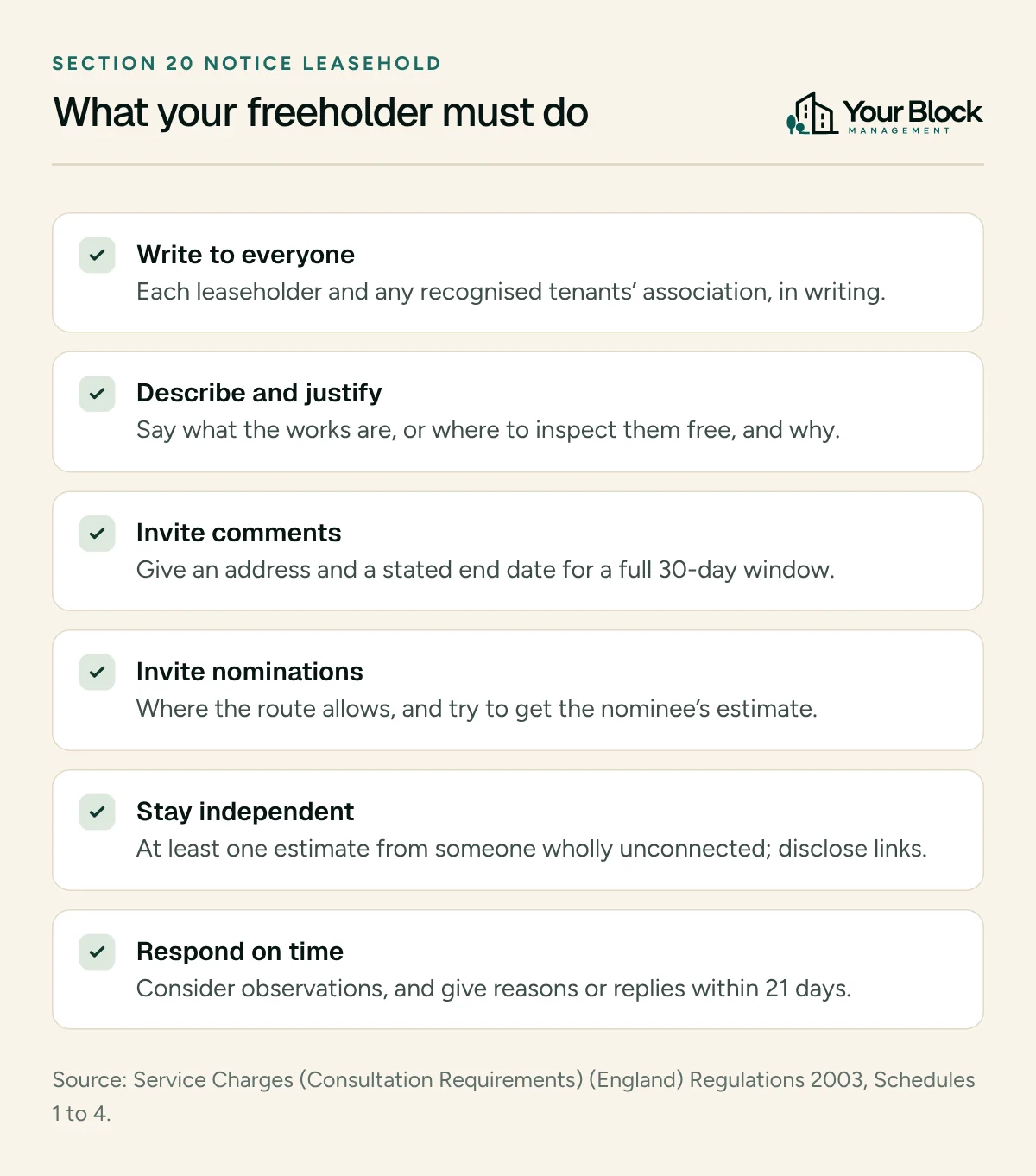
Across all five routes, the same core duties recur. Your freeholder must:
- Give notice in writing to each leaseholder and any RTA. A conversation, a noticeboard post or a residents’ meeting is not enough on its own.
- Describe the works or agreement in general terms, or name a reasonable place and hours where a description can be inspected free of charge. If copying facilities aren’t available there, a free copy must be supplied on request.
- Give reasons why the works, or the agreement, are considered necessary.
- Invite written observations, giving the address, the fact they must arrive within the relevant period, and the date that period ends.
- Invite nominations of contractors where the route allows it, and try to obtain an estimate from the right nominee.
- Have regard to observations received in time. That means genuinely considering them, not agreeing with them.
- Disclose connections. At least one estimate or proposal must come from someone wholly unconnected with the landlord, and the long-term agreement and public notice routes require any connection to be stated.
- Respond and give reasons within the deadlines the route sets, usually 21 days.
What “connected” means
The regulations assume a connection where, for example, the landlord is a company and the contractor is (or is to be) one of its directors or managers or a close relative of one, or where two companies share a director or manager. “Close relative” is defined in regulation 2 and includes a spouse or cohabitee, parents and parents-in-law, children and children-in-law, siblings and siblings-in-law, and step-relations. This matters in small RMCs: if a director’s brother-in-law runs the building firm, that firm’s estimate can’t be the independent one.
How to check the contents of your notice
Start by working out which route applies from the table above, then check the contents for that route. The items below are the ones most often missed in the less familiar routes.
Long-term agreements (Schedule 1)
Each of the landlord’s proposals must state the relevant matters, the name and address of each other party and any connection, the estimated contribution for each flat where reasonably practicable (otherwise the total expenditure, or a unit cost or rate), any provisions for varying the price, and the intended duration. Where the agreement is to appoint a managing agent, each proposal must also say whether the agent is a member of a professional body or trade association, whether it subscribes to a code of practice or voluntary accreditation scheme, and name the body. A proposal for a five-year management contract that says nothing about these is defective.
Works under an existing agreement (Schedule 3)
The single notice must describe the works, give the reasons, and include a statement of the total amount of expenditure the landlord estimates it is likely to incur. If you send observations, the landlord must reply in writing within 21 days of receiving them.
Public notice routes (Schedule 2 and Schedule 4, Part 1)
The notice of intention must say that nominations are not being invited because public notice is to be given. The later statement or proposal must name the intended contractor, disclose any connection, and give an estimated contribution per flat where reasonably practicable. If no estimate can be given yet, it must say why and when one is expected, and the landlord must send the figure within 21 days of having enough information.
The standard route (Schedule 4, Part 2)
Our guide to spotting an invalid section 20 notice has a 12-point checklist for the three standard notices, so we won’t repeat it here. One point worth stressing: a notice of intention under this route doesn’t need to include a price.
How to check the notice was properly served
The regulations require notice “in writing” to each tenant but don’t prescribe how it is delivered. Check:
- Was it sent to you, at the right address? If you let your flat and live elsewhere, make sure your landlord has your current correspondence address.
- Did every leaseholder get one? Ask neighbours. A notice that reached only some flats is a failure to consult the others.
- Did the RTA get one, if your building has one?
- What does your lease say? Many leases have a notices clause setting how notices may be given. Where a notice was sent by email, check whether you agreed to that.
Keep the envelope, the email, or a note of the date you received it. If service is ever disputed, that record is your evidence. The Government’s 2025 consultation described the current approach as notices being sent in hard copy by post, and asked whether email should be allowed with the leaseholder’s agreement. That is a proposal, not the law.
How to check the timing
Timing errors are easy to spot once you know the rules:
- The relevant period is 30 days beginning with the date of the notice (regulation 2).
- Posted notices: LEASE says the tribunal has ruled that the date of a posted notice should usually be treated as two working days after posting.
- The end date must be stated. A notice that says “within 30 days” but gives no date doesn’t meet the requirement to specify when the period ends.
- Contracts shouldn’t be signed early. On the standard route, the contract should follow the end of the second 30-day window.
- Reasons within 21 days of the contract, where the contractor was neither a nominee nor the lowest estimator.
Illustrative check: a notice dated Friday 6 November 2026 and posted that day would be treated as dated Tuesday 10 November. Thirty days beginning on 10 November ends on 9 December. If the notice gives an end date of 5 December, ask for it to be corrected or extended in writing.
What to do if your notice doesn’t comply
A defect doesn’t automatically mean you pay nothing. If consultation fails, each leaseholder’s contribution is capped at £250 for the works, or £100 per accounting period for a long-term agreement, unless the First-tier Tribunal grants dispensation under section 20ZA. Since Daejan Investments Ltd v Benson [2013] UKSC 14, the tribunal asks whether leaseholders suffered real prejudice. So:
- Point out the defect in writing straight away, so the landlord can reissue the notice.
- Still engage on the substance. Your observations and nominations show what you would have done, which is what prejudice turns on.
- Keep a file of every notice, envelope and reply.
Our guides to your rights to object, nominate and challenge and to the £250 cap and dispensation take it from there.
At Your Block, every notice we send on a building’s behalf records the route, the recipients and the dates, and residents can see each stage in the portal. Our full block management service includes running consultation, and our FAQs on switching managing agent explain how a handover mid-consultation is managed.
Frequently asked questions
Does a section 20 notice have to be sent by post?
The 2003 Regulations require notice in writing to each leaseholder but don’t prescribe a delivery method. Check your lease’s notices clause, and whether you agreed to email. The Government’s 2025 consultation asked whether email should be allowed with a leaseholder’s agreement, but that proposal isn’t law. Keep a record of how and when each notice reached you.
My managing agent sent the notice. Is the freeholder still responsible?
Yes. The agent acts on the landlord’s behalf, and the cap under section 20 limits what the landlord can recover from leaseholders. Where an RTM company or residents’ management company is the landlord, the company carries that risk, which is why boards should check their agent’s notices before they go out.
Can I nominate a contractor for a long-term agreement?
Usually, yes. Under Schedule 1, the notice of intention must invite nominations, and the landlord must try to obtain an estimate from the right nominee and base a proposal on it. You can’t nominate where public notice is required (Schedule 2), or for works under an existing long-term agreement (Schedule 3), but you can still send written observations.
What if I never received a section 20 notice?
Raise it in writing with the landlord or agent as soon as you find out, and ask for copies of every notice and proof of how they were sent. If you weren’t consulted, the landlord may be limited to £250 for your share unless the tribunal grants dispensation, and you can tell the tribunal what you would have done if consulted.
Sources and further reading
This article is general information about the law in England, not legal advice. Leasehold law is changing, so check your lease and get professional advice for your own situation. Spotted something out of date? Tell us and we’ll fix it.