
Section 20 Leasehold Rules: The £250 Threshold Explained
The maths behind consultation: how the £250 and £100 tests are applied flat by flat, what counts towards them, and what it costs when they are missed.
 By Sam Charlesworth8 min read
The short version
- Consultation is needed if any one leaseholder’s share of works would exceed £250 including VAT.
- Long-term agreements over 12 months need consultation if any share exceeds £100 in an accounting period.
- Test the largest lease share, not an equal split: unequal schedules pull the threshold down.
- The test applies to each set of works; Phillips v Francis sets out common-sense factors.
- Proposals to raise the limits to £600 and £300 are not law; £250 and £100 still apply.
Under section 20 leasehold rules, your landlord must consult before charging for works if any one leaseholder’s share of the cost would be more than £250, including VAT. For contracts lasting over 12 months, the trigger is a share of more than £100 in any accounting period. Skip consultation and, unless the tribunal grants dispensation, each leaseholder pays no more than those amounts.
This guide is a deep dive into the two numbers: exactly what the law says, how to do the maths flat by flat, the grey areas (VAT, fees, overruns and “one set of works”), and what the cap costs when it bites. It covers England only. If you want to know whether a type of job counts at all, see our guide to when section 20 works need consultation.
What the section 20 leasehold thresholds actually say
Section 20 of the Landlord and Tenant Act 1985 doesn’t contain the numbers itself. It says consultation applies where costs exceed an “appropriate amount”, and leaves that amount to regulations. The Service Charges (Consultation Requirements) (England) Regulations 2003 then set it:
- Qualifying works (regulation 6): the appropriate amount is “an amount which results in the relevant contribution of any tenant being more than £250”.
- Qualifying long-term agreements (regulation 4): section 20 applies if costs under the agreement “in any accounting period” result in any tenant’s relevant contribution for that period being more than £100.
Three phrases do the heavy lifting:
- “Relevant contribution” is defined in section 20(2) as the amount a leaseholder can be required to pay under the terms of their lease towards the cost. So the lease apportionment decides the share, not a simple head count.
- “Any tenant” means the test is met if even one leaseholder would pay more than the limit.
- “More than” means exactly £250.00 does not trigger consultation. £250.01 does.
A “qualifying long-term agreement” (QLTA) is an agreement entered into by or for the landlord for a term of more than 12 months (section 20ZA(2)). Regulation 3 excludes a few types, such as contracts of employment and agreements between companies in the same group.
How the £250 test works, flat by flat
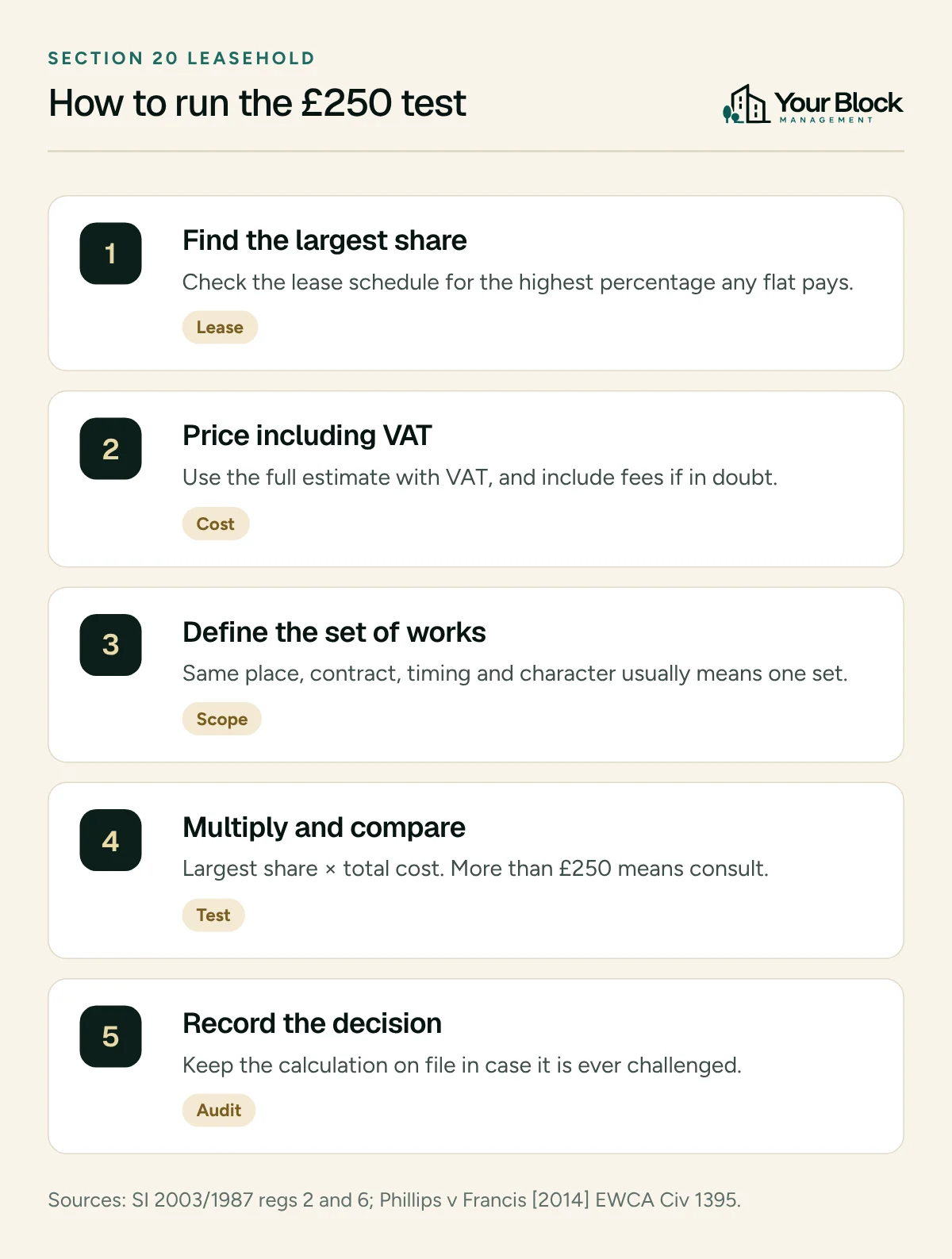
The test is simple once you have the right inputs: take the total cost including VAT, multiply by the largest percentage any lease requires, and compare the answer with £250. LEASE’s guidance says the same: where shares are unequal, test the flat that pays the largest share.
For a block with equal shares, a quick rule follows: consultation is needed once the job costs more than £250 multiplied by the number of flats. The table shows where that line falls. These examples are illustrative.
| Block | Largest share | Consultation needed once the job costs more than (inc. VAT) | Equivalent before 20% VAT |
|---|---|---|---|
| 4 flats, equal shares | 25% | £1,000 | £833 |
| 6 flats, equal shares | 16.67% | £1,500 | £1,250 |
| 8 flats, largest share 15% | 15% | £1,667 | £1,389 |
| 12 flats, equal shares | 8.33% | £3,000 | £2,500 |
| 20 flats, equal shares | 5% | £5,000 | £4,167 |
| 30 flats, equal shares | 3.33% | £7,500 | £6,250 |
Two things stand out. First, in small blocks the threshold is low: a £1,200 plus VAT repair in a four-flat house conversion needs full consultation. Second, an unequal lease schedule pulls the line down. In the eight-flat example, a flat paying 15% hits £250 on a job of about £1,667, even though an equal split would allow £2,000.
A worked example
Illustrative: a 10-flat block where the two penthouses each pay 14% and the other eight pay 9% each. The landlord gets a quote of £1,500 plus VAT to replace the communal entrance door.
- Total including VAT: £1,800.
- Penthouse share: 14% × £1,800 = £252.
- Other flats: 9% × £1,800 = £162.
Eight of the ten leaseholders are well under £250, but the penthouses are just over. That is enough: the works need consultation. Had the shares been equal (£180 each), they would not.
VAT, fees and cost overruns: what goes into the sum
VAT
Regulation 2(2) says that any estimate under the regulations must include VAT where it applies. Most leaseholders can’t recover VAT, so it is part of what they pay. A contractor who is not VAT-registered may be cheaper for the same reason, which is worth remembering when comparing estimates near the line.
Professional fees
Whether surveyors’ fees, project management or similar costs count towards the £250 is not settled. The Government’s 2025 consultation said this uncertainty “has resulted in considerable case law” and proposed to clarify that qualifying works do include these associated costs. Until the law changes, the cautious approach is to include them when you test the threshold.
Cost overruns
Section 20(3) applies the rule to “relevant costs incurred on carrying out the works”. The landlord tests the threshold in advance using estimates, but the cap bites on what is actually incurred. If a job was expected to cost each leaseholder £230 and ends up at £310 because of hidden defects, the landlord can be limited to £250 each for that job unless it consulted anyway or obtains dispensation. That is why sensible landlords consult whenever an estimate is close to the line.
One set of works or several?
The £250 test is applied to each set of qualifying works, not to everything spent in a year. The Court of Appeal settled this in Phillips v Francis [2014] EWCA Civ 1395, overturning a High Court ruling that had added up all qualifying works in a service charge year. The court accepted an example put to it: in a four-flat block, an unexpected £800 door repair and a £400 window repair later in the same year are separate sets of works, and neither needs consultation.
Whether several items are one set is a question of fact, to be answered “in a commonsense way”. The court listed factors likely to be relevant (paragraph 36):
- Location: are the items next to each other or physically far apart?
- Contract: are they covered by the same contract?
- Timing: are they done at more or less the same time?
- Character: are they different in character, or unconnected with each other?
The list is not exhaustive. In an earlier case decided under the old version of the Act, Martin v Maryland Estates [1999], the fact that all the works were under one contract was treated as decisive on its facts. Practical examples, all illustrative:
- Likely one set: repointing the front and rear elevations under one scaffold, priced by one contractor, a few weeks apart.
- Likely separate: clearing gutters in spring and replacing a broken door closer in autumn.
- Risky: splitting a single roof replacement into two invoices to keep each under £250. A tribunal is likely to see through it, and the cap then applies to the whole job.
The £100 threshold for long-term agreements
The QLTA test works the same way, but per accounting period rather than per job. Regulation 4 defines the accounting period as a 12-month period, linked to the dates the service charge accounts are made up, so in practice it usually follows your block’s service charge year.
Illustrative examples for a 20-flat block with equal shares, where consultation is needed once the contract costs more than £2,000 a year including VAT:
- Three-year cleaning contract at £1,800 a year: £90 per flat per year. No consultation needed.
- Two-year lift maintenance contract at £2,400 a year: £120 per flat per year. Consultation needed.
- A managing agent appointed for more than 12 months whose fee exceeds £100 per flat in a year: consultation needed. LEASE lists managing agent fees as a common example of a QLTA.
The term matters as much as the price. A contract for 12 months or less is not a QLTA, because the definition requires a term of more than twelve months. LEASE adds a caveat: that holds only if the contract effectively ends rather than continuing on a rolling basis. Check renewal and notice clauses before signing.
What happens if the thresholds are missed?
If consultation was required and wasn’t carried out properly, section 20(1) limits each leaseholder’s contribution to the appropriate amount unless the First-tier Tribunal dispenses with the requirements under section 20ZA. The maths can be stark. Illustrative: an eight-flat block where four flats pay 10% and four pay 15%, with £20,000 of roof works including VAT.
- Proper consultation: shares of £2,000 and £3,000, so £20,000 is recoverable.
- No consultation or dispensation: £250 × 8 = £2,000 recoverable. The other £18,000 can’t go through the service charge.
For a QLTA, the cap is £100 per leaseholder for each accounting period of the agreement.
Dispensation is often available. Under Daejan Investments Ltd v Benson [2013] UKSC 14, the Supreme Court said the tribunal should focus on whether leaseholders suffered real prejudice because of the failure, and can grant dispensation on terms, commonly that the landlord pays the leaseholders’ reasonable costs. In Daejan itself, a landlord facing recovery of just £1,250 against nearly £280,000 of works got dispensation on condition of a £50,000 reduction plus costs. Our guide to why skipping consultation can cap your bill at £250 covers dispensation in depth.
For RTM companies and residents’ management companies, the cap is especially dangerous: the company is the landlord, usually has no money except what leaseholders pay, and still owes the contractor in full. Our support for RTM and RMC directors starts with getting these numbers right before a contract is signed.
Will the £250 threshold change?
Not yet. The thresholds have been £250 and £100 since the 2003 Regulations took effect. The Government’s 2025 consultation, “Strengthening leaseholder protections over charges and services”, proposed raising them to £600 for works and £300 for QLTAs, alongside counting associated fees within qualifying works. In its response of 15 July 2026, the Government said major works reforms would get a separate response “in due course”. No change has been made, so the £250 and £100 limits still apply in full.
Running the numbers: a checklist for boards and freeholders
- Get the lease schedule and find the largest percentage, including any separate schedules for different parts of the building.
- Price including VAT, and include fees if in doubt.
- Define the set of works honestly, using the four Phillips v Francis factors, and write down why anything is being treated separately.
- Allow headroom. If the largest share is within reach of £250, consult.
- Check every contract term for anything over 12 months, including rolling renewals.
- Keep the calculation on file so you can show the tribunal how you decided.
At Your Block, every job’s threshold calculation is recorded before work is instructed, and residents can follow consultation stages in the resident portal. If you have received a notice, our guides on what to do when a section 20 notice arrives and your rights to object and nominate explain your next steps.
Frequently asked questions
Is the section 20 threshold £250 for the whole job or per flat?
Per flat. Regulation 6 of the 2003 Regulations asks whether the works would result in any leaseholder’s contribution being more than £250. The total cost of the job doesn’t matter on its own. A £2,000 job can need consultation in a six-flat block and not in a 20-flat block, depending on the largest share under the leases.
Does the £250 include VAT?
Yes. Regulation 2(2) says estimates under the regulations must include VAT where it applies. A quote of £220 plus VAT per flat is really £264 per flat, which is over the threshold. If the contractor isn’t VAT-registered, there is no VAT to add, which can make a difference near the line.
If consultation is skipped, do I pay nothing?
No. Without consultation or dispensation, each leaseholder’s contribution is limited to £250 for that set of works, or £100 per accounting period for a long-term agreement. You still pay up to that amount. The landlord can also apply to the First-tier Tribunal for dispensation, which may be granted on terms if you weren’t prejudiced.
Can my landlord add up all the small jobs in a year?
The law doesn’t require it. In Phillips v Francis the Court of Appeal rejected adding together all qualifying works in a year and held that the threshold applies to each set of works. Every cost must still be reasonably incurred under section 19, so small jobs remain open to challenge on reasonableness.
Sources and further reading
- Landlord and Tenant Act 1985, section 20
- Service Charges (Consultation Requirements) (England) Regulations 2003, regulation 6
- Service Charges (Consultation Requirements) (England) Regulations 2003, regulation 4
- Francis v Phillips [2014] EWCA Civ 1395
- GOV.UK: Strengthening leaseholder protections over charges and services (consultation)
This article is general information about the law in England, not legal advice. Leasehold law is changing, so check your lease and get professional advice for your own situation. Spotted something out of date? Tell us and we’ll fix it.