
Section 20 Process in 2026: Every Step, Deadline and Leaseholder Right
A dated walk-through of major works consultation for private blocks in England, from the first notice to the final bill, with your rights at each step.
 By Sam Charlesworth8 min read
The short version
- The standard process has a notice of intention, a statement of estimates and, sometimes, a notice of reasons.
- Each of the first two notices opens a 30-day window beginning with the date of the notice.
- A reasons notice is due within 21 days of the contract if the contractor wasn’t a nominee or the cheapest.
- Allow at least three months; posted notices are usually treated as dated two working days after posting.
- Proposed reforms, including 21-day windows and higher thresholds, are not in force.
The section 20 process for major works in a private block has up to three formal steps: a notice of intention, a statement of estimates and, sometimes, a notice of reasons. Each of the first two opens a 30-day window for your written observations, and any reasons notice must follow within 21 days of the contract. With time to gather estimates, the whole process usually takes at least three months.
This guide walks through it in date order, from the groundwork before the first notice to the bill at the end, with what you can do at each step and what the Government has proposed to change (none of it is law yet). It covers the standard route in Schedule 4, Part 2 of the Service Charges (Consultation Requirements) (England) Regulations 2003, used by most private blocks in England. If you need the contents of each notice in detail, see our guide to the three stages of section 20 notices.
Before day 0: the groundwork
The formal clock starts with the first notice, but a good process starts earlier. Before anything is sent, the landlord (the freeholder, or the RTM company or residents’ management company if one runs the building) should:
- Test the threshold. Consultation is needed if any leaseholder’s share would be more than £250 including VAT. Our deep dive on the £250 threshold shows the maths.
- Pick the right route. Works under an existing long-term agreement, or works needing public notice, follow different schedules. Most private blocks use Schedule 4, Part 2.
- Get a specification. A survey or written scope means estimates can be compared like for like, and leaseholders have something real to comment on.
- Plan the timetable. Work backwards from when the works need to start, allowing two full 30-day periods plus time to obtain estimates.
The section 20 process, day by day
The dates below are an illustrative timetable for a block starting in November 2026. Your own dates will differ, but the gaps between them are set by law.
Day 0: the notice of intention is given
The landlord gives written notice to each leaseholder and to any recognised tenants’ association (RTA). It must describe the works in general terms (or say where and when a description can be inspected), give the reasons the works are needed, invite written observations, and give the address for observations, the fact they must arrive within the relevant period, and the date that period ends. It must also invite each leaseholder and the RTA to nominate someone from whom the landlord should try to get an estimate.
Regulation 2 defines the “relevant period” as 30 days beginning with the date of the notice. LEASE notes that the tribunal has ruled that for a posted notice, the date of the notice should usually be treated as two working days after posting. So a careful landlord posting on Monday 2 November sets an end date of no earlier than Thursday 3 December.
What you can do: diarise the end date, inspect or ask for a copy of the description (free of charge), and start talking to neighbours about a contractor to nominate.
Days 1 to 30: the first observation window
This is your first chance to influence the job. Write to the address on the notice with your observations on the scope, the need for the works or the timing, and send any nomination with the contractor’s full details. The landlord must “have regard to” observations received within the period. Our guide to objecting, nominating and challenging explains how to write observations that count.
Roughly weeks 5 to 9: estimates are obtained
There is no fixed deadline for this step. The landlord obtains estimates and must try to get one from a nominee where a nomination was made in time. Which nominee depends on the rules in paragraph 4 of the Schedule: for example, a single nomination by the RTA, or the person most nominated by leaseholders. The duty is to try: if a nominee won’t quote, the landlord hasn’t failed.
At least two estimates go into the next notice, and at least one must come from someone wholly unconnected with the landlord. If a nominee’s estimate was obtained, it must be one of those included. In our example, estimates are in by early January.
Day S: the statement of estimates
The landlord supplies, free of charge, a statement setting out at least two of the estimates, and a summary of the observations received in the first window with its response. It must make all the estimates (not just the two in the statement) available for inspection, say where and when, and invite observations on them within a second 30-day period. In our example, a statement dated Monday 11 January 2027 gives a period ending no earlier than Tuesday 9 February, with posting time added on top.
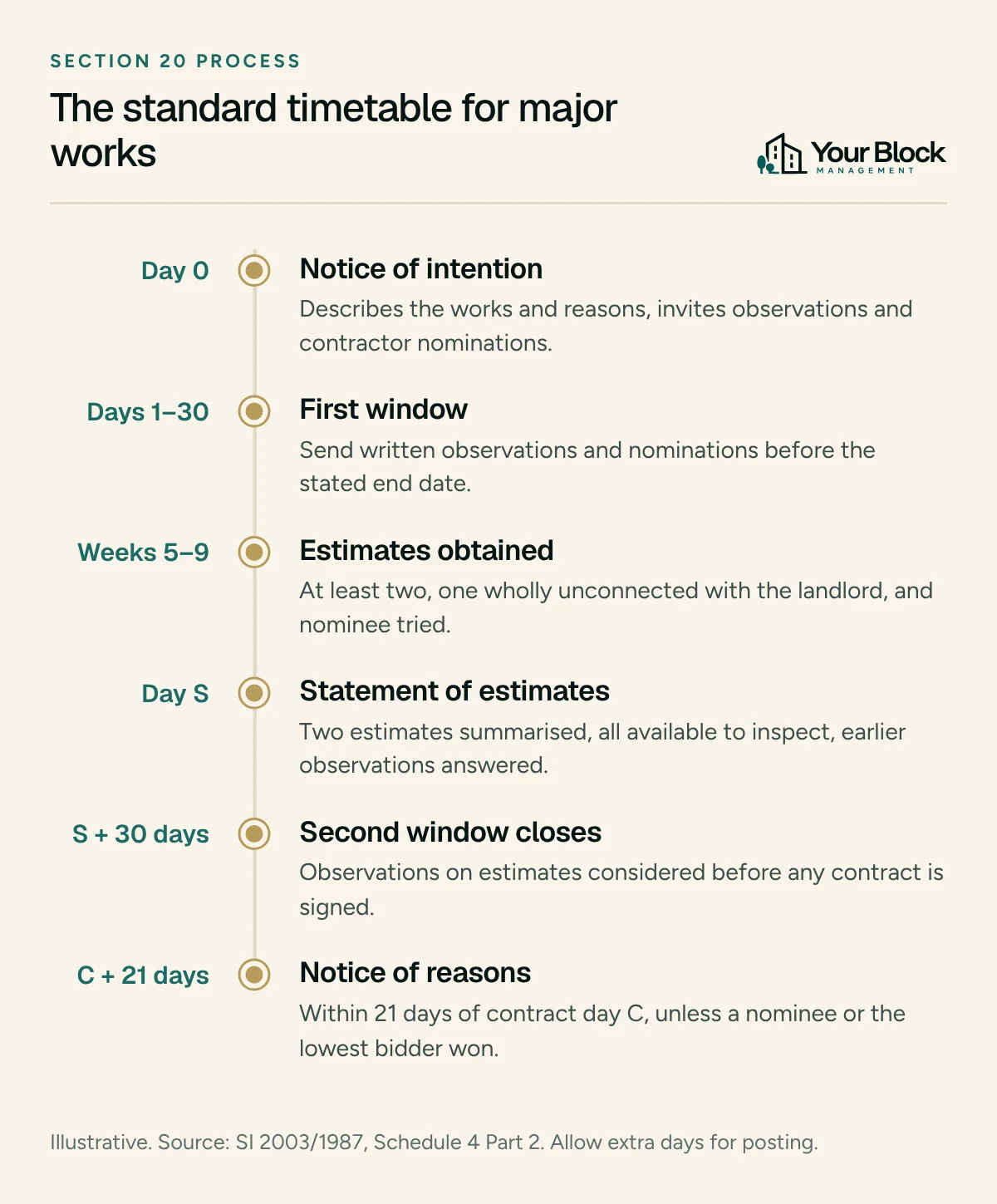
Days S+1 to S+30: the second observation window
What you can do: inspect every estimate, compare like with like (scaffolding, contingencies, prelims and VAT are common sources of difference), and send written observations. The landlord must have regard to them. Contracts shouldn’t be signed until this window has closed.
Contract day: the landlord chooses a contractor
Once the second window closes and observations have been considered, the landlord can enter into the contract. If the contract goes to a nominated contractor or to whoever submitted the lowest estimate, no further notice is needed and the formal consultation ends here.
Within 21 days of the contract: the notice of reasons
If the chosen contractor was neither a nominee nor the lowest estimator, the landlord must, within 21 days of entering into the contract, give each leaseholder and the RTA written notice of its reasons for the award (or say where they can be inspected), summarising and responding to observations from the second window. In our example, a contract signed on 15 February 2027 means reasons by 8 March 2027.
After consultation: works, demands and the final bill
Consultation doesn’t end your rights. Costs must still be reasonably incurred and the work of a reasonable standard (section 19 of the Landlord and Tenant Act 1985). Demands must come with the prescribed summary of rights and obligations (section 21B), and costs incurred more than 18 months before they are demanded are generally irrecoverable unless you were told in writing within that time (section 20B). If you dispute the bill, the First-tier Tribunal can decide what is payable under section 27A.
How long does the section 20 process take?
The two observation windows alone add up to 60 days. Add posting time, a few weeks for estimates and time to consider observations, and the Government’s own 2025 consultation said the process “takes at least three months”. In our illustrative timetable, the first notice goes out on 2 November 2026 and the last possible reasons notice is due on 8 March 2027, about 18 weeks later.
Common timing mistakes that put recovery at risk:
- Setting an end date that gives fewer than 30 days, especially when the notice is posted late.
- Signing the contract before the second window has closed.
- Treating the stages as one combined notice, so leaseholders never see estimates after nominating.
- Missing the 21-day deadline for the reasons notice.
- Letting the job change materially after consultation without consulting again.
Your leaseholder rights at each step
| Step | Your rights | Your deadline |
|---|---|---|
| Notice of intention | Inspect the description free; send observations; nominate a contractor | End of the first 30-day period |
| Estimates stage | Have your nominee approached under the nomination rules | Nomination must be made in the first period |
| Statement of estimates | See at least two estimates; inspect all of them; read the landlord’s response to your earlier observations; send observations | End of the second 30-day period |
| Notice of reasons | Be told why the contractor was chosen, with a summary of and response to observations | Landlord must send within 21 days of the contract |
| After the works | Request a summary of costs and inspect documents (sections 21 and 22); challenge reasonableness at the tribunal | No fixed deadline, but act promptly |
What you don’t have is a veto. Consultation gives you a voice and a record; it doesn’t let a majority stop necessary works.
Different routes, different clocks
Not every consultation follows the timetable above:
- Entering a long-term agreement (Schedule 1): a notice of intention with nominations, then at least two “proposals”, each with a 30-day window, and reasons within 21 days of the agreement if needed.
- Works under an existing long-term agreement (Schedule 3): a single notice with the estimated total cost and one 30-day window. The landlord must respond in writing within 21 days of receiving observations.
- Works needing public notice (Schedule 4, Part 1, mainly public bodies on large contracts): no nominations, and a landlord’s contract statement in place of the statement of estimates.
Our companion guide to the consultation rules your freeholder must follow sets out each notice set.
What if the works are urgent?
There is no emergency exemption from the section 20 process. A landlord facing genuinely urgent works can apply to the First-tier Tribunal for dispensation under section 20ZA, before or after the works. Since Daejan Investments Ltd v Benson [2013] UKSC 14, the tribunal focuses on whether leaseholders suffered real prejudice, and it can grant dispensation on terms. The practical approach is to make safe, tell leaseholders straight away, get competitive prices where possible and apply promptly. Our guide to what happens when consultation is skipped covers dispensation in detail.
Proposed changes to the section 20 process (not in force)
The Government’s consultation “Strengthening leaseholder protections over charges and services” (July to September 2025) put forward a package of proposals for the major works regime. They include:
- Raising the thresholds to £600 per leaseholder for works and £300 for long-term agreements.
- Mandatory standardised notice forms, with cost estimates, reserve fund use and timelines.
- Views on shortening both observation windows from 30 days to 21.
- A possible requirement for works to start within a fixed period (12 months was suggested) of the contract award, or consultation must be repeated.
- Allowing notices by email where the leaseholder agrees, with post remaining available.
- Consulting leaseholders directly where there is an intermediate landlord.
- Clearer grounds for dispensation, and a possible “majority dispensation” where a high proportion of leaseholders (85 to 90% was suggested) agree in advance.
In its response of 15 July 2026, the Government said the major works reforms would get a separate response “in due course”. None of these changes is in force, and the current 30-day periods and £250 and £100 thresholds still apply.
At Your Block, each consultation is run to a written timetable and every date, notice and observation is visible to residents in the resident portal. For RTM and RMC boards that carry the landlord’s duty, our director support includes drafting and tracking the notices.
Frequently asked questions
When does the 30-day period start?
Regulation 2 defines the relevant period as 30 days beginning with the date of the notice. LEASE says the tribunal has ruled that a posted notice should usually be treated as dated two working days after posting. Check the end date printed on the notice, and if it looks short once posting time is allowed for, raise it in writing straight away.
Can the landlord start the works before consultation finishes?
It shouldn’t enter into the contract until the second 30-day window has closed and observations have been considered. If it does, it risks the £250 per leaseholder cap unless the tribunal grants dispensation under section 20ZA. Genuinely urgent works are handled by applying for dispensation, not by skipping steps.
Do I have to pay before consultation is complete?
That depends on your lease. Many leases allow the landlord to demand reasonable sums on account before works, and section 19 limits advance payments to what is reasonable. Consultation affects how much can be recovered for the works. If you dispute a demand, consider paying under protest and asking the tribunal to decide under section 27A.
Has the section 20 process changed in 2026?
No. The 2025 consultation proposed higher thresholds, standard forms, shorter windows and dispensation changes, but on 15 July 2026 the Government said major works reforms would get a separate response in due course. Until new law is made and brought into force, the 2003 Regulations apply unchanged.
Sources and further reading
- Service Charges (Consultation Requirements) (England) Regulations 2003, Schedule 4
- Service Charges (Consultation Requirements) (England) Regulations 2003, regulation 2
- LEASE: Responding to Section 20 consultation
- GOV.UK: Strengthening leaseholder protections over charges and services (consultation)
- GOV.UK: Government response, 15 July 2026
This article is general information about the law in England, not legal advice. Leasehold law is changing, so check your lease and get professional advice for your own situation. Spotted something out of date? Tell us and we’ll fix it.