
Block Managing Agents: The Good, the Bad and the Ones to Sack Immediately
The habits of good agents, the bad habits that can be fixed, the red flags that cannot, and every route from complaint to Right to Manage.
 By Sam Charlesworth7 min read

The short version
- Most poor agents drift rather than misbehave; specific written feedback often fixes it.
- Red flags include missing accounts, skipped section 20 consultation, unexplained client money and ignored fire safety.
- Redress schemes can award compensation but cannot remove an agent or rule on service charges.
- The tribunal can appoint a manager under section 24 of the Landlord and Tenant Act 1987 after a preliminary notice.
- Right to Manage lets qualifying leaseholders take over and choose their own agent without proving fault.
Most block managing agents are neither heroes nor villains. The good ones answer, account and plan ahead. The mediocre ones drift. A few cross lines that justify ending the contract straight away: accounts that never appear, major works without section 20 consultation, client money nobody can explain, and fire safety duties ignored. Here is how to tell which you have, and what you can do about it.
This guide covers blocks in England. It focuses on behaviour: what agents actually do, week to week. For the full list of an agent’s duties, see our guide to what a managing agent is supposed to do for you.
What good block managing agents do
Good agents are not defined by glossy reports or apps. They show up in a handful of consistent habits:
- They reply. Emails get answered within a published timeframe, and when the answer is “we don’t know yet”, they say when they will know.
- They put things in writing. Decisions, quotes, visit notes and reasons for spending are recorded and shared, so nobody has to rely on memory.
- They plan. A planned maintenance schedule and a reserve fund mean the roof replacement is a line in a ten-year plan, not a surprise bill.
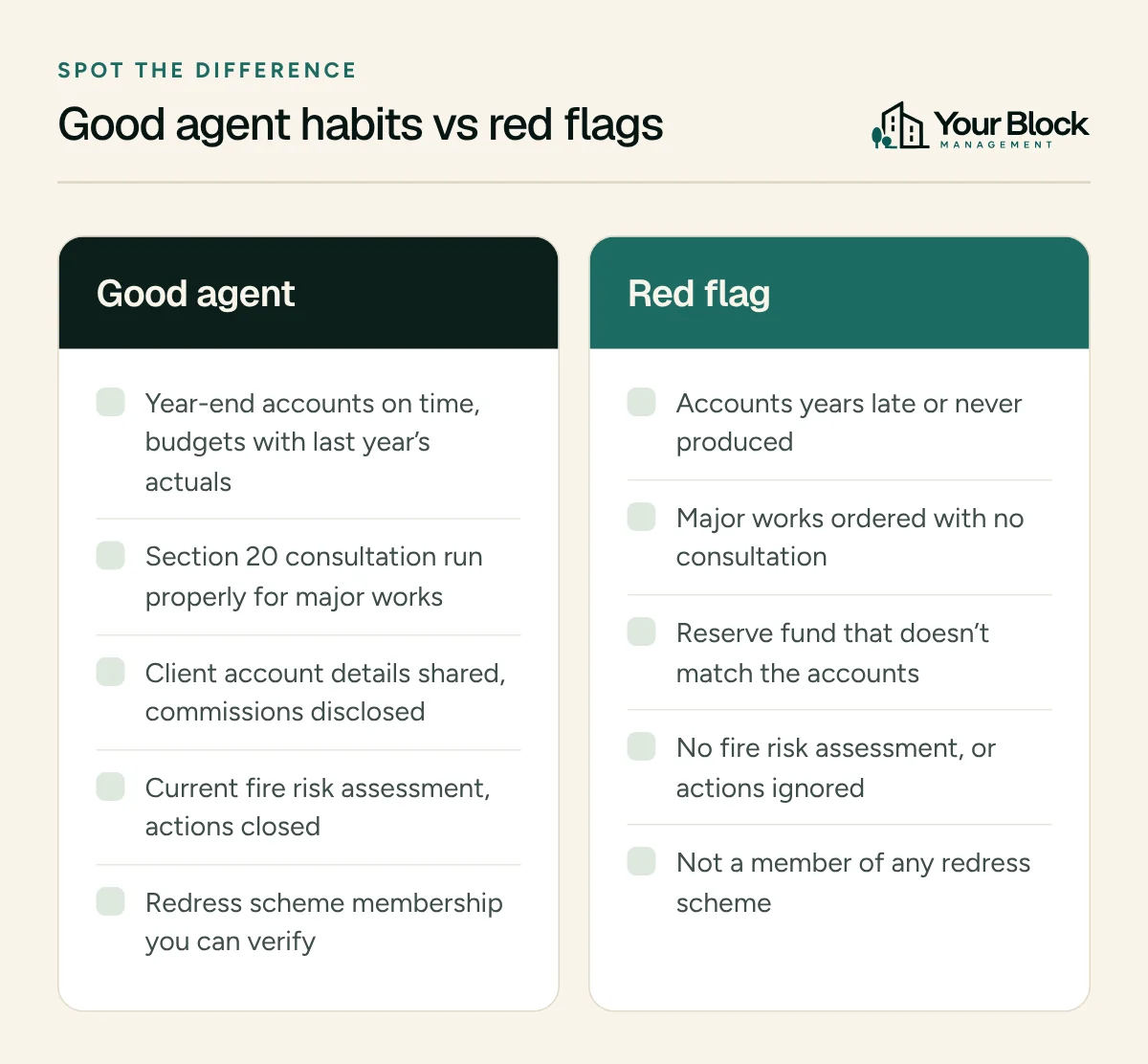
- They know the law and follow it without being asked. Demands come with the statutory summary of rights, major works go through consultation, and the fire risk assessment is current.
- They are open about money. Budgets show last year’s actual spending alongside, accounts arrive on time, and any commission is disclosed, or none is taken.
- They admit mistakes. Every agent gets things wrong. Good ones say so, fix it and explain what will change.
Bad habits: the agent who drifts
Most frustration with managing agents comes from habits that are poor but not catastrophic. They are worth raising firmly, because they tend to get worse if ignored, but they are usually fixable without changing agent:
- Slow or no replies, and a property manager who changes every few months.
- Repairs that are reported but never tracked, so residents report the same leak three times.
- Budgets that rise every year with no explanation beyond “inflation”.
- Site visits that happen, if at all, without any written record.
- Contractors chosen from the same small list year after year, with no evidence of market testing.
- Extra charges for things you assumed were included, such as attending the AGM.
Put specific examples in writing, ask for a response with dates, and review progress after a set period. A scored block management service checklist is a good way to make the conversation concrete rather than personal.
Red flags: when to sack block managing agents immediately
Some failures go beyond poor service. They expose leaseholders to real financial loss or safety risk, and they justify moving quickly.
Missing or years-late accounts
Without year-end accounts, nobody can check whether money was spent properly. Leaseholders can request a written summary of costs under section 21 of the Landlord and Tenant Act 1985 and then inspect receipts and invoices under section 22. Failing to comply without reasonable excuse is a criminal offence. Late accounts also create a section 20B problem: costs incurred more than 18 months before they are demanded cannot be recovered unless leaseholders were warned in writing within that time, so the building can end up absorbing them.
Major works without proper section 20 consultation
If any leaseholder’s share of works exceeds £250 and consultation was skipped or botched, recovery is capped at £250 per leaseholder unless the tribunal grants dispensation. An agent who repeatedly gets this wrong is putting your building’s money at risk. Our guide to the three stages of section 20 notices shows what a valid process looks like.
Client money nobody can explain
Service charge money is held on trust for leaseholders under section 42 of the Landlord and Tenant Act 1987. Warning signs include reluctance to say which bank account holds your funds, a reserve fund balance that does not match the accounts, unexplained transfers, or payments to connected companies that were never disclosed. Any of these justifies an immediate request for full bank statements, and professional advice if the answers do not add up.
Ignoring safety
The responsible person must have a written, current fire risk assessment of the common parts and act on it. In blocks over 11 metres, communal fire doors must be checked every quarter. An agent who cannot produce the fire risk assessment, has left high-priority actions open for months, or lets insurance lapse is exposing residents and directors to serious risk.
No redress scheme membership
Every business doing property management work in England must belong to The Property Ombudsman or the Property Redress Scheme. Check the scheme’s website. An agent that is not a member is breaking the law, and you will have no route to independent redress.
First, check who can actually remove the agent
A managing agent is a contractor to whoever has the management obligations. That decides your options:
- RTM, RMC or share of freehold company. The board can terminate under the management agreement. Most agreements have a notice period, typically around three months, and many allow immediate termination for serious breach. Check the clause before you act.
- Freeholder-managed block. Leaseholders cannot sack the freeholder’s agent directly. You can complain to the freeholder, use the routes below, and a recognised tenants’ association can require the freeholder to consult it about the agent’s performance under section 30B of the Landlord and Tenant Act 1985.
What you can do: from complaint to Right to Manage
1. Complain properly
Use the agent’s written complaints procedure, which every redress scheme member should have. Be specific: dates, what was promised, what happened, and what you want done. Keep copies. Most schemes will not look at a complaint until the agent’s own process has run its course. (For comparison, Your Block publishes its complaints procedure online.)
2. Go to the redress scheme
If the agent’s response is unsatisfactory, escalate to its redress scheme. The scheme can investigate and award compensation or require an apology or action. It cannot rule on whether a service charge is payable, and it cannot remove the agent.
3. Challenge charges at the tribunal
The First-tier Tribunal (Property Chamber) can decide whether service charges are payable and reasonable under sections 19 and 27A of the Landlord and Tenant Act 1985. You can also ask it to stop the landlord recovering its legal costs through the service charge under section 20C. Our guide to service charge disputes walks through typical outcomes.
4. Ask the tribunal to appoint a manager
Where the landlord is in breach of its management obligations, charges unreasonable amounts, or fails to follow the approved RICS management code, leaseholders can apply under section 24 of the Landlord and Tenant Act 1987 for the tribunal to appoint a manager of its choosing. Before applying, you must usually serve a preliminary notice under section 22 setting out the problems and giving a reasonable time to put them right. The tribunal will appoint only where it is just and convenient. It is a serious step, best kept for persistent failure.
5. Take over management
Leaseholders in a qualifying building can take over management through the Right to Manage, without proving any fault. Once the RTM company has acquired management, it chooses its own agent. Since 3 March 2025 RTM companies generally no longer pay the freeholder’s costs of the claim. Our guide to the Right to Manage explains the process, and the pros and cons of Right to Manage are worth reading before you start.
6. Switch at the end of the contract
If you control the appointment, the calmest route is often simply to serve notice and switch, using the handover clause in the agreement. Before the notice expires, line up the replacement using our guide to shortlisting and comparing residential block management companies, and see our switching FAQs for common snags.
If you do need to sack your agent immediately
When a red flag is serious enough to end the contract early, act carefully. Take advice on the termination clause. Write to the agent setting out the breaches and ending the agreement under the relevant clause. In the same letter, require the transfer of all funds, bank statements, accounts, contracts, insurance documents, fire risk assessments, keys and records by a specific date. Confirm the building is insured. Notify leaseholders of the new arrangements and where to pay. If money is missing, get professional advice quickly and consider reporting to the redress scheme and, where fraud is suspected, the police.
Most of the time, though, the right response to a disappointing agent is clear, written feedback and a fair chance to improve. Keep the most decisive options for agents who have shown they will not.
Frequently asked questions
Can leaseholders sack the managing agent?
Only if the leaseholders control the company that appoints it, such as an RTM company, RMC or share of freehold company, whose board can terminate under the management agreement. In freeholder-managed blocks, the agent works for the freeholder. Leaseholders can complain, use the redress scheme, apply to the tribunal, or exercise the Right to Manage.
What can the Property Ombudsman do about a bad managing agent?
The Property Ombudsman and the Property Redress Scheme can investigate complaints about member agents and award compensation or require action, usually once the agent’s own complaints process is complete. They cannot decide whether service charges are payable, which is for the First-tier Tribunal, and they cannot remove an agent from a building.
What is a section 24 appointment of manager?
Under section 24 of the Landlord and Tenant Act 1987, the First-tier Tribunal can appoint a manager to run a block where the landlord has breached management obligations or charged unreasonable amounts and it is just and convenient. Leaseholders normally must first serve a preliminary notice under section 22 giving a chance to put things right.
How much notice do we need to give a managing agent?
Whatever the management agreement says. Around three months is common. Many agreements also allow immediate termination for serious breach, such as failing to account for money. Read the termination and handover clauses before serving notice, and line up a replacement agent so the building is never left unmanaged or uninsured.
Sources and further reading
- Landlord and Tenant Act 1987, section 24 (appointment of manager)
- Landlord and Tenant Act 1987, section 42 (service charge contributions held in trust)
- Landlord and Tenant Act 1985, section 27A (tribunal jurisdiction over service charges)
- Redress Schemes for Lettings Agency Work and Property Management Work Order 2014
This article is general information about the law in England, not legal advice. Leasehold law is changing, so check your lease and get professional advice for your own situation. Spotted something out of date? Tell us and we’ll fix it.