
Block Management Company London vs Local Agents: Why Location Matters More Than You Think
Big London firms bring scale and specialists. Local agents bring proximity. Here’s how to tell which your building actually needs.

The short version
- Desk work can be done from anywhere; inspections, contractors and meetings depend on someone reaching your building.
- Large firms suit high-rise, mixed-use and remediation-heavy buildings with complex compliance duties.
- For small and mid-sized blocks outside London, a competent local agent usually gives better day-to-day service.
- Compare full fee schedules, not headline per-unit prices, and ask about commission in writing.
- Whoever you choose, ask how many buildings your named manager runs.
Is a block management company London-based better than a local agent for a building in Suffolk or Essex? A large London firm can bring deep specialist teams, which matters for high-rise, very large or complex blocks. For most small and mid-sized blocks outside London, though, a well-run local agent who can reach the building quickly will usually deliver better day-to-day management.
That’s not a knock on London firms. Plenty manage well. It’s about what block management actually involves day to day, and how much of it depends on someone being able to get to your building. This guide sets out the honest trade-offs, when a big firm genuinely makes sense, and what to check with any agent, wherever its office is.
Does it matter where your block management company is based?
More than most boards expect. A lot of block management is desk work: budgets, demands, accounts, insurance renewals, section 20 consultation. That can be done from anywhere. But the parts that residents notice most are physical:
- someone walking the common parts and spotting the blown light, the propped fire door or the gutter starting to overflow;
- a contractor turning up promptly to a leak and the agent checking the work was done;
- meeting a surveyor on site, or attending an AGM in the evening;
- knowing which local trades are reliable and which council department deals with what.
The RICS Service Charge Residential Management Code (4th edition, in force since 7 April 2026) applies to every managing agent in England, wherever it’s based. It expects competence, transparency and value for money. How often the agent visits and how fast it responds are set by your management agreement, so distance shows up in what an agent is willing to commit to in writing.
What large London-based firms often do well
Big firms, many of them headquartered in London, have real strengths. In fairness, these include:
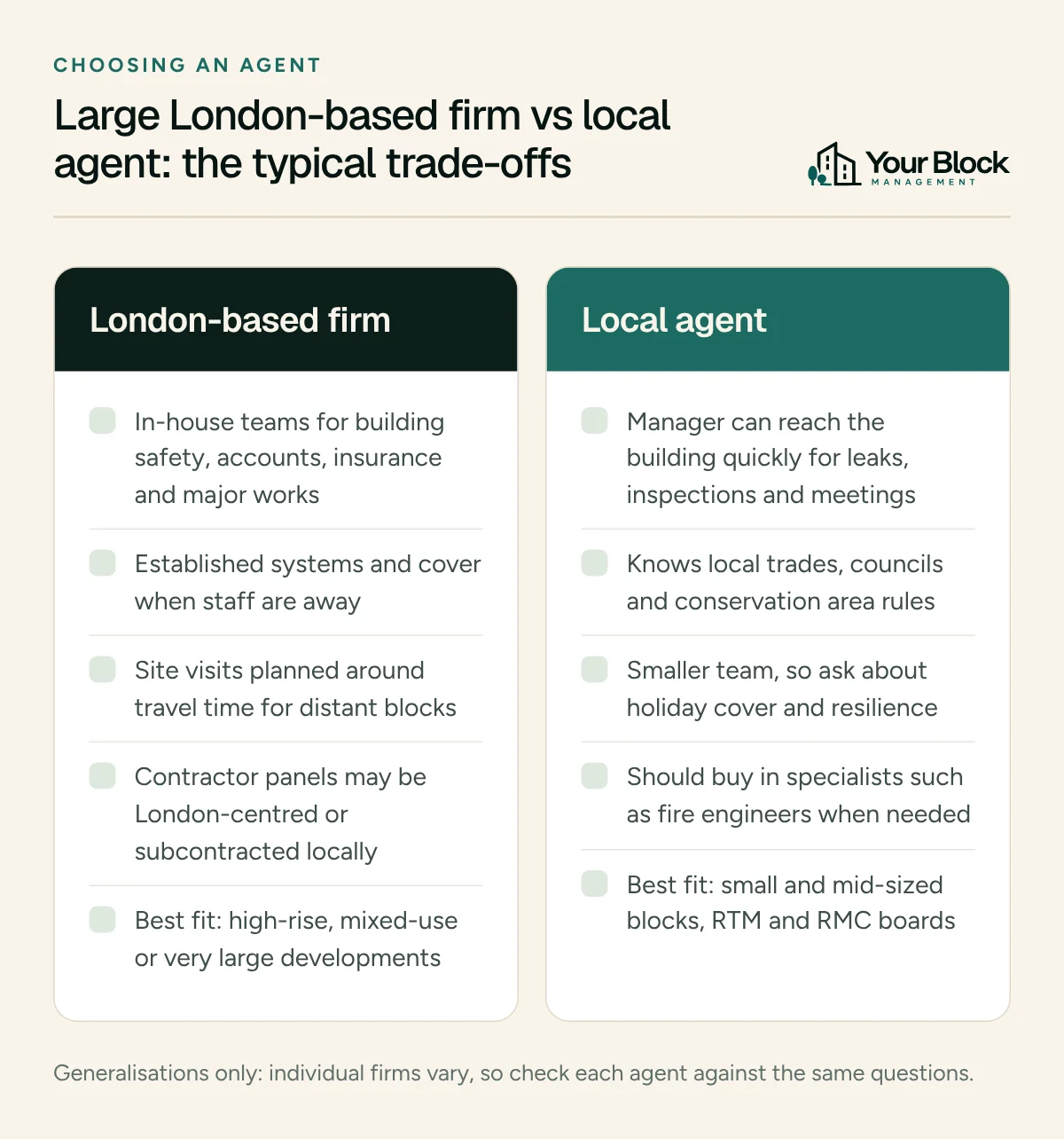
- In-house specialists. Dedicated teams for building safety, accounts, insurance, major works and company secretarial work, rather than one manager doing everything.
- Systems and resilience. Established software, out-of-hours cover and colleagues to step in when a manager is ill or leaves.
- Experience with complex buildings. High-rise blocks, mixed-use schemes with shops below, large estates with several landlords, and buildings going through cladding remediation.
- Buying power. Larger contractor and insurance relationships, though you should always check whether that benefit reaches your service charge or the agent’s income.
Where distance shows up for blocks outside London
Site visits
If your block is a two-hour round trip from your property manager’s office, every visit has a cost in time. That doesn’t mean visits won’t happen, but it affects how often they are scheduled and whether someone will pop in between visits. Ask exactly how many inspections a year are included and who carries them out. Some firms outside their home patch use regional staff or third-party inspectors; that can work, but you should know.
Contractor networks
A firm’s approved contractor list is often built around where most of its buildings are. For a block in Sudbury or Clacton, that can mean either a London contractor charging travel time or a local subcontractor the agent has never met. A local agent’s contractor network should already include trades who know the area’s housing stock and can be on site the same day.
Response times
For a burst pipe in the roof void, what matters is how quickly a competent contractor is on site and whether someone at the agent is chasing it. Ask any agent what its emergency process is, who you can actually reach out of hours, and what written response targets it commits to.
Local knowledge
Planning and listed building rules, conservation areas, bin collection arrangements, parking enforcement and highways all sit with local councils. In Suffolk and Essex that means working with a range of district and city councils, some with historic town centres and conservation areas where even replacement windows or a new door entry panel can need consent. An agent who already knows the local officers and processes will usually get there faster.
Portfolio size and staff turnover
The single best predictor of service is often the number of buildings your property manager personally looks after, and how long they stay. This applies to large and small firms alike. Ask directly: how many blocks does the named manager run, and how long have they been in post?
Cost: is a London firm more expensive?
Not necessarily, and there’s no reliable independent survey of management fees by region, so be wary of anyone who claims one. What differs is usually the structure of the fee rather than the headline:
- Base fee: usually quoted per flat per year, plus VAT. Compare it on a like-for-like scope.
- Extras: fees for section 20 projects (often a percentage of the contract value), company secretarial work, extra site visits, out-of-hours calls, attending more than one meeting a year, and administration charges paid by individual leaseholders.
- Travel: check whether site visits or meeting attendance outside a set number carry mileage or time charges.
- Commission: ask whether the agent receives commission on insurance or contractor work. The FCA hasn’t banned insurance commission, but insurers must disclose it, and leaseholders can ask the insurer directly.
Ask every agent for a full schedule of charges, not just the per-unit figure. Our guide to shortlisting and comparing block management companies includes a side-by-side checklist.
When a London block management company genuinely makes sense
Be honest about your building. A large firm, London-based or otherwise, is often the better fit where:
- the building is a higher-risk building (at least 18m or 7 storeys with 2 or more homes), with Building Safety Act duties such as the safety case report, resident engagement strategy and golden thread of information;
- it’s a large or mixed-use development with commercial units, car parks, lifts and plant;
- it’s going through major cladding remediation with multiple funders and contractors;
- the freeholder owns a portfolio across the country and wants one agent for all of it.
For a 6 to 30-flat block in Colchester, Chelmsford, Ipswich or a market town, those advantages are rarely decisive, and the practical benefits of being close tend to win.
What to look for in any agent, London or local
Whether you’re in Hackney or Halstead, these questions separate good agents from the rest:
- Who is our named property manager, how many buildings do they run, and can we meet them?
- How many site inspections are included, and will we see a written report each time?
- What are your written response times for routine and emergency issues?
- Which redress scheme are you a member of? (Membership of The Property Ombudsman or the Property Redress Scheme is compulsory for property management work in England.)
- Is service charge money held in a separate client account, and how is interest dealt with?
- Do you take commission on insurance or contractors, and will you disclose it in writing?
- What exactly is excluded from the base fee? Please list every additional charge.
- How do residents report repairs and see progress?
- How do you track fire risk assessments, fire door checks, insurance renewal and lift inspections?
- What happens to our records and money if we leave, and what notice period applies?
Our checklist of what a good block management service looks like and our guide to independent agents versus the big national firms go into each of these in more depth.
Local shouldn’t mean small-time
The flip side: a local agent should still be able to show the professional basics. That means redress scheme membership, professional indemnity insurance, a written complaints procedure, a client account, management agreements that follow the RICS Code, and access to specialists such as fire risk assessors, building surveyors and accountants when your building needs them. Proximity is an advantage only if it comes with competence.
At Your Block we’re based in Great Horkesley, near Colchester, and we only take on buildings across Essex and Suffolk so that a named managing director can get to each one. If you’re weighing up a move, our FAQs on switching managing agent explain how the handover works, and our guide to changing managing agent step by step covers notice periods and pitfalls.
Frequently asked questions
Can a London managing agent manage a block in Essex or Suffolk?
Yes. There is no rule limiting where an agent operates, and many London firms run buildings across the South East. The question is how they cover site inspections, emergencies and contractors at a distance. Ask how many visits are included, who carries them out and which contractors they use locally.
Are London managing agents more expensive?
Not necessarily. There is no reliable independent survey of block management fees by region. The bigger differences tend to be in what the base fee covers and what is charged as extras, such as section 20 fees, extra meetings, travel and company secretarial work. Ask every agent for their full schedule of charges.
What size of block suits a large national or London firm?
Large firms tend to suit higher-risk buildings of 18m or 7 storeys and above, big mixed-use schemes, estates with lifts and plant, and buildings in complex remediation. Small and mid-sized blocks of around 6 to 30 flats often benefit more from a local agent who can visit regularly.
Do managing agents have to be regulated?
Not yet in the full sense. Agents doing property management work in England must belong to a government-approved redress scheme, and the RICS Code applies to them. On 29 September 2026 the Government announced plans for licensing, qualifications and an independent regulator, but there is no legislation or start date yet.
Sources and further reading
This article is general information about the law in England, not legal advice. Leasehold law is changing, so check your lease and get professional advice for your own situation. Spotted something out of date? Tell us and we’ll fix it.