
What a Good Block Management Service Looks Like in 2026 (Use This Checklist)
Twenty-four checks across six areas, each with what good looks like and the warning sign to watch for. Score your agent in 20 minutes.
 By Sam Charlesworth7 min read

The short version
- Score your agent on 24 checks across six areas: 2 for good, 1 for partly, 0 for a warning sign.
- Any zero in finance or compliance is serious, whatever the total score.
- Demands without the statutory summary of rights can lawfully be withheld until it is served.
- Buildings over 11 metres need quarterly communal fire door checks, not annual ones.
- Check the handover clause in your management agreement now, while relations are good.
A good block management service in 2026 does six things well. It communicates promptly and on the record, accounts for every pound openly, fixes repairs to a clear timetable, keeps the building legally compliant, supports the directors or freeholder with governance, and would hand over cleanly if you left. The scored checklist below lets you test your own agent in about 20 minutes.
It is written for RTM and RMC directors, freeholders and leaseholders in England. If you want background first, read what a managing agent is supposed to do. This post is the practical test.
How to use this block management service checklist
There are 24 checks across six areas. Score each one:
- 2 points: your agent clearly does what the “good” column describes.
- 1 point: partly, sometimes, or you are not sure.
- 0 points: you recognise the warning sign.
The maximum is 48. Score each area separately too, because a high total can hide one area that is failing badly, and a single serious failure in finance or compliance matters more than several small communication niggles. Where a check is a legal requirement, we say so. The scoring bands at the end are our own rule of thumb, not an industry standard.
Gather a few things before you start: the last two service charge demands, the latest year-end accounts, the current budget, the insurance summary, the most recent fire risk assessment and your management agreement. If you cannot get hold of these easily, that tells you something already.
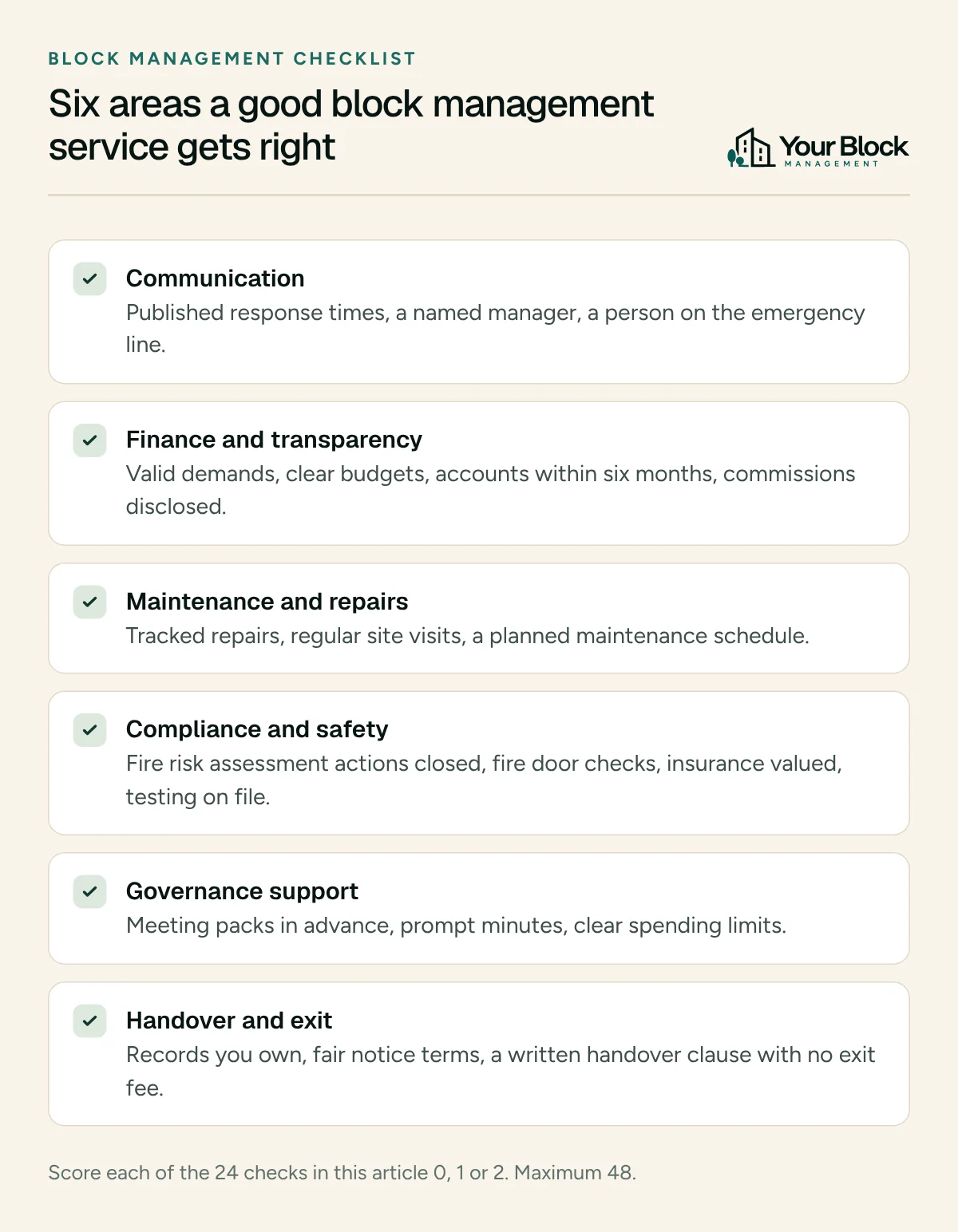
1. Communication and responsiveness
| Check | Good looks like | Warning sign |
|---|---|---|
| Response times | Published targets, for example a reply to emails within two working days, and they are met. | No targets, or emails that need chasing two or three times. |
| A named, accountable person | You know who your property manager is, and they know your building without looking it up. | A different person every time, or a generic inbox with no name attached. |
| Emergency cover | A 24-hour number answered by a person who can authorise a contractor. | An answerphone out of hours, or no idea what happens at 2am. |
| Updates to residents | Residents hear about works, visits and decisions before they happen, in plain English. | Scaffolding appears without warning; residents find out from each other. |
Communication is where most complaints start, but it is also the easiest area to fix. A shared online record helps a lot: if repairs, updates and replies are visible to everyone, nobody has to ask twice. That is why every resident in a block we manage gets a resident portal login to report repairs and follow them through.
2. Finance and transparency
| Check | Good looks like | Warning sign |
|---|---|---|
| Valid demands | Every service charge demand includes the landlord’s name and address and the statutory summary of rights and obligations. | Demands without the summary, which under section 21B of the Landlord and Tenant Act 1985 you may lawfully withhold until it is served. |
| Budget you can follow | A budget with clear headings, last year’s actual figures alongside, and the reasons for any increase. | A single total figure, or rises of 15% or more with no explanation. |
| Timely year-end accounts | Accounts issued within six months of the year end, with any independent examination or audit the lease requires. | Accounts years late, or bills for costs more than 18 months old without a prior written warning under section 20B. |
| Client money and commission | Funds held in a designated client account in trust under section 42 of the Landlord and Tenant Act 1987; all commissions disclosed or none taken. | Vague answers about where money is held, or commissions you only discover by asking the insurer. |
Finance is the area where a low score matters most. Late accounts are not just irritating: they make it impossible to check whether charges were reasonable. Our guide to where every pound of your service charge goes shows how to read the numbers.
3. Maintenance and repairs
| Check | Good looks like | Warning sign |
|---|---|---|
| Repair reporting and tracking | Every report gets a reference, a priority and a target date, and you can see progress. | Reports vanish; residents re-report the same issue for months. |
| Regular site visits | Visits at an agreed frequency, with a short written report of what was checked and found. | No visits you know of, or visits that produce no record. |
| Planned maintenance | A planned maintenance schedule looking five to ten years ahead, linked to the reserve fund. | Everything is reactive; big bills arrive as surprises. |
| Major works done properly | Section 20 consultation run correctly whenever a leaseholder’s share of works would exceed £250. | Large works ordered without consultation, or notices that skip a stage. |
On the last point, failing to consult caps recovery at £250 per leaseholder unless the tribunal grants dispensation, so poor process here costs the building real money. See our explainer on how section 20 consultation works.
4. Compliance and building safety
| Check | Good looks like | Warning sign |
|---|---|---|
| Fire risk assessment | A written fire risk assessment of the common parts, reviewed regularly and after significant changes, with actions tracked to completion. | An assessment several years old, or a list of actions nobody has closed. |
| Fire door checks (blocks over 11m) | Quarterly checks of communal fire doors and annual best-endeavours checks of flat entrance doors, as the Fire Safety (England) Regulations 2022 require. | No record of checks, or no one knows the building’s height. |
| Insurance | Reinstatement value assessed within the last few years, a plain-English summary circulated at each renewal. | No one knows when the building was last valued, or what the excess is. |
| Statutory testing and records | A compliance calendar covering lifts, fire alarms, emergency lighting, water hygiene and electrical testing, with certificates on file. | Dates kept in someone’s head; certificates missing when a buyer’s solicitor asks. |
The law does not set a fixed frequency for fire risk assessment reviews, but it does require them to be kept under review and recorded in writing. Our guide to fire risk assessments for flats explains what yours should cover.
5. Governance support for directors and freeholders
| Check | Good looks like | Warning sign |
|---|---|---|
| Meeting packs | Agendas, reports and finance updates circulated a week before board meetings and AGMs. | Directors walk into meetings with nothing to read, or the agent does not attend. |
| Decisions recorded | Draft minutes within a fortnight, with actions, owners and deadlines. | Decisions forgotten or re-made at the next meeting. |
| Company secretarial | Companies House filings, members’ register and confirmation statements kept up to date (if this is in the agreement). | Late filing penalties or a company struck off. |
| Clear authority limits | Written limits on what the agent can spend without approval, and approvals logged. | Spending first and telling directors afterwards. |
For volunteer directors, governance support is often the difference between a board that copes and one that resigns. Our page for RTM and RMC directors sets out what we think good support looks like.
6. Handover and exit
| Check | Good looks like | Warning sign |
|---|---|---|
| Records you own | Leases, contracts, accounts, safety documents and correspondence held in an organised, exportable form. | Records held only in the agent’s systems, with no clear way to get them out. |
| Fair notice terms | A reasonable notice period, usually around three months, and the right to end the contract for serious breach. | Long lock-ins with automatic renewal and penalty clauses. |
| Handover clause | A written handover obligation: funds, records, keys and contracts transferred within a fixed period, with no exit fee. | Handover fees, or vague wording such as “reasonable assistance”. |
| Smooth past handovers | References from blocks that left say the handover was clean and quick. | Stories of reserve funds taking months to arrive. |
Most people never test this area until it is too late. Check your management agreement now, while relations are good.
Scoring your agent and what to do next
Whatever your score, share it. Send the completed checklist to your agent and ask for a written response within 28 days. Good agents welcome specific feedback. If the response is defensive or vague, that is useful information too.
If you decide to look elsewhere, our step-by-step guide to shortlisting and comparing residential block management companies takes you through the process, and our guide to good and bad block managing agents covers when poor service becomes grounds to end the contract early. For a broader overview of how a building should be run, see our block management guide.
Frequently asked questions
What should a block management service include?
At minimum: collecting service charges and managing the budget, producing year-end accounts, arranging repairs and maintenance, running section 20 consultations for major works, keeping fire safety and insurance up to date, and communicating with leaseholders. Many services also include support for RTM or RMC directors such as meeting packs and company secretarial work, though this is sometimes charged extra.
How quickly should a managing agent reply to emails?
There is no legal standard. A reasonable expectation is an acknowledgement within one or two working days and a substantive answer, or a date for one, within about five. What matters most is that the agent publishes its targets and meets them. Emergencies such as leaks or failed door entry need a same-day response.
How often should a managing agent visit the building?
It depends on the size and complexity of the block and what the management agreement says. For a small block, monthly or quarterly visits are common. The key is an agreed frequency and a written note of each visit, so directors and residents can see what was checked and what follow-up is needed.
What can we do if our block management service scores badly?
Put the specific failings to your agent in writing and ask for a response with dates. If that fails, use its complaints procedure and then its redress scheme. Directors can also give notice under the management agreement and appoint a new agent. Leaseholders in freeholder-managed blocks have tribunal and Right to Manage options.
Sources and further reading
This article is general information about the law in England, not legal advice. Leasehold law is changing, so check your lease and get professional advice for your own situation. Spotted something out of date? Tell us and we’ll fix it.