
Block Management Explained: What You're Actually Paying For (And What You Should Be Getting)
The management fee and the service charge are not the same thing. Here is what each should buy, where extra costs hide and how to tell if your block gets value.

The short version
- The management fee pays the agent; the service charge pays for the building, with the fee as one line in it.
- What the fee covers depends entirely on your management agreement, so read it.
- A management contract over 12 months costing any leaseholder over £100 a year needs section 20 consultation.
- Insurance commission is not banned, but you can ask for it to be disclosed.
- Judge value by total spend and service, not by the lowest fee.
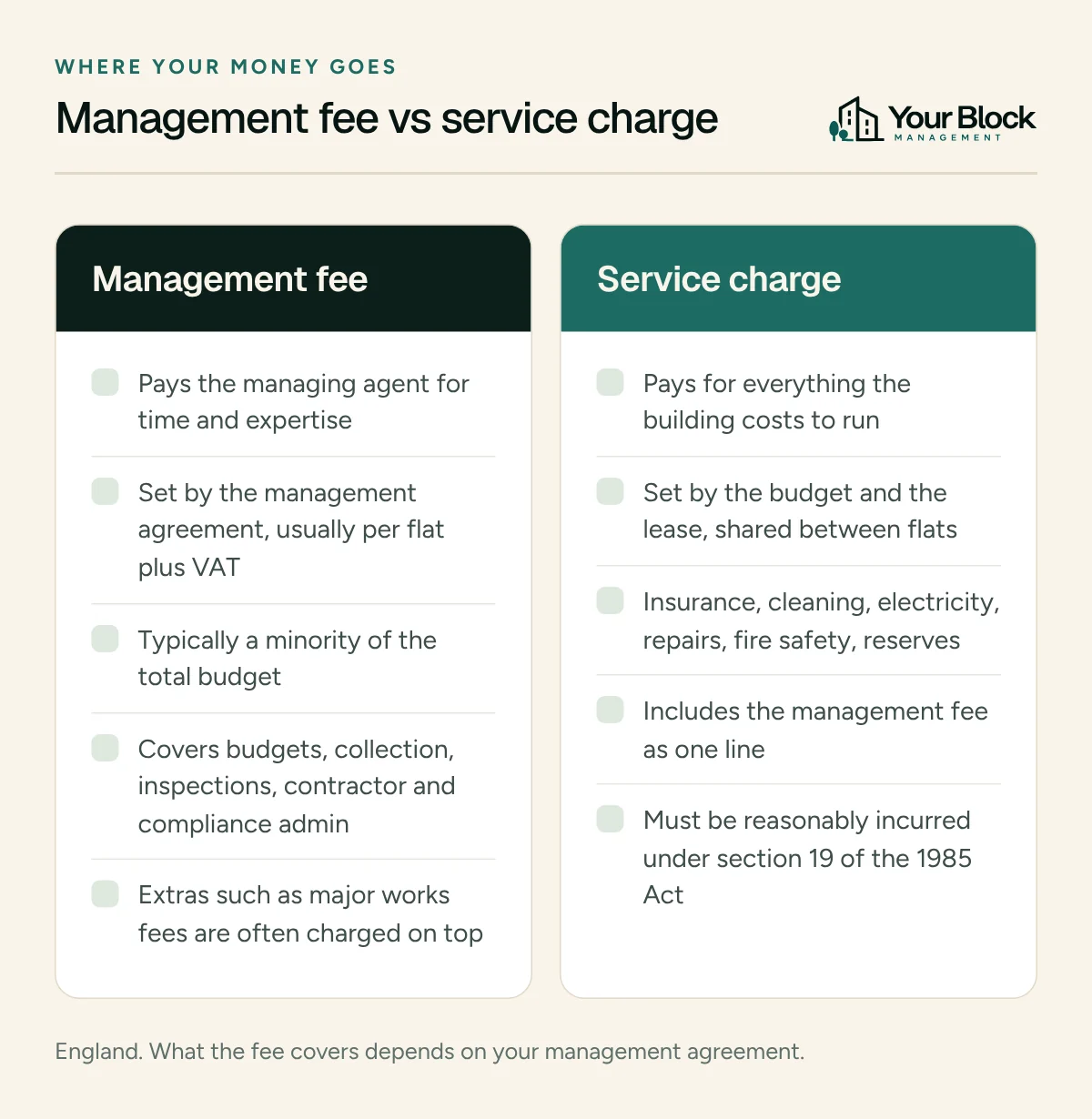
Block management is paid for in two very different ways. The management fee pays the managing agent for its time and expertise. The service charge pays for everything the building actually costs to run, from insurance to cleaning to the roof fund, and the fee is just one line within it. Knowing which is which is the fastest way to judge whether you are getting value.
This guide is about the money: what the fee should buy, what tends to cost extra, the red flags, and how to tell whether your block is getting a good deal. It applies to leasehold blocks in England.
Management fee vs service charge: two bills in one demand
When your service charge demand arrives, it usually shows one total. Inside it are two kinds of cost that need judging in different ways.
- The building’s running costs are set by what the block needs and by the market: an insurance premium, a cleaning contract, the electricity for the stairwell lights, a contribution to the reserve fund.
- The management fee is set by the management agreement between the agent and its client, which is the freeholder, an RTM company or a residents’ management company (RMC). It is usually a fixed annual sum per flat, plus VAT.
Both count as service charge costs in law, so both must be reasonably incurred under section 19 of the Landlord and Tenant Act 1985. A cheap fee does not excuse poor spending of the other 80 to 90 per cent, and an expensive fee can be justified if it saves the block money elsewhere.
A worked example (illustrative)
Take a 12-flat block with an annual budget of £28,800, which averages £2,400 per flat. That is close to the £2,405 average Hamptons found in its 2025 Service Charge Index for flats in England and Wales. Suppose the agent charges £300 per flat plus VAT.
- Management fee: 12 × £300 = £3,600, plus £720 VAT = £4,320, or £360 per flat.
- Everything else: £28,800 − £4,320 = £24,480, or £2,040 per flat.
In this example the fee is about 15% of the budget. If better tendering and tighter control trimmed just 10% from the other costs, that would save £2,448 a year, more than half the fee. That is why the cheapest quote is rarely the best value.
What does the block management fee usually cover?
There is no statutory list. What the fee covers is whatever your management agreement says, and agreements vary a lot. The RICS Service Charge Residential Management Code, 4th edition, which has applied in England since 7 April 2026, puts new emphasis on clear terms of engagement, so a modern agreement should spell out what is in and out.
Services that are commonly included in the fixed annual fee:
- Preparing the annual budget and issuing service charge demands.
- Collecting service charges and chasing routine arrears (early reminder letters, not legal action).
- Holding funds in a client account and paying contractors.
- Preparing year-end figures for the independent accountant.
- A set number of routine site inspections each year.
- Arranging and supervising routine repairs and service contracts such as cleaning, gardening and lift maintenance.
- Arranging buildings insurance and keeping the policy documents.
- Tracking compliance dates: fire risk assessment, fire equipment, lift and electrical checks.
- Answering routine correspondence from leaseholders and residents.
- Attending one annual meeting.
Check your management agreement for the specifics: how many inspections, how quickly they reply, whether evening meetings cost extra, and the notice period to end the contract.
What block management costs extra?
This is where the real cost of an agent often hides. Items commonly charged on top of the fixed fee include the following. Who pays depends on the item.
| Item | Usually paid by | What to check |
|---|---|---|
| Section 20 major works administration | All leaseholders, via the service charge | Often a percentage of the contract value. Is it on top of a surveyor’s fee for the same work? |
| Extra meetings and directors’ meetings | Service charge | How many are included, and the hourly rate after that. |
| Insurance claims handling | Service charge or the claim itself | Whether a fee is taken from the claim, and how much. |
| Company secretarial work for an RTM or RMC | Service charge | Confirmation statements, accounts filing, register of members. |
| Arrears recovery beyond reminders | Usually the defaulting leaseholder, if the lease allows | Fixed fees per letter or stage, and when solicitors are instructed. |
| Leasehold sale packs and consents | The individual leaseholder | A published fee schedule for packs, licences, pets and alterations. |
| Tribunal and legal work | Service charge, if the lease allows | Leaseholders can ask the tribunal under section 20C to block recovery. |
Charges billed to you personally under your lease, such as permission and consent fees, are administration charges. Variable administration charges must be reasonable under Schedule 11 of the Commonhold and Leasehold Reform Act 2002. On 29 September 2026 the Government announced powers to cap permission, administration and document fees, with details to go to consultation. That is not yet law.
What does the service charge pay for?
The rest of the budget goes on the building itself. Typical headings in a small or medium block are:
- Buildings insurance, often the biggest single line.
- Cleaning, window cleaning and gardening contracts.
- Communal electricity for lighting, door entry and any lift.
- Fire safety: the fire risk assessment, alarm and emergency lighting servicing, fire door checks.
- Lift maintenance and the statutory thorough examination, where there is a lift.
- Repairs and maintenance, both routine and reactive.
- Reserve fund contributions towards future major works, if the lease allows.
- Accountancy for the independent check of the year-end accounts.
- The management fee itself.
Our service charge guide goes through each heading and how to check the figures, and our guide to block management insurance explains how cover should be arranged and what to ask at renewal.
Red flags in block management fees
None of these is automatically unlawful, but each should prompt a question.
Undisclosed commission
Agents and freeholders can still be paid commission on buildings insurance: the FCA did not ban it. But since 31 December 2023, FCA rules treat leaseholders as customers, and insurers must provide pricing and commission information that can be passed to leaseholders, or directly to you on request. Commission limits in the Leasehold and Freehold Reform Act 2024 are not yet in force. If your agent is vague about what it earns from the policy, ask in writing.
Contractors linked to the agent
An in-house maintenance team or a connected contractor is not wrong in itself, but you should be told about the connection. For works needing section 20 consultation, at least one estimate must come from a contractor wholly unconnected with the landlord.
A long contract nobody consulted on
This one catches many blocks. A management agreement lasting more than 12 months is a qualifying long-term agreement. If any leaseholder’s share of its cost is more than £100 in an accounting period, the landlord must consult under section 20 before signing. Otherwise, without tribunal dispensation, each leaseholder’s contribution is capped at £100 a year. With per-flat fees of £250 or more, almost every multi-year agreement crosses that line. See our guide to section 20 notices for how consultation works.
Fees for things that should be routine
Charges for answering a leaseholder’s email, issuing a duplicate demand or “reviewing” a repair report suggest the fixed fee covers very little. Compare the agreement with what is actually being billed.
Late or vague accounts
Year-end accounts that arrive very late, or that lump costs into “sundries” or “general repairs” with no detail, make value impossible to judge. Costs demanded more than 18 months after they were incurred are generally irrecoverable under section 20B unless you were warned in writing.
Money not held properly
Service charge money, including reserve funds, is held on trust under section 42 of the Landlord and Tenant Act 1987. Ask which account it is in, whether it is separate from the agent’s own money, and who receives any interest.
How to judge whether your block management is good value
Value is not the lowest fee. It is what the block gets for its total spend. Ask these questions once a year:
- Budget vs actual: how close was last year’s spending to the budget, and are differences explained?
- Tendering: when were insurance, cleaning and other contracts last tested against the market, and how many quotes were obtained?
- Response: how long did repairs take from report to completion? Ask the agent for the log.
- Compliance: are the fire risk assessment and all safety checks up to date?
- Extras: how much was billed outside the fixed fee, and for what?
- Communication: do residents know what is happening without having to chase?
You have legal tools to get this information. Under section 21 of the 1985 Act you can ask for a written summary of costs, and under section 22 you can inspect the accounts, receipts and other documents behind it. Under section 30A you can ask for a summary of the insurance cover.
For a wider test of service quality, see our checklist for a good block management service, and for the warning signs in an agent’s behaviour, our guide to good and bad block managing agents.
What to do if you are not getting value
If you are a director of an RTM company or RMC, you are the agent’s client. Raise the issues formally, give the agent a chance to fix them, and check the notice period in the agreement. If you decide to move, our guide to shortlisting and comparing residential block management companies explains how to run a fair comparison. Our FAQs on switching managing agent cover handover.
If your block is managed for an outside freeholder, you can complain to the agent, then to its redress scheme (The Property Ombudsman or the Property Redress Scheme), and challenge specific charges at the First-tier Tribunal under section 27A. If the management itself is the problem, Right to Manage lets qualifying leaseholders take over without buying the freehold.
At Your Block we publish what our fee includes, we say we do not take commission on insurance or contractors, and every resident can see budget against actual spending in our portal. You can read how our pricing works before you ask for a proposal.
Frequently asked questions
How much does block management cost per flat?
There is no official benchmark. One managing agent, Ringley, quotes roughly £250 to £500 per unit per year plus VAT, which gives an indication. The fee depends on block size, services, lifts, number of meetings and what the agreement includes, so compare what is covered as well as the headline price.
Is the managing agent’s fee part of the service charge?
Yes, in most leases the management fee is recovered through the service charge as one of the building’s costs. That means it must be reasonable under section 19 of the Landlord and Tenant Act 1985, and leaseholders can challenge it at the First-tier Tribunal if it is not.
Can I see the management agreement?
Ask for it. If your block has an RTM company or RMC, members can usually ask the directors. Leaseholders can also use section 22 of the Landlord and Tenant Act 1985 to inspect documents supporting service charge costs, which can include the agreement behind the management fee.
Does a managing agent need to consult before signing a long contract?
If the agreement lasts more than 12 months and any leaseholder would contribute more than £100 in an accounting period, it is a qualifying long-term agreement and section 20 consultation is required. Without consultation or tribunal dispensation, recovery is capped at £100 per leaseholder per period.
Are insurance commissions banned for managing agents?
No. Since 31 December 2023 FCA rules require insurers to provide pricing and commission information that can be passed to leaseholders, and directly on request, but commission itself is not banned. Limits in the Leasehold and Freehold Reform Act 2024 have not yet been brought into force.
Sources and further reading
This article is general information about the law in England, not legal advice. Leasehold law is changing, so check your lease and get professional advice for your own situation. Spotted something out of date? Tell us and we’ll fix it.