
How Much Is Service Charge on a UK Flat? Real Figures for 2026
Averages only go so far. How to work out what your own building should cost, line by line, and spot a charge that doesn’t add up.
 By Sam Charlesworth8 min read

The short version
- Leaseholders in flats outside London paid a median £1,300 a year in 2023–24 (English Housing Survey).
- Insurance, a lift, block size, age, height, staff and reserves drive most of the difference.
- In our illustrative 16-flat block, a lift adds about £450 per flat a year.
- Before buying, get the budget, three years of accounts, the reserve balance and any section 20 notices.
- Unexplained jumps, no reserve and undisclosed insurance commission are red flags.
How much is service charge on a UK flat? Typical figures run from about £1,300 to £2,400 a year, but the only number that matters is what your own building should cost. That depends on a handful of things you can check: insurance, whether there is a lift, how many flats share the bills, the building’s age and height, staff, and how much goes into reserve. Here is how to work out a fair figure for your flat.
For the national and regional averages in detail, see our guide to the average service charge for flats in the UK. This page is about getting from those averages to your flat. It covers leasehold flats in England.
How much is service charge? The averages, in one paragraph
Two sources are worth knowing. The government’s English Housing Survey 2023–24 found leaseholders in flats outside London paid a median of £1,300 a year (mean £1,561), and those in London a median of £1,865. Hamptons’ 2025 Service Charge Index, based on flats marketed for sale in England and Wales, puts the average at £2,405 a year. Hamptons also found the cheapest charges are typically in low-rise blocks from the 1970s and 1980s. Averages are a sanity check, not a target: a small, simple block can be well run at well below them, and a large block with a lift and staff can be fair at well above.
The cost drivers that decide what your flat should pay
Almost every service charge is built from the same few drivers. Work through them for your building and you will have a good idea whether the bill is in the right range.
| Driver | Why it moves the bill | What to check |
|---|---|---|
| Buildings insurance | Often the largest single line, and sensitive to claims history, construction and fire safety questions | Premium, excess, claims record, and any commission paid to the landlord, agent or broker |
| Lift | Maintenance contract, inspections, repairs, electricity, and eventually replacement | Whether a lift replacement reserve exists, and the age of the lift |
| Number of flats | Fixed costs (insurance excesses, fire risk assessments, accountancy) are split between fewer people in small blocks | Total budget, not just your share |
| Age and condition | Older roofs, windows and drainage need more repair; blocks around 30 years old often face big renewals | Planned maintenance plan and recent major works |
| Height | Blocks over 11 metres need quarterly communal fire door checks; 18 metres or 7 storeys brings higher-risk building duties | Fire risk assessment actions and any building safety costs |
| Staff and amenities | Concierge, porters, gyms, communal heating and large gardens all add running costs | Staff contracts and whether services are actually used |
| Reserve fund policy | A healthy contribution raises this year’s bill but avoids shock demands later | Reserve balance against upcoming works |
| Management fee | Usually a smaller share than people think; often quoted per flat | What the fee includes and what is charged as extra |
Two drivers with numbers attached
Insurance commission. The Financial Conduct Authority’s review of multi-occupancy buildings insurance found that average per-policy broker commission rose by 46% between January 2019 and September 2022, and that firms in its sample paid over £80 million of commission to other parties, usually freeholders or managing agents. Since 31 December 2023, insurers must provide information about the policy and its cost, including commission, directly to leaseholders on request. Commission isn’t banned, but it is a line worth asking about. Our guide to block management insurance explains what cover a block needs.
Management fees. There is no authoritative national survey of block management fees. As one indicative example, the managing agent Ringley quotes roughly £250 to £500 per unit per year, from about £250 plus VAT for standard blocks. Treat any single firm’s figure as a guide, not a benchmark.
A worked budget: one illustrative 16-flat block, with and without a lift
To show how the drivers add up, here is a line-by-line budget for a fictional 16-flat, four-storey block in Suffolk built in the 2000s, under 11 metres tall, with a small car park and garden. The figures are invented to show typical proportions. They are not quotes and not a real building.
| Budget line | With a lift | Without a lift |
|---|---|---|
| Buildings insurance | £11,200 | £11,200 |
| Lift maintenance contract and repairs | £2,800 | – |
| Lift inspections and engineering insurance | £500 | – |
| Communal electricity | £2,400 | £1,500 |
| Cleaning of common parts | £3,600 | £3,600 |
| Gardening and car park | £1,800 | £1,800 |
| Fire safety (risk assessment review, alarm, emergency lighting) | £1,600 | £1,600 |
| Door entry maintenance | £600 | £600 |
| General repairs | £4,000 | £4,000 |
| Reserve fund: building | £8,000 | £8,000 |
| Reserve fund: lift replacement | £3,000 | – |
| Management fee (16 × £400 incl. VAT) | £6,400 | £6,400 |
| Accountancy | £900 | £900 |
| Bank charges and sundries | £300 | £300 |
| Total | £47,100 | £39,900 |
| Per flat, equal shares | £2,944 | £2,494 |
Three lessons from the illustration:
- The lift adds about £450 per flat per year here, once you include its electricity and a reserve for replacement. Leave out the lift reserve and the bill looks cheaper now, but someone pays for a new lift later in one go.
- Insurance and reserves together are close to half the bill. These are the first lines to examine when a charge looks high.
- Your share may not be equal. If the lease gives the eight one-bed flats 5% each and the eight two-beds 7.5% each (adding up to 100%), a one-bed pays £2,355 and a two-bed £3,533 on the “with lift” budget.
For a smaller example without a lift, our guide to where every pound of your service charge goes walks through a 12-flat budget line by line.
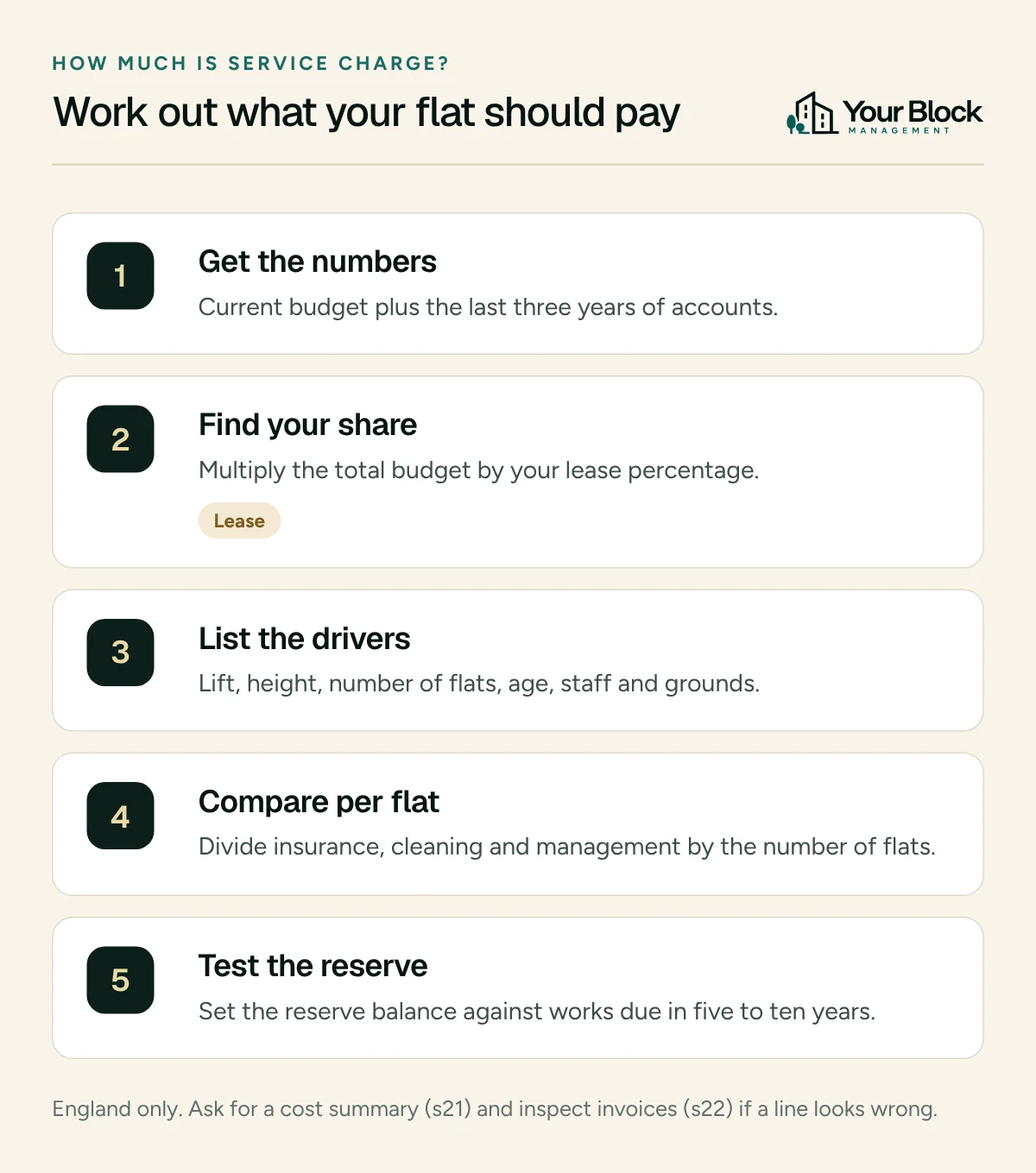
How to work out what your flat’s service charge should be
- Get the current budget and the last three years’ accounts. Budgets show intentions; accounts show what was actually spent. A budget that hasn’t changed in years, or never matches the accounts, needs explaining.
- Find your percentage in the lease. Multiply the total budget by it. If your bill doesn’t match, ask why.
- List your building’s drivers. Lift, height, number of flats, age, staff and grounds. Compare against the table above.
- Divide each major line by the number of flats. Insurance, cleaning and management per flat are easier to compare than a single total.
- Check the reserve against known works. Ask what the reserve fund holds and what is planned in the next five to ten years. A small reserve with a roof or window job coming means a large one-off demand is likely. Our guide to sinking funds explains how much is sensible.
If something still looks out of line, you can ask for a written summary of costs under section 21 of the Landlord and Tenant Act 1985 and inspect the invoices under section 22. Costs only count to the extent they were reasonably incurred (section 19).
Sense-checking a service charge before you buy a flat
A high service charge can be fair; a low one can be a warning that the building is being under-maintained. Before you commit:
- Read the listing. National Trading Standards guidance on material information says leasehold listings should state current service charge information, the ground rent and the length of the lease.
- Ask your conveyancer for the managing agent’s replies. The Law Society’s LPE1 leasehold property enquiries form, completed by the landlord or managing agent, covers service charges, insurance and, since its January 2023 update, fire safety and external wall questions.
- Ask for the budget, three years of accounts and the reserve balance. Not just the current year’s figure.
- Ask about planned or current major works, and whether any section 20 notices have been served. Works costing any leaseholder more than £250 need section 20 consultation, so a notice in progress tells you a bill is coming.
- Check affordability against the flat’s value. Lenders and buyers increasingly look at the charge as a percentage of value; our guide to average service charges explains the 1% rule of thumb.
Our checklist of questions to ask before buying a leasehold flat covers the rest of the lease.
Red flags that a service charge is wrong
- A big jump with no explanation. Rises happen, but the agent should be able to point to the lines that changed and why.
- No reserve fund in an older block, or a reserve that is tiny compared with the work everyone knows is coming.
- Insurance you can’t get details on. If nobody will tell you the premium, the cover or any commission, ask the insurer directly.
- Accounts that arrive very late, or not at all. Costs billed more than 18 months after they were incurred can’t generally be recovered unless you were warned in writing (section 20B).
- Repeated repair bills for the same fault, which can point to poor workmanship.
- Long contracts that appeared without consultation. Agreements over 12 months costing anyone more than £100 a year need consultation.
- Percentages across the block that don’t add up to 100%.
Plenty of owners share the frustration: in the English Housing Survey 2023–24, 62% of leaseholders who paid a service charge thought it was too high. The fix is usually visibility. At Your Block every resident gets a portal login showing the budget against actual spending through the year. If you are a director weighing up management costs, our page on how our pricing works explains what is included.
What’s changing
The Government plans a standard service charge demand form, with the first demand accompanied by a budget under set headings, plus a prescribed annual report and standard accounts. The relevant parts of the Leasehold and Freehold Reform Act 2024 are not in force; the Government said in July 2026 that leaseholders should start to see changes during 2027. Until then, comparing budgets line by line is up to you.
Frequently asked questions
How much is service charge per month on a flat?
Using the English Housing Survey 2023–24, the median for flats outside London was £1,300 a year, about £108 a month; Hamptons’ 2025 average for England and Wales was £2,405 a year, about £200 a month. Your own figure depends on your building’s insurance, lift, size, age, staff and reserve contributions, and your share under the lease.
Why is my service charge higher than my friend’s?
Usually because the buildings differ. A lift, concierge, communal heating, taller construction, an older structure needing repairs, or fewer flats sharing the fixed costs can all push the bill up. A healthy reserve fund contribution also raises the annual figure. Compare the budget line by line rather than the total.
Does a lift make a big difference to service charge?
It can. A lift brings a maintenance contract, inspections, repairs, electricity and eventually replacement. In our illustrative 16-flat block, those costs plus a lift replacement reserve added about £450 per flat per year. Real figures vary with the lift’s age and the contract, so ask for the actual lift lines in your budget.
What is a reasonable management fee within the service charge?
There is no official benchmark. One managing agent, Ringley, quotes roughly £250 to £500 per unit per year as an indicative range. What matters as much as the figure is what it includes: ask which tasks are covered by the fee and which, such as major works supervision or sale packs, are charged on top.
Can I check a service charge before buying a flat?
Yes. Ask the seller’s side, through your conveyancer, for the current budget, the last three years of accounts, the reserve fund balance, details of planned major works and any section 20 notices, plus insurance details. The managing agent usually answers these on the LPE1 leasehold enquiries form.
Sources and further reading
This article is general information about the law in England, not legal advice. Leasehold law is changing, so check your lease and get professional advice for your own situation. Spotted something out of date? Tell us and we’ll fix it.