
Do You Have to Pay Service Charge? When You Can Legally Push Back
Your lease makes the service charge a legal duty. The law decides how much of any bill is actually payable, and when you can lawfully hold back.
 By Sam Charlesworth9 min read

The short version
- Yes, if your lease says so, but only what is reasonable, properly demanded and lawfully recoverable.
- A missing summary of rights or landlord address only delays payment until the paperwork is fixed.
- Costs billed over 18 months late, or unconsulted major works over £250, may be irrecoverable.
- A landlord can’t forfeit for service charge arrears without an admission or a tribunal or court ruling.
- Pay under protest and challenge at the tribunal: paying is not an admission.
Do you have to pay service charge? If your lease says you do, then yes: it is a binding promise, and ignoring it can put your home at risk. But you only have to pay what the law says is payable. A charge can be unreasonable, demanded on the wrong paperwork, billed too late or tied to works nobody consulted you about. Here is when you can legally push back, and the safest way to do it.
This guide covers leasehold flats in England. Wales has some different rules and Scotland has an entirely different system.
Do you have to pay service charge? It starts with your lease
Your duty to pay comes from your lease, not from any general law. Most flat leases contain a covenant (a formal promise) to pay a share of the landlord’s costs of insuring, repairing, maintaining and managing the building. That promise binds you for as long as you own the lease, and it passes to whoever buys the flat from you.
The lease also sets the edges of what you can be charged. Three questions decide most cases before any statute comes into it:
- Does the lease allow this kind of cost? If a cost isn’t covered by the service charge clauses, it isn’t payable as a service charge, however sensible the spending was. Legal fees and improvements are the classic examples.
- What share does the lease give you? A fixed percentage, an equal share or a “fair proportion”. You can only be asked for your share.
- When and how must you pay? Many leases require payments on account (in advance) on set dates, with a balancing charge or credit after the year end.
Our guide to reading the service charge clauses in your lease shows where to look. If you rent your flat rather than own the lease, the service charge is normally your landlord’s bill, not yours.
The five legal limits on what you have to pay
On top of the lease, sections 18 to 30 of the Landlord and Tenant Act 1985 and parts of the Landlord and Tenant Act 1987 protect leaseholders who pay variable service charges. These are the five that most often decide whether a bill is payable.
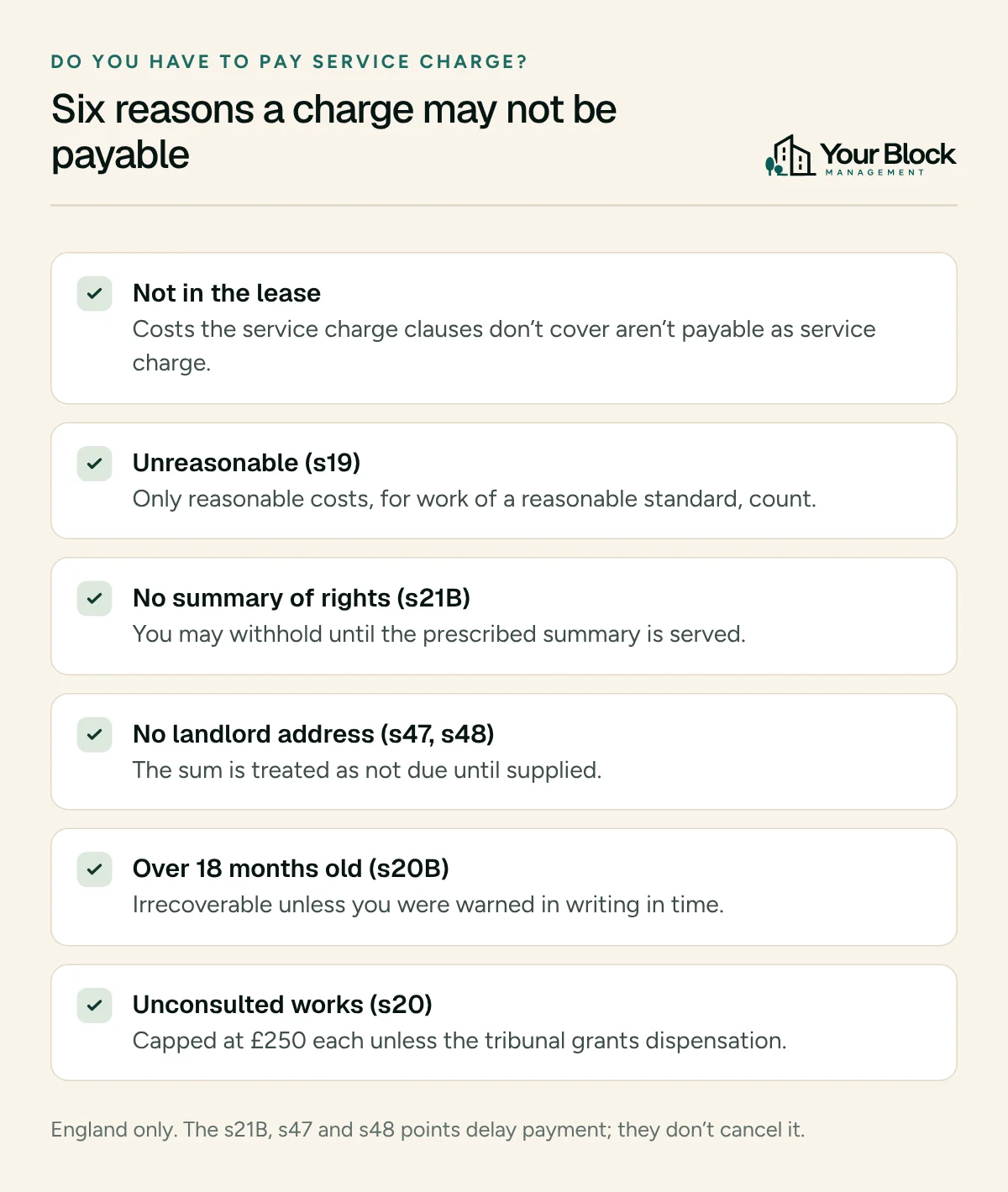
1. The cost must be reasonable (section 19)
Under section 19 of the Landlord and Tenant Act 1985, costs count towards a service charge only to the extent they were reasonably incurred, and works or services must be of a reasonable standard. Advance payments must be no more than is reasonable. This doesn’t mean the cheapest quote must always win, but an inflated price or shoddy work can be cut down to a reasonable figure by the tribunal.
2. The demand must come with a summary of your rights (section 21B)
Every service charge demand must be accompanied by the prescribed “summary of rights and obligations”, usually a page of small print attached to the bill. If it is missing, section 21B lets you withhold payment until it is served, and any lease terms about non-payment or late payment (interest, penalties) don’t apply while you are lawfully withholding.
3. The demand must give the landlord’s name and address (sections 47 and 48 of the 1987 Act)
A written demand must contain the landlord’s name and address, plus an address in England and Wales for notices if the landlord’s address is elsewhere (section 47). If not, the service charge part of the demand is treated as not due until the landlord supplies the information. Separately, section 48 says the landlord must give you an address in England and Wales where notices can be served; until it does, rent and service charges are treated as not due. Note that the name to look for is the landlord’s, not just the managing agent’s.
4. Old costs must be billed within 18 months (section 20B)
If a cost was incurred more than 18 months before you were sent a demand for it, it can’t be recovered, unless within those 18 months you were told in writing that the cost had been incurred and that you would be asked to contribute. This often catches up with blocks where year-end accounts run very late. Our guide to where every pound of your service charge goes explains how the yearly cycle should run.
5. Major works and long contracts need consultation (section 20)
Before works that would cost any one leaseholder more than £250, or a contract lasting over 12 months that would cost anyone more than £100 in an accounting period, the landlord must follow the section 20 consultation procedure. If it doesn’t, and the First-tier Tribunal doesn’t grant dispensation, recovery is capped at £250 per leaseholder for the works (or £100 per period for the contract). Dispensation is common, though: in Daejan Investments Ltd v Benson [2013] UKSC 14 the Supreme Court said the key question is whether leaseholders suffered real prejudice from the failure. See our guide to section 20 consultation for the full procedure.
“Not payable” or just “not payable yet”?
This is the distinction most people miss, and it decides whether pushing back saves you money or simply delays the bill.
| Problem | Effect | Can the landlord fix it? |
|---|---|---|
| Cost not allowed by the lease | Not payable as a service charge | Not by re-sending the bill. The lease would have to be varied. |
| Unreasonable cost or poor work (s19) | Payable only at a reasonable level | Only by showing the cost was reasonable |
| No summary of rights (s21B) | You may withhold until it is served | Yes: serve the summary, and the sum becomes payable |
| No landlord name or address (s47, s48) | Treated as not due | Yes: supply the information, and the sum becomes due |
| Billed over 18 months late (s20B) | Irrecoverable | No, unless a valid written warning was given in time |
| Major works not consulted on (s20) | Capped at £250 per leaseholder | Only through tribunal dispensation |
So a missing summary of rights is a reason to wait, not a reason to keep the money. Once the paperwork is put right, the charge is due, and if you have spent the money elsewhere you will be in arrears. The permanent defences are the lease, reasonableness, the 18-month rule and missed consultation.
Can you withhold service charge? What the law protects, and what it doesn’t
Outside the paperwork rules above, there is no general right to stop paying because you disagree with a charge. That said, Parliament has put real limits on how far a landlord can go over unpaid service charges:
- No forfeiture without a ruling or admission. Under section 81 of the Housing Act 1996, a landlord can’t forfeit your lease, or even serve the formal section 146 notice that starts the process, for unpaid service charges unless you have admitted the sum or a tribunal, court or arbitrator has finally decided it is payable. It must then wait 14 days.
- No forfeiture for small, recent arrears. Section 167 of the Commonhold and Leasehold Reform Act 2002 bars forfeiture where the unpaid rent, service and administration charges total £350 or less, unless some of it has been outstanding for more than three years.
- Other breaches need a ruling too. Section 168 of the 2002 Act requires a tribunal or court determination (or your admission) before a forfeiture notice for breaches of other lease covenants, such as unauthorised alterations. Unpaid service charges are dealt with under section 81 instead.
Those protections are a safety net, not a strategy. Withholding still exposes you to:
- a county court claim for the debt, with interest and possibly administration charges for late payment, if the lease allows them;
- the landlord’s legal costs, which some leases let it recover in full. The Court of Appeal confirmed in Chaplair Ltd v Kumari [2015] EWCA Civ 798 that a contractual costs clause can override the usual small-claims limits;
- a tribunal or court decision that the sum is payable, after which the forfeiture route opens;
- your mortgage lender being contacted, paying the arrears to protect its security and adding them to your loan;
- delays when you sell, because buyers’ solicitors ask about arrears and disputes.
Our guide to what happens if you don’t pay service charge walks through each stage from reminder letter to forfeiture.
Pay and dispute, or withhold? Choosing the right approach
For almost everyone, the answer is to pay and dispute. Section 27A of the 1985 Act lets the First-tier Tribunal (Property Chamber) decide whether a service charge is payable, how much and when, and it says that paying a charge is not, by itself, an admission that it was payable. You can pay now and still win the money back.
| Pay under protest and challenge | Withhold | |
|---|---|---|
| Risk to your lease | Very low | Grows once the sum is decided or admitted |
| Interest, fees, legal costs | Avoided | Likely, if the lease allows them |
| Can you still get money back? | Yes, through the tribunal | Only what the tribunal decides wasn’t payable |
| When it makes sense | Almost always | Mainly where s21B, s47 or s48 apply, and only until put right |
A sensible middle course is to pay the parts of the bill you accept in full, and pay the disputed part with a short written note. Something like: “I am paying £X under protest and without admission that it is payable. I dispute it for the following reasons, and reserve the right to apply to the tribunal under section 27A.” Keep a copy.
How to push back on a service charge, step by step
- Check the lease. Find the clauses that list what can be charged and your percentage. Confirm the cost is covered.
- Check the demand. Is the summary of rights attached? Does it show the landlord’s name and address? Are any costs more than 18 months old?
- Ask for the evidence. Under section 21 you can request a written summary of costs, and under section 22 you can then inspect invoices and receipts.
- Put your objection in writing. Be specific: which item, why, and what you think a reasonable figure is. Alternative quotes help.
- Complain formally. Use the landlord’s or agent’s complaints procedure, then the agent’s redress scheme (The Property Ombudsman or the Property Redress Scheme).
- Apply to the tribunal if needed. In England the form is Leasehold 3. Since 13 July 2026 a section 27A application costs £114, with a £227 hearing fee if there is a hearing. Ask for orders under section 20C and paragraph 5A of Schedule 11 so the landlord can’t pass its costs back to you.
Many of these cases can be run without a lawyer. Our guide to whether you need a service charge dispute solicitor explains when it is worth paying for one, and seven real service charge disputes shows how tribunals tend to decide.
Most of these arguments start because leaseholders can’t see what is being spent until long after the event. At Your Block we give every resident a portal login showing the budget against actual spending through the year, and we publish our complaints procedure so you know what happens if you query a charge.
Is the law changing?
Not yet. The Leasehold and Freehold Reform Act 2024 will replace parts of this regime, including the section 21B summary, with standard demand forms, annual reports and new rules on litigation costs. None of those service charge provisions is in force. In July 2026 the Government said the regulations would be laid later in 2026 and leaseholders should start to see changes during 2027. Until then, the rules above are the ones that apply.
Frequently asked questions
Can I refuse to pay service charge if I disagree with it?
You can refuse to accept it, but refusing to pay is risky. Unless a statutory paperwork rule applies, the landlord can sue for the debt and add interest and costs if the lease allows. The safer route is to pay under protest in writing and apply to the First-tier Tribunal, which can order that unreasonable sums were not payable even after you have paid them.
What if the demand doesn’t include the summary of rights?
Section 21B of the Landlord and Tenant Act 1985 lets you withhold payment until the prescribed summary of rights and obligations is served, and lease penalties for late payment don’t apply in the meantime. Once the landlord serves it, the charge becomes payable, so set the money aside and ask for a corrected demand.
Can my landlord take my flat if I don’t pay the service charge?
Forfeiture is possible in principle but heavily restricted. The landlord can’t start it for service charge arrears unless you have admitted the debt or a tribunal or court has decided it is payable, and not at all for arrears of £350 or less unless part is over three years old. A court can also grant relief. Paying under protest avoids the risk.
Do I have to pay for major works I wasn’t consulted on?
If the works cost any leaseholder more than £250 and the landlord skipped section 20 consultation, it can recover only £250 from each leaseholder unless the First-tier Tribunal grants dispensation. Tribunals often grant it, sometimes on terms, where leaseholders can’t show real prejudice from the failure. So the cap is a strong point but not a guaranteed win.
Do tenants renting a flat have to pay service charge?
Usually not. The service charge is owed by the leaseholder under the lease, so if you rent from a leaseholder, it is normally your landlord’s bill. Check your tenancy agreement for anything unusual, and pay your rent as normal: disputes about the building’s costs are between your landlord and the freeholder or managing agent.
Sources and further reading
- Landlord and Tenant Act 1985, section 19 (reasonableness)
- Landlord and Tenant Act 1985, section 21B (summary of rights)
- Landlord and Tenant Act 1987, section 47 (landlord’s name and address)
- Housing Act 1996, section 81 (restriction on forfeiture for service charges)
- Commonhold and Leasehold Reform Act 2002, section 167 (small amounts)
This article is general information about the law in England, not legal advice. Leasehold law is changing, so check your lease and get professional advice for your own situation. Spotted something out of date? Tell us and we’ll fix it.