
Average Service Charge for Flats UK: What Apartment Owners Really Pay in 2026
The latest figures from Hamptons, the English Housing Survey and the London Assembly, what they really mean, and how to tell whether your bill is fair.

The short version
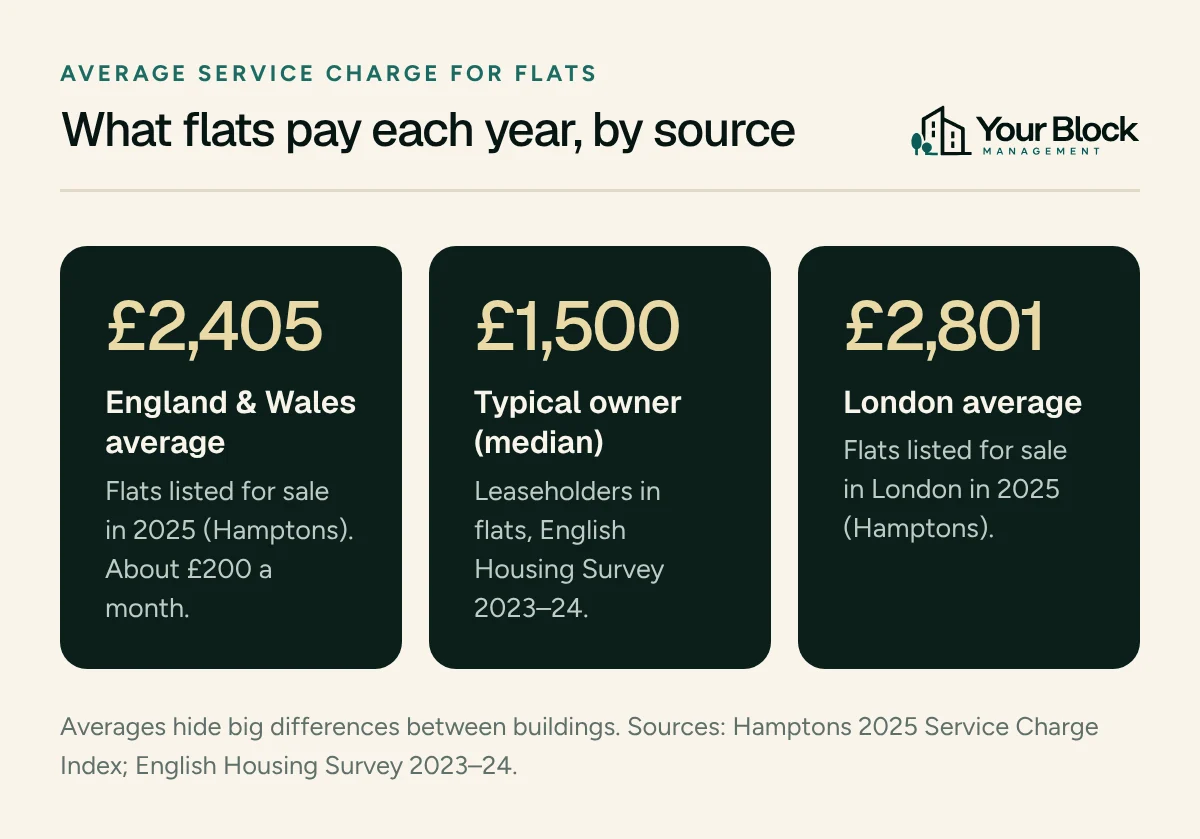
- Hamptons puts the average flat service charge at £2,405 a year (about £200 a month) in England and Wales in 2025.
- The government’s English Housing Survey median for flats is lower, at £1,500 a year (2023–24).
- London is higher: £2,801 a year on average for flats listed for sale, per Hamptons.
- Charges have risen faster than inflation over ten years, and many lenders now watch the 1%-of-value line.
- Your bill is only payable if it’s reasonable, and you have legal rights to see the costs behind it.
What’s the average service charge for flats UK owners pay? About £2,405 a year, or roughly £200 a month, according to Hamptons’ analysis of flats marketed for sale in England and Wales in 2025. The government’s own English Housing Survey puts it lower, at a median of £1,500 a year for leaseholders in flats. London apartments cost more, and the honest answer for your building depends on what it has: lifts, a concierge, gardens and its age all move the number a long way.
This guide brings the most reliable figures together in one place, explains why they disagree, and shows you how to tell whether your own bill is fair. It covers England, where most of the data comes from.
The average service charge for flats UK: the headline numbers
There is no single official “average service charge”. There are two good sources, and they measure slightly different things.
| Source | What it measures | Figure |
|---|---|---|
| Hamptons 2025 Service Charge Index (published March 2026) | Average charge on flats listed for sale in England and Wales, 2025 | £2,405 a year (£200.42 a month), up 4.6% on 2024 |
| English Housing Survey 2023–24 (government) | What owner-occupier leaseholders in flats say they pay | Mean £1,857 a year; median £1,500 a year |
| Hamptons, London only | Flats listed for sale in London, 2025 | £2,801 a year (£233.45 a month) |
| London Assembly Housing Committee survey (June 2025) | London leaseholders who responded to its survey | Median £3,912 a year (£326 a month) |
If you only remember one thing: somewhere between £1,500 and £2,400 a year is typical for a flat outside London, and a lot of perfectly well-run small blocks sit below that range.
Why the averages don’t agree
The gap between £1,500 and £2,405 isn’t a mistake. Three things explain it.
- Different flats. Hamptons looks at flats being put up for sale. Newer, larger developments with lifts and staff turn over often and push that average up. The English Housing Survey asks a cross-section of owner-occupiers, including plenty of small, older, low-rise blocks.
- Mean versus median. A few very expensive buildings drag a mean (the ordinary average) upwards. The median, the figure in the middle, is usually a better guide to what a “normal” flat pays. In the English Housing Survey the mean for flats is £1,857 but the median is £1,500.
- Different years. The survey covers 2023–24; Hamptons covers 2025. Charges have risen in between.
The survey also found that the average had been “relatively stable” over five years once you allow for its methods, while Hamptons and other researchers report steady rises. Both can be true: the overall picture moves slowly, but many individual buildings have seen sharp jumps, especially where insurance or safety work is involved.
Average service charge by flat size
Bigger flats usually pay a bigger share, because most leases split costs by floor area, number of bedrooms or a fixed percentage. Hamptons’ 2025 figures for England and Wales:
| Flat size | Average per year | Per month | Change on 2024 |
|---|---|---|---|
| One bedroom | £2,074 | £172.81 | +3.3% |
| Two bedrooms | £2,463 | £205.28 | +4.8% |
| Three bedrooms | £3,146 | £262.16 | +5.7% |
Your own share is set by your lease, not by these averages. If your neighbour in an identical flat pays a different amount, check the apportionment clause in both leases before assuming something has gone wrong. Our guide to where every pound of your service charge goes explains how shares are worked out.
London versus the rest of the country
London is the outlier. Hamptons puts the average London flat at £2,801 a year in 2025, up 6.4% in a year, 41.2% over five years and 64.5% over ten. It links that to taller buildings with more shared facilities. The London Assembly’s 2025 survey of leaseholders found a median of £3,912, with 11% of respondents paying more than £7,000 a year. That survey drew on people who chose to respond, so it probably leans towards those with high bills, but it shows how far the top end stretches.
At the other end, Hamptons found the share of flats with charges under £100 a month was highest in the North East (30%), followed by the East Midlands and the South West (28% each). Nationally, only 14% of flats now come in under £100 a month, down from 34% five years earlier.
No reliable average is published for Suffolk and Essex on their own. In our patch, the main split is between older low-rise conversions and small purpose-built blocks, which often run at the lower end, and newer developments in towns such as Colchester, Chelmsford and Ipswich with lifts, car parks, door entry systems and landscaping, which run higher. If you want a local view, our pages on block management in Essex and Suffolk explain how we price buildings like yours.
How fast are service charges rising?
Hamptons’ figures show the average flat service charge up 32.6% over five years (from £1,814 in 2020) and 55.6% over ten years. Over the same periods consumer prices rose 30.9% and 39.8%, so charges have been running ahead of inflation, particularly over the longer term.
Leaseholders feel it too. A Propertymark survey reported in July 2026 found 86% of leaseholders had seen their service charge rise in the previous two years. A separate survey of 2,000 leaseholders commissioned by Justice for Property Rights found two in five said their charges had risen unexpectedly.
What usually drives the increases
- Buildings insurance. Often the single biggest line, and one that has risen sharply for many blocks, especially those with fire safety questions. Our guide to block management insurance explains what the policy should cover and how commission must be disclosed.
- Fire and building safety. Fire risk assessments, door checks, alarm and emergency lighting servicing, and any remedial works they identify.
- Energy for communal areas. Lighting, lifts, door entry and any communal heating.
- Reserve fund contributions. Saving for roofs, windows and redecoration. A healthy reserve can make this year’s bill look higher but avoids a shock demand later.
- Major works. Big one-off projects should go through section 20 consultation before you’re asked to pay more than £250 towards them.
- Staff and services. Cleaning, gardening, concierge and on-site staff, which rise with wages.
- The management fee. Usually a smaller part of the total than people assume. Our explainer on what block management fees actually pay for breaks it down.
The 1% rule: when a service charge starts to hurt your flat’s value
Lenders and buyers increasingly judge a service charge against the value of the flat. Hamptons found the average flat’s annual charge was 0.90% of its value in 2025, but 37% of flats were above 1%, 14% above 2% and 6% above 3%. Flats with charges at or below 1% of value were 50% more likely to find a buyer than those at 2% or more.
Some mortgage lenders now look closely at, or decline, flats where the annual charge goes above about 1% of value. One broker quoted in The Negotiator called 1% “a good rule of thumb”, while stressing that each lender sets its own policy.
That’s one reason the cost of running a building matters even to owners who never complain about the bill: an unnecessarily high charge can quietly take value off every flat in the block.
Is your service charge reasonable? How to check
An average tells you whether your bill is unusual. It doesn’t tell you whether it’s lawful. Under section 19 of the Landlord and Tenant Act 1985, service charge costs are only payable if they were reasonably incurred and the work or service is of a reasonable standard. A cheap bill can still be unreasonable, and an expensive one can be fully justified.
- Get the budget and last year’s accounts. Compare budget with actual spend line by line. Big unexplained jumps are the first thing to ask about.
- Ask for a summary of costs. Section 21 of the 1985 Act lets you request a written summary of the costs behind your charges, and section 22 lets you then inspect the invoices and receipts.
- Check the demand is valid. Every demand must come with the prescribed summary of tenants’ rights and obligations. Costs more than 18 months old generally can’t be added unless you were warned in writing.
- Compare like with like. Insurance, cleaning and gardening can be benchmarked. Ask how contractors were chosen and whether alternatives were sought.
- Raise it in writing, then escalate. If the answers don’t satisfy you, use your managing agent’s complaints procedure, then its redress scheme. The First-tier Tribunal (Property Chamber) can decide what is reasonable and payable.
Don’t simply stop paying while you query a charge: unpaid service charges can lead to court action and, in the worst cases, the risk of forfeiture. Our guide to service charge disputes walks through seven real tribunal and court cases and how they ended.
What’s changing for service charges
The Leasehold and Freehold Reform Act 2024 includes service charge transparency measures, but those parts are not yet in force. In July 2026 the Government confirmed it plans standard service charge demand forms, a prescribed annual report and standard accounts, with regulations expected later in 2026 and changes likely to reach leaseholders from 2027. Until then, the existing rights above are the ones that count.
At Your Block we think the simplest fix doesn’t need new law: show residents the budget, the spending and the invoices as they happen. That’s why every resident in a block we manage gets a portal login with budget against actual spending, rather than a single set of accounts once a year.
Frequently asked questions
What is the average monthly service charge for a flat in the UK?
Hamptons’ 2025 analysis of flats listed for sale in England and Wales puts it at £200.42 a month, the first time the average has passed £200. The government’s English Housing Survey suggests a typical owner pays less, with a median of £1,500 a year, or about £125 a month, for leaseholders in flats.
Is a £2,000 a year service charge high?
Not by national standards. It is slightly below the 2025 Hamptons average of £2,405 for flats in England and Wales, though above the English Housing Survey median of £1,500. What matters more is what your building has, whether costs are reasonably incurred, and how the charge compares with your flat’s value.
Why is my service charge higher than the average?
Lifts, concierge staff, communal heating, gated parking, large gardens, high-rise fire safety duties and major works all push charges up, as can a large reserve fund contribution or a recent insurance increase. Ask for the budget and accounts and compare each line. A higher charge is fine if the costs are reasonable and properly explained.
What service charge will put off mortgage lenders?
There is no single rule, but some lenders look closely at, or decline, flats where the annual service charge is above about 1% of the property’s value. Hamptons found 37% of flats were above that level in 2025. Each lender sets its own criteria, so a mortgage broker can tell you how a specific flat will be treated.
Sources and further reading
- Hamptons – 2025 Service Charge Index (March 2026)
- English Housing Survey 2023 to 2024: leasehold experience fact sheet (GOV.UK)
- London Assembly – Soaring service charge costs for new London leaseholders should be capped (June 2025)
- Property Industry Eye – Leaseholders face record-high service charges (March 2026)
- The Negotiator – Lenders reject flats as service charges breach 1% ‘red line’ (July 2026)
- The Negotiator – Leaseholder service charges rise “unexpectedly” (July 2026)
- Landlord and Tenant Act 1985, section 19 (reasonableness)
This article is general information about the law in England, not legal advice. Leasehold law is changing, so check your lease and get professional advice for your own situation. Spotted something out of date? Tell us and we’ll fix it.