
What Are Service Charges? The No-Nonsense Guide for Flat Owners
A beginner’s guide to the bill every flat owner pays: what it legally is, what it covers, how your share is set and how it differs from ground rent.
 By Sam Charlesworth8 min read

The short version
- Service charges pass the real costs of running your building on to flat owners, as the lease allows.
- Legally, they vary with costs incurred, which brings them under the Landlord and Tenant Act 1985 protections.
- Your share is set by the lease: fixed percentage, equal shares, floor area or a fair proportion.
- Most blocks bill an estimated budget in advance, then a balancing charge or credit after the year end.
- Ground rent is separate: it buys no services, isn’t held on trust and is nil on most new leases.
What are service charges? They are the payments flat owners make towards the shared costs of running their building: insurance, repairs, cleaning, communal electricity, fire safety, management and savings for big future works. Your lease decides what can be charged and what share you pay, and the law adds rules on reasonableness and paperwork. This guide explains it all from scratch.
It is written for leasehold flat owners in England. If you have just bought your first flat, or are about to, start here.
What are service charges? The legal definition in plain English
When you buy a flat in England you almost always buy a lease: the right to occupy your flat for a long period, often 99 or 125 years or more. Someone else, usually a freeholder, a residents’ management company or a right to manage company, is responsible for the structure, the roof and the shared parts. The lease lets them pass those costs on to the flat owners. That pass-through is the service charge.
The legal definition is in section 18 of the Landlord and Tenant Act 1985. Broken into plain English, a service charge is an amount that:
- is paid by a tenant of a dwelling (in this context “tenant” includes you as a long leaseholder);
- is payable as part of, or in addition to, the rent;
- covers services, repairs, maintenance, improvements, insurance or the landlord’s costs of management; and
- varies, in whole or in part, with the costs actually incurred or expected to be incurred.
That last point matters most. Because the charge goes up and down with real costs, it falls within sections 18 to 30 of the 1985 Act, which give you rights to information and protection against unreasonable bills. A truly fixed charge that never changes with costs falls outside those protections.
Service charge money is also not the landlord’s income. Under section 42 of the Landlord and Tenant Act 1987 it is held on trust, for the purposes the lease sets out.
Who pays service charges?
- Leaseholders of flats, nearly always. The government’s English Housing Survey for 2023–24 found 88% of leaseholders in flats paid one.
- Some leasehold house owners, especially on newer estates.
- Not usually renters. If you rent from a flat owner, the service charge is normally your landlord’s bill.
- Freehold house owners on managed estates often pay “estate charges”. These work differently and only some of the leasehold protections apply. See our guide to service charges on freehold houses.
What typically goes into service charges
Every lease is different, so the only definitive list is the one in your lease. In practice, most blocks charge for some or all of these:
| Category | Typical examples |
|---|---|
| Buildings insurance | The policy covering the structure and common parts, often the biggest single line |
| Repairs and maintenance | Roof, gutters, external walls, windows (if the lease puts them in the common parts), communal doors |
| Cleaning and grounds | Hallway and stair cleaning, window cleaning, gardening, bin stores, car parks |
| Utilities | Electricity for corridor lighting, lifts and door entry; any communal water or heating |
| Safety and compliance | Fire risk assessments, alarm and emergency lighting servicing, fire door checks, lift inspections |
| Management and professional fees | The managing agent’s fee, accountants, surveyors for major works |
| Reserve fund | Savings for future big-ticket items such as roof renewal or redecoration |
What usually isn’t included: anything inside your own flat that the lease makes your responsibility, ground rent (which is a separate payment), and any cost the lease doesn’t allow. For a fuller list, see what service charge covers and what should never be on your bill.
The reserve fund: paying now for the big jobs later
A reserve fund (also called a sinking fund) is money collected through the service charge and set aside for large, predictable costs. Instead of a sudden bill when the roof fails, everyone pays a smaller amount each year.
A simple illustrative example: a six-flat block expects to need roof work costing £18,000 in ten years. With no reserve, each flat faces a £3,000 bill at once. Collecting £1,800 a year into the reserve spreads that to £300 a year per flat, and the money is already there when the work is due.
Three things to know as a beginner:
- A reserve can only be collected if your lease allows it.
- Reserve money is trust money and should be kept separately, not mixed with the landlord’s or agent’s own funds.
- When you sell, the reserve normally stays with the building rather than being refunded, which is why buyers like to see a healthy balance.
The RICS Service Charge Residential Management Code (4th edition, in force since 7 April 2026) gives more guidance on reserve funds and planned maintenance than earlier editions. Our guide to why your block needs a sinking fund goes into how much to save.
How your share is worked out (apportionment)
The total cost of running the building is divided between the flats. This is called apportionment, and your lease sets the method. The common ones are:
- Fixed percentages written into each lease, for example 12.5% per flat.
- Equal shares, common where flats are similar.
- Floor area or rateable value, so bigger flats pay more.
- A “fair proportion” decided by the landlord, which must be reasonable.
An illustrative floor-area example: a converted house holds six flats with a combined floor area of 400 square metres. Your flat is 50 square metres, so your share is 50 ÷ 400 = 12.5%. If the year’s budget is £12,000, your share is £1,500, or £125 a month.
Larger developments often split costs into separate “schedules” (the block, the estate roads, the car park, the lift), and you only pay into the schedules that serve your flat. Whatever the method, the shares across the block should add up to 100%. Our guide to where every pound of your service charge goes has a fully worked budget for a small block.
How and when service charges are billed
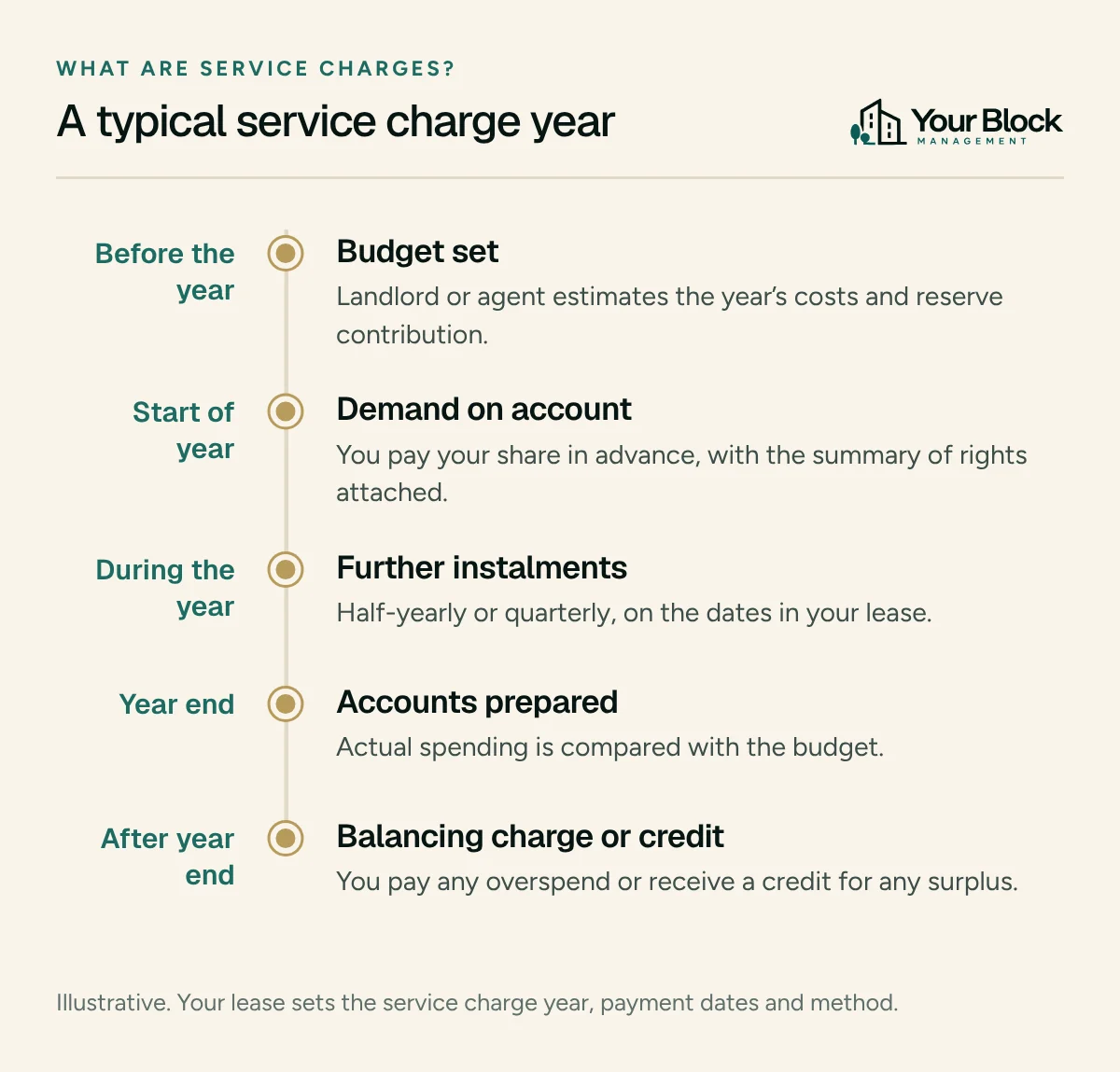
Most leases use a two-step cycle each service charge year.
Step 1: the estimated budget and payments on account
Before or at the start of the year, the landlord or managing agent prepares a budget of expected costs. You then pay your share “on account”, in advance, usually in one, two or four instalments on dates set by the lease. Under section 19(2) of the 1985 Act, advance payments must be no more than is reasonable.
Each demand should come with two things. First, the prescribed summary of your rights and obligations: under section 21B you can withhold payment until it is provided. Second, the landlord’s name and an address in England and Wales, under sections 47 and 48 of the 1987 Act. Without them, the charge is treated as not yet due.
Step 2: the year-end accounts and balancing charge
After the year ends, the actual spending is set against the budget in year-end accounts. If the block spent less than the budget, you usually receive a credit (or, if the lease says so, the surplus goes into the reserve). If it spent more, you receive a balancing charge for your share of the overspend.
Two time rules protect you here. Costs incurred more than 18 months before you were billed for them generally can’t be recovered, unless you were warned in writing within that time (section 20B). And for major works costing any leaseholder more than £250, the landlord must consult first under section 20, or the amount it can recover is capped. Our guide to section 20 consultation explains that process.
Service charges vs ground rent: what’s the difference?
New flat owners often confuse the two, because they can arrive on the same piece of paper. They are completely different payments.
| Service charge | Ground rent | |
|---|---|---|
| What it pays for | Real costs of running the building | Nothing: it is a payment to the freeholder under the lease |
| Does it vary? | Yes, with actual costs | Fixed by the lease, sometimes with set increases |
| Held on trust? | Yes (s42 LTA 1987) | No, it is the freeholder’s income |
| Key protections | Reasonableness, consultation, 18-month rule, tribunal challenge | Must be formally demanded with a notice given 30 to 60 days before it is due (s166 CLRA 2002) |
| New leases | Still payable | Peppercorn (nil) for most leases granted on or after 30 June 2022 |
| Typical flat (England, 2023–24) | Median £1,500 a year | Median £160 a year |
The typical figures come from the English Housing Survey 2023–24 and include leaseholders who paid each charge. A cap on ground rent in existing leases has been proposed in a draft Bill but is not law. For more, see our guide to ground rent and how the law has changed.
What to do if your service charges seem wrong
You don’t have to take a bill on trust. The core rights, all in force as at October 2026:
- Ask for a summary of costs (section 21), then inspect the invoices and receipts (section 22).
- Challenge reasonableness. Costs count only if reasonably incurred and the work is of a reasonable standard (section 19).
- Go to the tribunal. The First-tier Tribunal (Property Chamber) can decide whether a charge is payable and how much, under section 27A.
Keep paying while you query a bill, ideally “under protest” in writing: paying is not an admission that the charge was right, but withholding can put your lease at risk. Our guide to when you can legally push back on a service charge explains the safe approach.
The simplest protection is being able to see the numbers. At Your Block every resident gets a portal login showing the budget against actual spending through the year, not just once the accounts arrive. If you would like to know what full management includes, see our services.
What’s changing for service charges
The Leasehold and Freehold Reform Act 2024 contains new service charge transparency rules, including standard demand forms and annual reports, but none of them is in force yet. The Government said in July 2026 that regulations would follow later in 2026, with leaseholders seeing changes during 2027. Until then, the rules above are the ones that apply.
Frequently asked questions
Are service charges the same as ground rent?
No. A service charge pays for the actual costs of running the building and is held on trust for that purpose. Ground rent is a payment to the freeholder under the lease and buys no services. They have different legal rules, and for most leases granted since 30 June 2022 ground rent is a peppercorn, while service charges still apply.
Can service charges go up every year?
Yes, because they follow real costs. If insurance, energy or repair costs rise, so does the charge. What the landlord can’t do is charge more than is reasonable, include costs the lease doesn’t allow, or skip consultation on major works costing any leaseholder over £250. You can ask for a summary of costs and inspect the invoices behind it.
Do I get my reserve fund contributions back when I sell?
Usually not. Reserve money is held on trust for the building, so it normally stays with the block when you sell, and the buyer benefits from it. Check your lease, as a few say otherwise. A healthy reserve can make a flat easier to sell, because it reduces the risk of a large one-off bill for major works.
How often are service charges paid?
Your lease sets the timing. Many leases require payment on account once a year, twice a year or quarterly, based on a budget, followed by a balancing charge or credit once the year-end accounts are ready. Some managing agents let you spread payments monthly by arrangement, but that is a concession, not a right, unless the lease says so.
Who decides how much my service charge is?
The landlord, residents’ management company or right to manage company sets the budget, often through a managing agent. Your lease fixes your share and what can be included. If you think a charge is unreasonable or not allowed, the First-tier Tribunal (Property Chamber) can decide what is payable under section 27A of the Landlord and Tenant Act 1985.
Sources and further reading
- Landlord and Tenant Act 1985, section 18 (meaning of service charge)
- Landlord and Tenant Act 1987, section 42 (service charge contributions held on trust)
- Commonhold and Leasehold Reform Act 2002, section 166 (notice that rent is due)
- English Housing Survey 2023 to 2024: leasehold experience fact sheet
- Leasehold Reform (Ground Rent) Act 2022
This article is general information about the law in England, not legal advice. Leasehold law is changing, so check your lease and get professional advice for your own situation. Spotted something out of date? Tell us and we’ll fix it.