
Service Charge Dispute Solicitors: Do You Need One, or Can You Do It Yourself?
The tribunal is built for leaseholders without lawyers, but some disputes need one. How to tell which yours is, and what each route really involves.
 By Sam Charlesworth8 min read

The short version
- A section 27A tribunal application costs £114, plus £227 if there is a hearing.
- Each side usually pays its own costs; costs orders need unreasonable conduct.
- Ask for section 20C and paragraph 5A orders so the landlord’s legal costs don’t land on you.
- Get a solicitor for forfeiture threats, county court claims, large sums, tricky leases or appeals.
- LEASE gives free initial advice, and leaseholders can apply together to share costs.
Do you need service charge dispute solicitors? Often not, at least to begin with. The First-tier Tribunal (Property Chamber) is designed so leaseholders can bring a challenge themselves, the fees are modest and each side usually pays its own costs. A solicitor or barrister earns their fee when the sums are large, the lease is unclear, forfeiture is threatened or the landlord takes you to court. Here is how to decide.
This guide covers residential leasehold in England. It explains the process and the costs rules; it isn’t legal advice on your case.
Where service charge disputes are decided
Most service charge disputes end up in one of two places.
- The First-tier Tribunal (Property Chamber). Under section 27A of the Landlord and Tenant Act 1985, the tribunal can decide whether a service charge is payable, by whom, to whom, how much, when and how. It covers past charges and future budgets. Leaseholders and landlords can both apply. In England the form is Leasehold 3.
- The county court. If you stop paying, the landlord may sue you for the debt. A court can transfer the question of whether the charge is payable to the tribunal, then deal with the rest of the claim itself.
The tribunal is usually the better place for a leaseholder to be. It is a specialist body, its panels often include a surveyor, and its procedures are built for people without lawyers. LEASE notes that it may decide a case on paper or invite the parties to a hearing, and that you can say in your application if you don’t think a hearing is needed.
The tribunal can’t decide a charge you have already agreed or admitted, but paying a bill is not, on its own, an admission. That is why the standard advice is to pay under protest and apply, rather than withhold. Our guide to when you can legally push back on a service charge explains why.
What it costs to go to the tribunal yourself
New fees took effect on 13 July 2026. For a service charge application under section 27A (or a section 20C application), the First-tier Tribunal (Property Chamber) Fees Order 2013, Schedule 1 now sets:
| Fee | Amount | When it is paid |
|---|---|---|
| Application fee | £114 | With the application |
| Hearing fee | £227 | Within 14 days of being told the hearing date, if there is a hearing |
| Most other applications under the 1985 Act | £200 application, £300 hearing | As above |
So a leaseholder who runs their own section 27A case to a hearing pays £341 in tribunal fees, and only £114 if it is decided on paper. Fee remission (Help with Fees) is available if your income and savings are low or you receive certain benefits, using form EX160. The tribunal can also order the other side to reimburse your fees under rule 13(2) of its procedure rules.
A group of leaseholders challenging the same charges can apply together, which spreads the fee and means everyone is covered by the decision.
The costs rules: why the tribunal is mostly a no-costs zone
This is the single biggest reason many people don’t need a solicitor. In the courts, the loser usually pays the winner’s legal costs. In the tribunal, the general rule is that each side bears its own.
Rule 13: costs only for unreasonable conduct
Under rule 13 of the Tribunal Procedure (First-tier Tribunal) (Property Chamber) Rules 2013, the tribunal can order one party to pay another’s costs in a leasehold case only where that party “acted unreasonably in bringing, defending or conducting proceedings” (or for wasted costs). In Willow Court Management Co (1985) Ltd v Alexander [2016] UKUT 290 (LC), the Upper Tribunal set a high bar:
- losing is not enough, and the “acid test” is whether there is a reasonable explanation for the conduct;
- a lay person’s lack of skill or poor presentation should not be treated as unreasonable;
- an unrepresented party is judged by the standard of a reasonable person without legal advice;
- costs applications “should not be regarded as routine”.
Behaving sensibly (complying with directions, not making allegations you can’t support, engaging with settlement offers) keeps that risk very low.
The catch: lease costs clauses, and how to neutralise them
Many leases let the landlord recover its legal costs, either from everyone through the service charge or from you personally as an administration charge. So even in a no-costs tribunal, a landlord’s solicitor’s bill could come back to you. Two orders deal with this:
- Section 20C of the Landlord and Tenant Act 1985: the tribunal can order that the landlord’s costs of the proceedings are not to be added to the service charge.
- Paragraph 5A of Schedule 11 to the Commonhold and Leasehold Reform Act 2002: it can reduce or extinguish your liability to pay those costs as an administration charge.
Ask for both in your application, and make sure every leaseholder who wants protection is named on it. In the county court the position is harsher: the Court of Appeal held in Chaplair Ltd v Kumari [2015] EWCA Civ 798 that a lease clause entitling the landlord to its costs could override the usual small-claims limits. That is one reason court claims are where professional help most often pays for itself.
When service charge dispute solicitors add real value
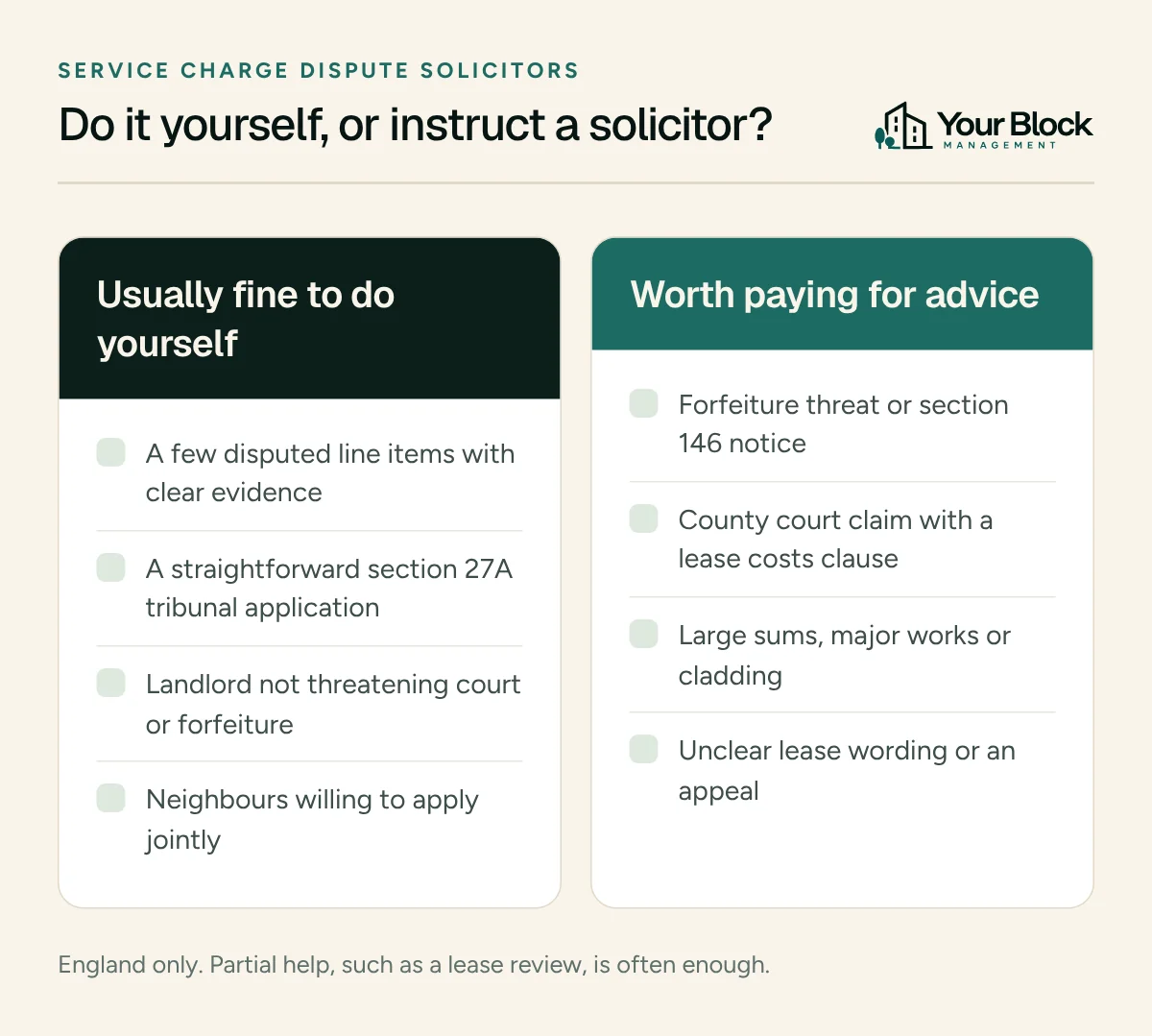
Doing it yourself is realistic for a clear dispute over a few line items. Consider paying for advice, at least for part of the case, in these situations:
- Forfeiture or a section 146 notice. If the landlord threatens to forfeit the lease, or a tribunal or court has already decided arrears are payable, get advice quickly. Forfeiture can’t be pursued for service charge arrears without a determination or admission, but once that exists, the stakes are your home.
- A county court claim against you, especially where the lease has a costs clause.
- Large sums or major works, such as a five-figure share of a roof or cladding project, particularly if section 20 consultation was skipped or disputed, where the cost of advice is small relative to what is at stake.
- Difficult lease wording. Whether a cost is covered at all is a question of interpretation, and specialist lawyers know how tribunals have read similar clauses.
- A professionally represented landlord with counsel and expert reports, in a case with complex evidence.
- Appeals. Permission to appeal must first be sought from the First-tier Tribunal in writing, within 28 days of it sending written reasons. Appeals turn on legal error, which is lawyer territory.
- Building safety disputes involving the Building Safety Act 2022 leaseholder protections, which are technical.
Sometimes the expert you need is not a lawyer at all. In a dispute about whether works were necessary or overpriced, a chartered surveyor’s report may carry more weight than a solicitor’s letter. For a sense of how tribunals approach typical arguments, see seven real service charge disputes and how they ended.
Free and lower-cost help before you pay anyone
- LEASE (the Leasehold Advisory Service). A government-funded body giving free initial advice on residential leasehold law in England. Its guidance on applying to the tribunal and on fees is a good starting point.
- The tribunal’s own guidance and forms. The Leasehold 3 form explains what to include: your lease, details of the disputed costs and an outline of your case.
- Your neighbours. If several leaseholders are affected, a joint application lets you share fees, evidence and any professional costs. A recognised tenants’ association can also request cost summaries and be consulted on major works.
- Legal expenses insurance. Check whether your home insurance includes legal expenses cover, and what it says about property disputes.
- Limited-scope help. Many solicitors will review your lease and documents, or draft your statement of case, while you run the rest. Barristers registered for public access can be instructed directly by members of the public for some work, without a solicitor.
How to choose a solicitor for a service charge dispute
If you decide you need one, look for residential leasehold experience specifically. General conveyancers and high-street litigators may not know the tribunal well.
- Check they are regulated. Solicitors in England are regulated by the Solicitors Regulation Authority; check the firm and the individual on its online register.
- Ask about tribunal experience. How many service charge cases have they run in the Property Chamber in the last couple of years?
- Ask how they charge. Hourly rates, fixed fees for defined stages (for example, a lease review or drafting the application), or a capped estimate. Get it in writing in the client care letter.
- Ask what you could do yourself to keep costs down, such as preparing the document bundle.
- Ask about the costs risk. Have they checked the lease for a costs clause, and will they apply for section 20C and paragraph 5A orders?
- Check for conflicts. Make sure the firm doesn’t act for your landlord or managing agent.
Prices vary widely by firm, region and complexity, so compare written estimates for the same scope of work.
What a service charge dispute typically involves, with or without a lawyer
- Gathering evidence. Your lease, the demands, the budget and accounts, and the invoices (request a summary under section 21 and inspect documents under section 22).
- A letter before action. Set out what you dispute and why, and invite a response. Many disputes settle here.
- The application. Form Leasehold 3, the £114 fee, and your section 20C and paragraph 5A requests.
- Directions. The tribunal sets a timetable, often including a schedule where each disputed item, your comments and the landlord’s reply sit side by side.
- Statements and bundle. Witness statements, any expert report, and an indexed bundle of documents.
- Hearing or paper decision, then a written decision with reasons.
Keeping records from day one makes every stage cheaper, whoever is doing the work. RTM and RMC boards often face the other side of these disputes; our support for resident directors includes keeping the paper trail that tribunals expect, and our complaints procedure is published so residents can raise concerns before anything escalates.
If the same arguments come up every year, the root problem may be the management. See what a managing agent should be doing for you and our guide to where every pound of your service charge goes.
Frequently asked questions
Can I represent myself at the property tribunal?
Yes. The First-tier Tribunal (Property Chamber) is designed for people without lawyers, and many leaseholders represent themselves. The Upper Tribunal has said an unrepresented party should be judged by the standard of a reasonable person without legal advice. You can also appoint a non-lawyer representative, such as a neighbour or a surveyor, by notifying the tribunal in writing.
Will I have to pay my landlord’s legal costs if I lose?
Not usually through a tribunal costs order, which needs unreasonable conduct. The bigger risk is the lease: some let landlords recover legal costs through the service charge or as an administration charge. Ask the tribunal for orders under section 20C and paragraph 5A of Schedule 11 to block that, and name every leaseholder who wants protection.
How much does it cost to take a service charge dispute to tribunal?
Since 13 July 2026, a section 27A application costs £114, and a further £227 hearing fee is due if the case goes to a hearing. Help with Fees can reduce or remove these for people on low incomes or certain benefits. Any professional help, such as a solicitor or surveyor, is extra and varies by firm.
Is there a time limit for a service charge dispute?
There is no fixed time limit for a section 27A application, but you should apply within a reasonable time, and you can’t challenge a charge you have agreed or admitted. Paying alone isn’t an admission. If you want to appeal a tribunal decision, you must apply to the First-tier Tribunal for permission within 28 days of it sending its written reasons.
Can LEASE represent me at the tribunal?
LEASE gives free initial advice and publishes detailed guidance on applying to the tribunal, but it is an advice service rather than a law firm that runs cases. For representation you would need to act yourself, appoint someone you trust, or instruct a solicitor or a public access barrister.
Sources and further reading
- First-tier Tribunal (Property Chamber) Fees Order 2013, Schedule 1 (fees)
- Tribunal Procedure (First-tier Tribunal) (Property Chamber) Rules 2013, Part 2 (rule 13 costs)
- Willow Court Management Co (1985) Ltd v Alexander [2016] UKUT 290 (LC)
- Landlord and Tenant Act 1985, section 27A (tribunal jurisdiction)
- LEASE: Tribunal fees and exemptions
This article is general information about the law in England, not legal advice. Leasehold law is changing, so check your lease and get professional advice for your own situation. Spotted something out of date? Tell us and we’ll fix it.