
Service Charge Disputes: 7 Real Scenarios and How Each One Ends
Seven common fights over service charges, each anchored in a real reported decision, plus the safe route to challenge a bill without putting your lease at risk.
 By Sam Charlesworth9 min read

The short version
- Tribunals reduce unreasonable charges to a reasonable level; they rarely wipe them out entirely.
- If the lease doesn’t clearly allow a cost, it isn’t payable as a service charge.
- Missed section 20 consultation is not an automatic win: landlords can get dispensation.
- Costs billed over 18 months late usually fall away unless a valid written notice gave a figure.
- Don’t withhold payment: pay under protest and challenge through the tribunal instead.
Most service charge disputes fall into a handful of patterns: a bill that looks too high, a cost the lease doesn’t allow, major works without consultation, a bill for old costs, an inflated admin fee, the landlord’s legal costs, or insurance commission. Below are seven, each based on a real reported court or tribunal decision, with how it ended and what it means for you.
The law here is for England. Each case turned on its own facts and lease, so treat the outcomes as a guide to how judges think, not a promise of how yours will go. For the basics of what you’re paying for, start with our plain guide to the service charge.
Scenario 1: “The bill is far too high” (reasonableness, section 19)
The situation. Works have been done, or a contract renewed, and the cost looks wildly out of line with what you’d expect.
The real case. In London Borough of Hounslow v Waaler [2017] EWCA Civ 45, the council replaced a block’s timber windows with metal-framed units, which also meant replacing cladding and removing asbestos, and passed the cost to leaseholders. The council argued it only had to show it had reached its decision rationally. The Court of Appeal disagreed: under section 19 of the Landlord and Tenant Act 1985, reasonableness is an objective test and “also a question of outcome”. For optional improvements, a landlord must give real weight to leaseholders’ views and the financial impact on them.
How these usually end. A tribunal decides what a reasonable cost would have been and reduces the charge to that, rather than wiping it out. Arguments win on evidence: alternative quotes, a surveyor’s view, photos of poor work. “It feels expensive” does not.
Scenario 2: “The lease doesn’t let them charge for that”
The situation. A cost appears on the bill that you can’t find anywhere in your lease, often legal fees.
The real case. In Geyfords Ltd v O’Sullivan [2015] UKUT 683 (LC), a freeholder tried to put around £54,000 of legal costs from court and tribunal proceedings through the service charge. It relied on a general clause covering “all other expenses” of the “proper and convenient management and running” of the development. The Upper Tribunal upheld the First-tier Tribunal: the wording wasn’t clear enough to cover litigation against leaseholders, especially when other clauses dealt expressly with legal costs. The costs weren’t recoverable as service charges.
How these usually end. If the lease doesn’t clearly allow a cost, it isn’t payable as a service charge, however reasonable it is. But don’t assume a general “sweeper” clause is useless: in other cases tribunals have found clear enough wording. Read the whole lease, not one clause.
Scenario 3: “They did major works without consulting us” (section 20)
The situation. A large bill arrives for roof, window or external works, and you never received section 20 notices.
The real case. Daejan Investments Ltd v Benson [2013] UKSC 14 concerned works costing just under £280,000 at Queens Mansions, a seven-flat building. The landlord had not consulted properly, so without dispensation it could recover only £250 per leaseholder. The Supreme Court granted dispensation anyway, on terms: a £50,000 reduction in the leaseholders’ total bill and the landlord paying their reasonable costs. The key question, the court said, is whether leaseholders suffered real prejudice from the failure.
How these usually end. The £250 cap is not an automatic win. Landlords often apply for dispensation, and tribunals frequently grant it, sometimes with conditions. Your strongest position is showing what you’d have done differently with proper consultation, such as nominating a cheaper contractor. Our guide to section 20 consultation explains what should have happened.
Scenario 4: “We’re being billed for costs from years ago” (the 18-month rule)
The situation. A demand includes costs you think were incurred long ago.
The real case. Under section 20B, costs incurred more than 18 months before a demand can’t be recovered, unless within those 18 months you were notified in writing that the costs had been incurred and that you would have to contribute. In Brent LBC v Shulem B Association [2011] EWHC 1663 (Ch), the council had sent a letter with estimated contributions, warning the final cost could be higher, then billed the actual costs much later. The High Court held the letter did not count as a valid notice because it didn’t state the costs actually incurred. A notice that states a figure protects the landlord only up to that figure.
How these usually end. If the dates and paperwork are on your side, these costs fall away entirely. The battle is usually over when the cost was “incurred” and whether an earlier letter counts as a notice, so ask for the invoices and payment dates.
Scenario 5: “That admin fee is a money-spinner” (Schedule 11)
The situation. You’re charged for consent to sublet, a copy of a document, a late-payment letter or a pet licence, and the amount seems unrelated to any real work.
The real case. Variable administration charges must be reasonable under Schedule 11 to the Commonhold and Leasehold Reform Act 2002, and the tribunal can decide them. In Freehold Managers (Nominees) Ltd v Piatti [2012] UKUT 241 (LC), the landlord’s published fee for a sublet licence was £260, later reduced to £165. The first tribunal said nothing at all was payable. The Upper Tribunal disagreed: a landlord may charge a reasonable sum for giving consent, and on those facts £165 including VAT was reasonable. It stressed that this did not endorse the landlord’s other published fees.
How these usually end. Tribunals trim admin charges to a reasonable level for the work actually done; they rarely cut them to nil. The Government announced in September 2026 that it plans powers to cap these fees, and its July 2026 response promised published schedules of charges. Neither is law yet.
Scenario 6: “They want us to pay for suing us” (section 20C)
The situation. You challenge a charge, and the landlord warns that its legal costs will go on everyone’s service charge.
The real case. Section 20C of the 1985 Act lets the tribunal order that a landlord’s litigation costs aren’t recoverable through the service charge, and paragraph 5A of Schedule 11 does the same for administration charges. In Firstport Property Services Ltd v Various Leaseholders of Switch House [2023] UKUT 219 (LC), the first tribunal made a section 20C order after leaseholders won a small reduction. The Upper Tribunal set it aside: the reduction was trivial, a separate breach about how the reserve fund was held was irrelevant, and the order could only protect the 14 leaseholders who had applied.
How these usually end. A section 20C order is decided on what is “just and equitable”. It broadly follows who really won. Two practical lessons: every leaseholder who wants protection should be named in the application, and first check whether the lease allows legal costs at all (see scenario 2).
Scenario 7: “Someone is taking commission on our insurance”
The situation. The buildings insurance has gone up and you suspect the landlord, agent or a related broker is taking a cut.
The real cases. In Spender v Fit Nominee Ltd [2024] UKUT 175 (LC), leaseholders at St David’s Square in east London challenged commission kept by a broker in the same group as the managing agent. The sum was under £5 per leaseholder over three years; they argued on principle. The landlord’s witness didn’t attend to be questioned, the leaseholders had made a prima facie case, and the Upper Tribunal held the landlord had not shown the commission was reasonably incurred, so it wasn’t payable. Contrast Octagon Overseas Ltd v Cantlay [2024] UKUT 72 (LC), where the first tribunal cut about £1.5 million of commission over ten years to nothing. The Upper Tribunal said that went too far because real work had been done, and allowed around £536,000.
How these usually end. Commission is not banned, and the limits in the Leasehold and Freehold Reform Act 2024 are not in force. What tends to be recoverable is fair pay for genuine work that the landlord can evidence. Under FCA rules, you can ask the insurer directly for information about the policy, including commission.
How to resolve service charge disputes: the practical route
Most service charge disputes never reach a tribunal, and the ones that do go better when the earlier steps were done properly.
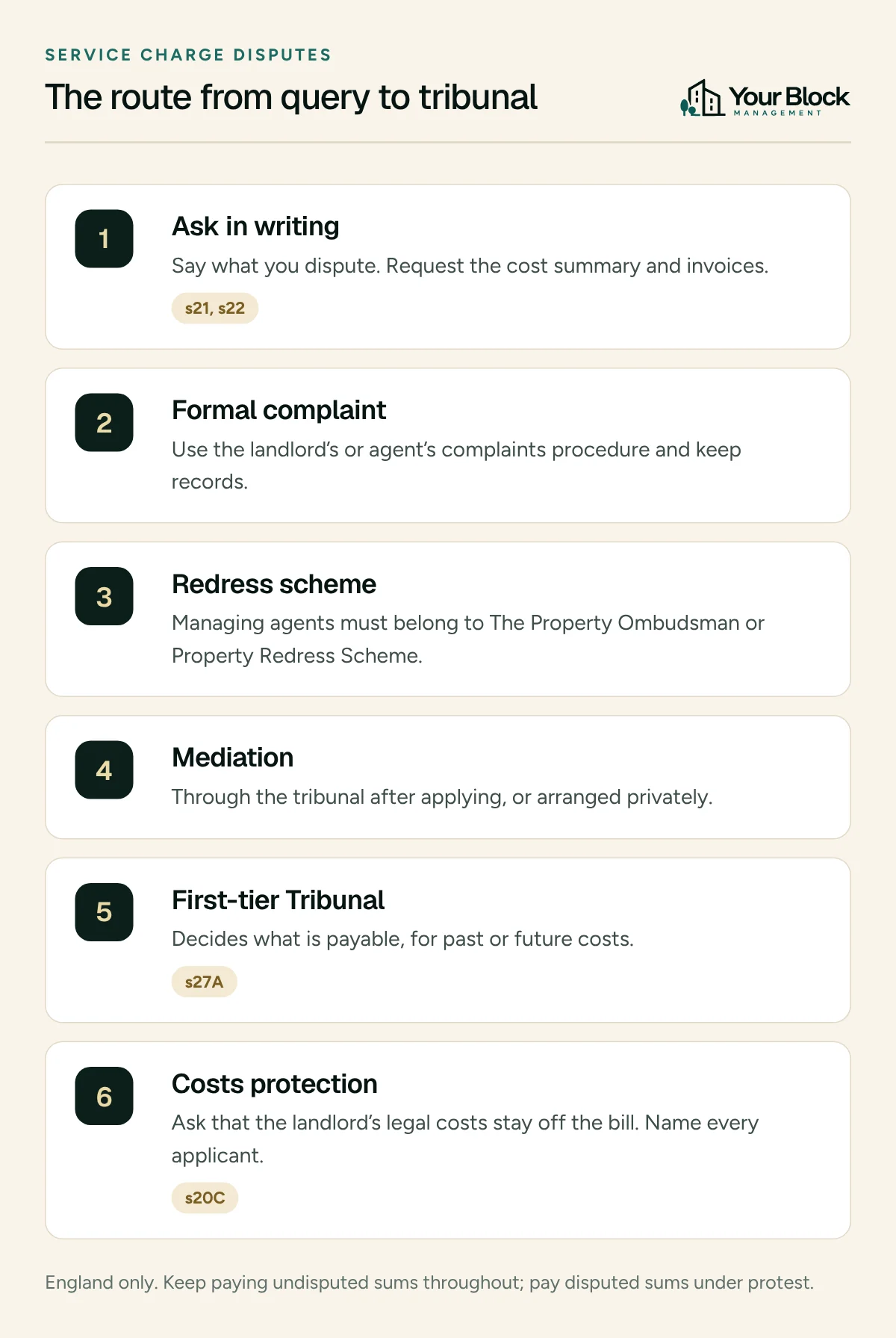
- Ask, in writing. Set out what you dispute and why. Request the cost summary under section 21 and then inspect invoices under section 22. For insurance, use section 30A. Keep copies of everything.
- Make a formal complaint. Use the landlord’s or agent’s complaints procedure. At Your Block we publish our complaints procedure so residents know exactly what happens and when.
- Use the redress scheme. Managing agents in England must belong to The Property Ombudsman or the Property Redress Scheme. Social landlords fall under the Housing Ombudsman. Private freeholders who manage their own blocks aren’t currently required to join a scheme.
- Consider mediation. LEASE, the government-funded Leasehold Advisory Service, notes that mediation may be available through the tribunal after you apply, or you can arrange it yourself.
- Apply to the First-tier Tribunal. Under section 27A it can decide whether a charge is payable, how much and when, for past or future costs. In England the application form is Leasehold 3. There’s no fixed time limit, but don’t sit on it.
- Ask for costs protection. Include applications under section 20C and paragraph 5A of Schedule 11, naming every leaseholder who wants to be covered.
Why you shouldn’t just stop paying
Withholding service charges is the most common mistake in service charge disputes. A landlord can’t forfeit your lease for unpaid service charges unless the amount has been admitted or decided by a tribunal or court (section 81 of the Housing Act 1996), and not at all for arrears of £350 or less unless part has been outstanding for more than three years. But once a determination is made, forfeiture proceedings become possible, legal costs may follow, and your mortgage lender may pay the arrears and add them to your loan. Our guide to when you can legally push back on a service charge covers this in more depth.
The safer approach: pay the undisputed part, pay the disputed part “under protest” in writing, and challenge it. Section 27A says payment alone is not an admission, so you can still recover money the tribunal finds wasn’t payable. One exception: if a demand comes without the statutory summary of rights and obligations, you may lawfully withhold that sum until it’s served.
If the same disputes keep coming back, the problem may be the management itself. See what a managing agent should be doing for you, how to tell the good agents from the ones to sack, and our FAQs on switching managing agent.
Frequently asked questions
Can I withhold my service charge while I dispute it?
It’s risky and usually a mistake. Unpaid sums can lead to court or tribunal action, extra costs and eventually forfeiture proceedings. Pay the undisputed part, pay the rest under protest in writing, and challenge it. Payment alone isn’t an admission, so the tribunal can still order money back. The main exception is a demand served without the statutory summary of rights.
Is there a time limit for challenging a service charge at the tribunal?
There’s no fixed deadline for an application under section 27A, but you can’t challenge something you have agreed or admitted, and delay weakens your evidence. Different limits apply to the landlord: costs billed more than 18 months after being incurred are generally irrecoverable unless you were notified in writing with a figure.
Do I need a solicitor for a service charge dispute?
Not always. The First-tier Tribunal is designed so leaseholders can represent themselves, costs orders are limited, and LEASE gives free initial advice. For complex leases, large sums or forfeiture threats, specialist advice is worth paying for. Groups of leaseholders often share the cost of one adviser and apply together.
Can the tribunal order the landlord to refund me?
The tribunal decides what was payable. If you have already paid more than that, you can rely on its decision to recover the difference, often by credit against future charges or by a court claim if the landlord won’t refund. Applications under section 20C and paragraph 5A can also stop the landlord adding its tribunal costs to your bill.
Who do I complain to about my managing agent?
Start with the agent’s own complaints procedure. If that fails, escalate to the redress scheme the agent belongs to: The Property Ombudsman or the Property Redress Scheme, as membership is compulsory for property management work in England. Complaints about social landlords go to the Housing Ombudsman. Disputes over whether a charge is payable go to the tribunal.
Sources and further reading
- Landlord and Tenant Act 1985, section 27A (tribunal jurisdiction)
- Daejan Investments Ltd v Benson [2013] UKSC 14, press summary
- Spender v Fit Nominee Ltd [2024] UKUT 175 (LC)
- Firstport Property Services Ltd v Various Leaseholders of Switch House [2023] UKUT 219 (LC)
- LEASE: Applying to the tribunal about service charges
This article is general information about the law in England, not legal advice. Leasehold law is changing, so check your lease and get professional advice for your own situation. Spotted something out of date? Tell us and we’ll fix it.