
Right to Manage Pros and Cons: The Honest Version Freeholders Won't Give You
Control on one side, responsibility on the other. A balanced look at whether right to manage is right for your block, and what else you could do.

The short version
- RTM gives leaseholders control of the agent, budget, contractors and insurance without paying a premium.
- Since March 2025 leaseholders generally no longer pay the freeholder’s costs of an RTM claim.
- Volunteer directors take on service charge, section 20 and fire safety duties, with some personal risk.
- The freeholder keeps ownership, ground rent, forfeiture and a say over consents.
- Alternatives include a section 24 manager, buying the freehold or persuading the freeholder to switch agent.
The honest right to manage pros and cons come down to this. Right to manage (RTM) gives leaseholders control of their building’s agent, budget, contractors and insurance, with no premium and, since March 2025, usually without paying the freeholder’s costs. In return, volunteer directors take on real legal duties, neighbours have to cooperate, and the freeholder keeps more than most people expect.
Freeholders tend to stress the downsides and RTM promoters the upsides. This guide sets out both, explains who RTM suits, and compares the alternatives. The law described is for England. For the mechanics of a claim, read our full right to manage guide.
The real advantages of right to manage
1. You choose who manages your building
The RTM company appoints, and can dismiss, the managing agent. If the current agent is slow, opaque or expensive, this is the most direct fix. You can also choose to self-manage.
2. You control spending decisions
The board sets the budget, chooses contractors and places the buildings insurance. You can obtain your own insurance quotes and ask brokers about commission. Since 31 December 2023, FCA rules have required insurers to provide information on policy pricing, including commission, which freeholders and agents can pass on to leaseholders. The FCA did not ban commission.
3. No fault to prove, no price to pay
Unlike asking a tribunal to appoint a manager, you do not have to prove mismanagement. Unlike buying the freehold, there is no valuation and no premium. If the building qualifies and enough leaseholders join, the freeholder cannot stop the claim.
4. The 2025 changes cut the risk
Before 3 March 2025, an RTM company paid the freeholder’s reasonable costs of dealing with the claim. Under the new section 87A of the Commonhold and Leasehold Reform Act 2002 (CLRA 2002), the company and its members are generally not liable for them. The non-residential limit also rose from 25% to 50%, so more mixed-use blocks qualify. And the Supreme Court’s Cresta Court ruling of August 2026 means a missed invitation notice no longer sinks an otherwise valid claim.
5. Faster and simpler than buying the freehold
An uncontested claim typically takes five to seven months, and the legal paperwork is lighter than collective enfranchisement.
The real disadvantages of right to manage
1. Someone has to do the work
The RTM company needs directors, and the prescribed articles set a board quorum of two. Directors are unpaid unless members vote otherwise. Even with a managing agent, the board approves budgets, signs off major works, deals with complaints and keeps the company filed at Companies House. When enthusiastic founders sell up, blocks often struggle to replace them.
2. The duties and liability are real
Once it takes over, the RTM company is bound by service charge law, including the section 20 consultation rules for major works. It also becomes a responsible person for fire safety in the common parts. Under article 32(8) of the Regulatory Reform (Fire Safety) Order 2005, a director whose consent, connivance or neglect leads to the company committing an offence can be personally prosecuted. Read RTM directors’ responsibilities before anyone volunteers.
3. Neighbour friction
You are now managing, and sometimes chasing, the people you live next to. Arrears are a common flashpoint. The RTM company can sue for unpaid service charges, but it cannot forfeit a lease (section 100(3)). Disagreements about spending on the roof versus the garden become disagreements between neighbours.
Illustrative example: a 10-flat block with a £20,000 annual budget, so £2,000 per flat. If two owners stop paying, £4,000 is missing. The RTM company has no landlord’s balance sheet behind it, so that means delaying works or dipping into the reserve until the debt is recovered. Recovery can mean a county court claim against a neighbour. A healthy reserve fund and a clear, written arrears policy agreed in advance make this much less personal.
4. The freeholder keeps more than you think
- Ownership and ground rent stay with the freeholder.
- Consents: before granting a consent such as subletting or alterations, the RTM company must give the landlord 30 days’ notice (14 for others), and the landlord can object (sections 98 and 99).
- Reporting: the RTM company must report leaseholder breaches to the landlord within three months (section 101).
- Membership: after takeover the freeholder can join the company and vote, although since March 2025 landlord votes are capped at one third of the qualifying tenants’ votes.
5. It does not fix the lease
RTM changes who manages, not what the lease says. Short leases, onerous ground rent and badly drafted repair clauses remain. A poorly drafted service charge clause binds the RTM company just as it bound the freeholder.
6. It is not free, and it can end
You will still pay for incorporation, notices, company insurance and accounts, and possibly a professional to check the claim. A tribunal can order the company to pay the freeholder’s costs if a failed claim was pursued unreasonably (section 87B). After takeover, if the company is struck off for not filing, the right to manage ends automatically (section 105). The tribunal can also appoint a manager over a failing RTM company.
Right to manage pros and cons side by side
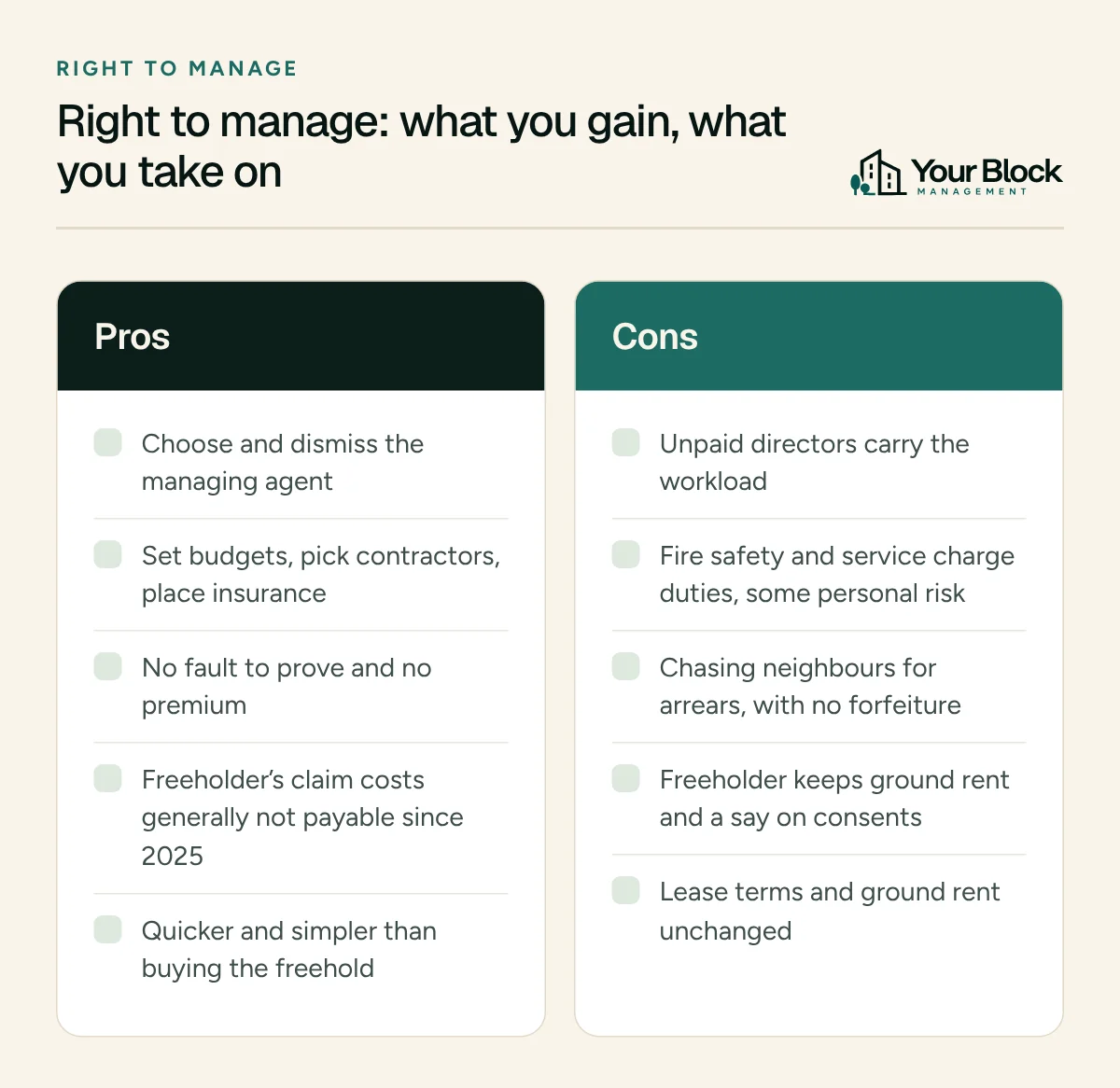
The pattern is clear. The benefits are about control, and the costs are about responsibility. If your block has the people to carry the responsibility, the control is usually worth it.
Who right to manage suits, and who it doesn’t
RTM tends to work well where:
- most flats are owner-occupied, or investor owners are engaged;
- two or three people are willing to be directors for several years;
- the main complaint is about the management (cost, responsiveness, transparency), not the lease;
- the building is a single self-contained block without complex shared services.
Think harder where:
- most owners are absent landlords who are hard to contact;
- there are known big-ticket problems such as cladding, structural defects or a failing lift. Your board would be taking these on, and qualified advice is essential;
- the block is a higher-risk building (18m+ or 7+ storeys) with Building Safety Act duties;
- the real goal is a longer lease or getting rid of ground rent, which RTM does not deliver.
The alternatives to right to manage
Ask the freeholder to change the agent
Many freeholders will change agent if leaseholders present a clear case. A recognised tenants’ association can also serve notice under section 30B of the Landlord and Tenant Act 1985 requiring the landlord to consult it about the managing agent. This costs little and keeps the duties with the freeholder, but the decision stays theirs.
Apply for a tribunal-appointed manager (section 24)
Under Part 2 of the Landlord and Tenant Act 1987, the First-tier Tribunal can appoint a manager where the landlord is in breach of management obligations, service charges are unreasonable, the RICS Code has not been followed, or it is otherwise “just and convenient”. You must usually serve a preliminary notice first and prove your case. The manager answers to the tribunal, not to you. See our guide to the court-appointed managing agent route.
Buy the freehold (collective enfranchisement)
Qualifying tenants of at least half the flats can buy the freehold under the Leasehold Reform, Housing and Urban Development Act 1993. You then own the building and can grant yourselves lease extensions. The catches: you pay a premium, marriage value still applies because its abolition has not been commenced, and the non-residential limit for enfranchisement is still 25%. Compare the two in right to manage or buy the freehold.
Switch agent and stay put
If your freeholder is reasonable and the problem is the agent, a better agent may solve it without a company. That was the thinking behind our own model at Your Block. We give every resident a portal login to track repairs, see budgets against actual spending and take part in informal polls, whoever our client is.
Questions to settle before you decide
- Do we have qualifying tenants of at least half the flats willing to join?
- Who will be the first two or three directors, and who will replace them?
- Are there known major works, safety or cladding issues the company would inherit?
- Will we self-manage or appoint an agent, and has the board met any agents yet?
- Do we want help with the notices? Our guide to right to manage solicitors explains what that costs and when it is worth it.
- Is our real problem management, or the lease itself?
If the answers point to RTM, the next step is forming the RTM company. If you would rather talk it through with a local agent first, our page for RTM and RMC directors explains how we work with boards.
Frequently asked questions
What is the biggest disadvantage of right to manage?
For most blocks it is the volunteer burden. The RTM company needs at least two directors who will approve budgets, handle major works consultation, keep fire safety on track and file at Companies House, usually unpaid. When founding directors move away, blocks that cannot replace them run into trouble. A managing agent reduces the work, but the board stays responsible.
Can the freeholder stop right to manage?
Not if the building qualifies, enough qualifying tenants are members and the claim is valid. The freeholder can dispute entitlement by counter-notice, and the tribunal then decides. Since the Supreme Court’s August 2026 Cresta Court ruling, a missed invitation notice or short 14-day wait is not enough on its own to defeat a claim.
Is right to manage cheaper than buying the freehold?
Usually much cheaper to obtain, because there is no premium or valuation and, since March 2025, generally no liability for the freeholder’s costs. But RTM gives you management only. Buying the freehold costs more but gives ownership and lets you grant yourselves lease extensions. Which is better value depends on your lease lengths and ground rent.
Does right to manage affect selling my flat?
Buyers’ solicitors will ask who manages the building and send enquiries to the RTM company or its agent instead of the freeholder. A well-run RTM company with clear accounts and up-to-date safety records can help a sale. A struggling one with missing documents, arrears or lapsed filings can slow it down.
Sources and further reading
This article is general information about the law in England, not legal advice. Leasehold law is changing, so check your lease and get professional advice for your own situation. Spotted something out of date? Tell us and we’ll fix it.