Right to Manage: How Leaseholders Are Taking Back Control of Their Buildings
Every step, deadline and cost of taking over your building’s management, updated for the 2025 reforms and the Supreme Court’s 2026 Cresta Court ruling.
 By Sam Charlesworth11 min read
The short version
- RTM transfers management, not ownership: no premium, no need to prove fault, leases unchanged.
- You need qualifying tenants of at least half the flats as members when the claim notice is served.
- Uncontested claims take five to seven months; the legal minimum is about four and a half.
- Since 3 March 2025 RTM companies generally no longer pay the freeholder’s costs of the claim.
- After acquisition the RTM company must follow service charge, section 20 and fire safety law.
The right to manage (RTM) is a legal right that lets leaseholders in a block of flats take over the management of their building from the freeholder, without proving the freeholder has done anything wrong and without paying them compensation. You form an RTM company, serve the right notices, and on a fixed date the company takes control of repairs, insurance, service charges and the managing agent.
This guide covers the whole journey for blocks in England: whether your building qualifies, each step and its deadline, what changes hands and what the freeholder keeps, what it costs now that the 2025 reforms are in force, and what life looks like afterwards. Wales has its own rules and Scotland has no leasehold system of this kind.
What is the right to manage?
The right to manage comes from Chapter 1 of Part 2 of the Commonhold and Leasehold Reform Act 2002 (CLRA 2002). It is often called a no-fault right: you do not need to show the freeholder or their agent has been slow, expensive or careless. If the building and the leaseholders meet the qualifying rules and the process is followed, the freeholder cannot stop it.
Three points surprise most people:
- The freehold does not change hands. The freeholder still owns the building and still collects ground rent. RTM transfers management, not ownership.
- Nobody pays a premium. Unlike buying the freehold, there is no valuation and no price.
- The leases do not change. Your service charge proportion, repair obligations and lease length stay exactly as they are. What changes is who carries out the landlord’s management side of the lease.
The body that takes over is an RTM company: a private company limited by guarantee, owned by the participating leaseholders, using articles of association prescribed by law. We cover how it is set up, who can join and its running costs in our separate guide to the RTM company itself.
Does your building qualify for the right to manage?
Section 72 of CLRA 2002 sets three tests. The premises must be:
- a self-contained building, or a self-contained part of a building (a part that is structurally detached, or divides vertically and could be run independently, with its own services);
- containing at least two flats held by qualifying tenants; and
- where qualifying tenants hold at least two-thirds of all the flats.
A qualifying tenant is, broadly, someone who owns a flat on a long lease, meaning one originally granted for more than 21 years (sections 75 and 76). People renting on an assured shorthold tenancy are not qualifying tenants, although the flat’s owner may be. Each flat has only one qualifying tenant, so joint owners count once.
Schedule 6 then excludes some buildings:
- where the non-residential parts (shops, offices) take up more than 50% of the internal floor area, ignoring common parts;
- small converted buildings of no more than four units with a resident landlord who has lived there as their only or main home for 12 months (purpose-built blocks are not caught);
- buildings where a local authority is the landlord;
- buildings where RTM was exercised and ended in the last four years, unless the tribunal allows a new claim.
For a fuller walk-through, including estates with several blocks and buildings with shared plant, see whether your building passes the qualifying criteria.
The right to manage process, step by step
Step 1: Count heads and check the numbers
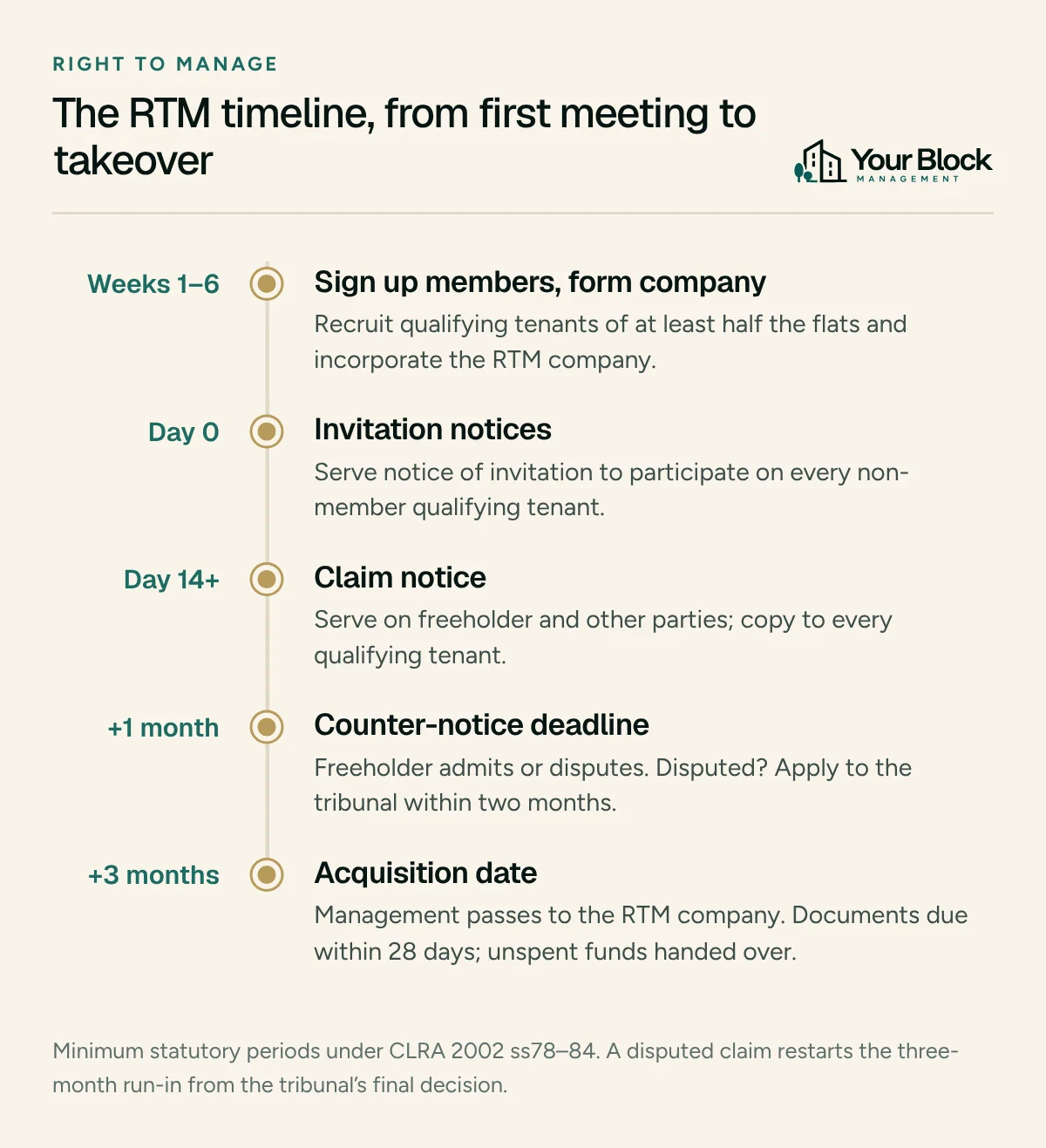
At the date you serve the claim notice, the RTM company’s members must include the qualifying tenants of at least half of the total number of flats in the building (section 79(5)). If there are only two flats, both must join.
Illustrative example: a 12-flat block where 10 flats are on long leases and 2 are owned outright by the freeholder and let out. Ten out of 12 is 83%, comfortably above two-thirds, so the building qualifies. The membership test is half of all 12 flats, so you need at least 6 qualifying tenants signed up, not 5.
Step 2: Form the RTM company
Incorporate a private company limited by guarantee at Companies House using the prescribed RTM articles. By convention its name ends “RTM Company Limited”, and only an RTM company may use “RTM” in its name. Online incorporation currently costs £100. Directors now have to verify their identity with Companies House as part of incorporation.
Step 3: Gather the information you need
The claim notice must list every member’s name, flat and lease details (date, term and start date). Office copies of leases from HM Land Registry usually give you this. If you need information held by the freeholder or anyone else, the RTM company can serve a notice under section 82; the recipient has 28 days to comply. The company has to pay the recipient’s reasonable costs of complying.
Step 4: Serve the notice of invitation to participate
Every qualifying tenant who is not already a member, and has not agreed to become one, must be sent a notice of invitation to participate (section 78), in the prescribed form, with a copy of the articles or details of where to inspect them. You must then wait at least 14 days before serving the claim notice (section 79(2)).
In the Cresta Court case (judgment 27 August 2026), the Supreme Court held that these two rules are procedural requirements, not conditions of entitlement. A freeholder can no longer defeat an otherwise valid claim just because one leaseholder was missed or the 14 days were cut short. The rules still apply, and the First-tier Tribunal can order a company to put a breach right under section 107, so follow them.
Step 5: Serve the claim notice
The claim notice (sections 79 and 80) goes to the freeholder, any intermediate landlord, any other party to the leases such as a management company, and any tribunal-appointed manager. A copy goes to every qualifying tenant. It must use the prescribed form and give:
- a counter-notice deadline at least one month after the notice is given; and
- an acquisition date at least three months after that deadline.
Most claims that fail do so here: the wrong premises described, a landlord left out, or dates miscalculated. This is the step where paying for a professional check is most worthwhile. We weigh up when you need a right to manage solicitor in a separate guide.
Step 6: Wait for the counter-notice
By the deadline, the freeholder can serve a counter-notice admitting the claim or disputing it, naming the provision they say has not been met (section 84). Many freeholders do not respond at all, which counts as no dispute.
If the claim is disputed, the RTM company has two months to apply to the First-tier Tribunal (Property Chamber). Miss that window and the claim notice is treated as withdrawn (section 87). If the tribunal finds in your favour, the acquisition date becomes three months after its decision is final.
Step 7: Handover and the acquisition date
Before the acquisition date, the outgoing manager must send “contractor notices” to existing contractors and “contract notices” to the RTM company (section 92), so you know which contracts are running. On the acquisition date management passes to the company. From then on it can demand documents it reasonably needs, which must be handed over within 28 days (section 93), and the outgoing side must pay over any accrued uncommitted service charges, meaning the reserve and other unspent funds (section 94).
How long does right to manage take?
The statutory minimum, from posting invitation notices to taking control, is roughly four and a half months: 14 days, then at least one month, then at least three months. In practice, allow five to seven months for an uncontested claim once you add time to form the company, sign up members and get lease details.
A disputed claim adds the tribunal stage. The application is due within two months of the counter-notice, the hearing takes as long as the tribunal’s list allows, and then the three-month run-in starts again from the final decision. A contested claim can easily run past a year. That is one reason to get the claim notice right first time.
What transfers to the RTM company, and what the freeholder keeps
Section 96 transfers the landlord’s “management functions” under the leases: services, repairs, maintenance, improvements, insurance and management. The table sets out the split.
| RTM company takes over | Freeholder keeps |
|---|---|
| Repairs and maintenance of structure and common parts | Ownership of the freehold and any right to sell it |
| Setting budgets and collecting service charges | Ground rent |
| Buildings insurance (where the lease puts it on the landlord) | Forfeiture and re-entry: the RTM company cannot forfeit a lease (section 100(3)) |
| Appointing and dismissing the managing agent and contractors | Management of flats not held by qualifying tenants, where the function relates only to that unit |
| Granting consents under the lease, after notice to the landlord | The right to object to consents and to receive reports of breaches |
| Enforcing leaseholder covenants (other than by forfeiture) | Lease extensions and freehold sales |
Two details matter in practice. First, consents: before granting a consent for assignment, subletting, charging, structural alterations or change of use, the RTM company must give the landlord 30 days’ notice; for other consents it is 14 days (section 98). If the landlord objects, the company needs their written agreement or a tribunal decision (section 99). Second, if any flats are not let on long leases, the landlord must pay the RTM company the share of service costs those units would carry (section 103).
What does right to manage cost after the 2025 changes?
Before 3 March 2025, an RTM company had to pay the freeholder’s reasonable costs of dealing with the claim, and those bills could be significant. Section 50 of the Leasehold and Freehold Reform Act 2024 repealed that rule. Under the new section 87A of CLRA 2002, the RTM company and its members are not liable for anyone else’s costs arising from a claim notice, with limited exceptions:
- the reasonable cost of complying with a section 82 information notice;
- costs a court or tribunal orders under some other power, for example for unreasonable conduct in proceedings;
- under section 87B, where a claim is withdrawn or fails and the RTM company acted unreasonably, the tribunal can order it to pay the landlord’s reasonably incurred costs, and current and former members become jointly liable.
Separately, section 20J of the Landlord and Tenant Act 1985 stops the freeholder recovering its RTM claim costs through the service charge.
Your own costs remain. Expect Companies House fees (£100 to incorporate online, £50 a year for the confirmation statement), any legal or specialist help with the notices, directors’ and officers’ insurance once you take over, and annual accountancy. The RTM company guide breaks the running costs down.
Life after acquisition: running the building
On the acquisition date the RTM company steps into the landlord’s shoes for management, and the law treats it that way. Schedule 7 applies sections 18 to 30 of the Landlord and Tenant Act 1985 to the RTM company. That means the reasonableness test, the 18-month rule, the summary of rights with every demand and section 20 consultation for major works all apply, and service charge money is held on statutory trust.
Other duties come with it:
- Fire safety: the company is a responsible person for the common parts under the Regulatory Reform (Fire Safety) Order 2005, so it needs a current fire risk assessment.
- Reporting breaches: the company must monitor whether leaseholders keep their covenants and report breaches to the landlord within three months of becoming aware of them (section 101).
- The freeholder can join: from the acquisition date, landlords are entitled to become members. Since 3 March 2025 their votes are capped at one third of the votes of qualifying tenants (SI 2025/130).
- Keep the company alive: if the company is struck off for not filing, the right to manage ends (section 105).
The directors carry all this, usually unpaid. Read what RTM directors are signing up for before you volunteer. Most RTM companies appoint a managing agent to handle the daily work while the board keeps control of decisions. At Your Block we set up RTM boards with a resident portal that every resident can log into, showing repairs, budgets against actual spending and informal polls. Those polls stay separate from the company’s formal votes.
Is right to manage right for your block?
RTM works best where enough neighbours want change and two or three are willing to serve as directors. It doesn’t fix lease terms, ground rent or a short lease. It also gives you no say over a freehold sale, beyond the right of first refusal you already have. For the trade-offs, read our honest pros and cons of right to manage. If you are unsure whether you want management or ownership, compare right to manage with buying the freehold first.
On reform: the Government’s draft Commonhold and Leasehold Reform Bill has not yet been introduced to Parliament. As at October 2026, the RTM rules described above are the law in England. Recheck the position before you serve notices.
Frequently asked questions
Can the freeholder refuse a right to manage claim?
Only by showing the RTM company was not entitled, for example because the building does not qualify or too few qualifying tenants were members on the claim date. The freeholder does this by counter-notice, and the tribunal decides. Since the Supreme Court’s Cresta Court ruling in August 2026, missing an invitation notice or the 14-day wait is not enough on its own.
Do all leaseholders have to join the RTM company?
No. Qualifying tenants of at least half the flats must be members when the claim notice is served. Others can join later or never. Non-members still pay service charges under their leases, but to the RTM company once it takes over, and the company manages the whole building for everyone.
Does right to manage reduce service charges?
Not automatically. Leaseholders gain control of contractor choice, insurance and the agent’s fee, which can cut costs, but the building still has to be insured, maintained and kept compliant. Some blocks spend more in the early years catching up on neglected repairs. The gain is control and transparency rather than a guaranteed saving.
Who pays the freeholder’s legal costs in an RTM claim now?
Since 3 March 2025, generally nobody on the leaseholder side. Section 87A of CLRA 2002 means the RTM company and its members are not liable for the freeholder’s costs, except for information-notice compliance costs, tribunal costs orders, or where a failed claim was pursued unreasonably under section 87B.
Can we use right to manage if our block has shops underneath?
Possibly. Since 3 March 2025 a building is only excluded if non-residential parts exceed 50% of the internal floor area, ignoring common parts. Before that the limit was 25%. Measure the floor areas carefully, because this is a common ground for a freeholder’s counter-notice.
Sources and further reading
- Commonhold and Leasehold Reform Act 2002, Part 2 Chapter 1 (Right to manage)
- Commonhold and Leasehold Reform Act 2002, section 87A (costs)
- The Leasehold and Freehold Reform Act 2024 (Commencement No. 3) Regulations 2025 (SI 2025/131)
- LEASE: Supreme Court clarifies right to manage rules for leaseholders
This article is general information about the law in England, not legal advice. Leasehold law is changing, so check your lease and get professional advice for your own situation. Spotted something out of date? Tell us and we’ll fix it.