What Is Block Management? The Plain-English Guide Every Flat Owner Needs
Who looks after your building, why it needs looking after, and the words you will keep hearing, explained without the jargon.
The short version
- Block management is running the shared parts of a block: repairs, insurance, safety and the service charge.
- Your lease decides what is yours to maintain and what is shared.
- A managing agent works for whoever appointed it: the freeholder, an RMC or an RTM company.
- Service charge money is held on trust for leaseholders, not owned by the agent.
- You can ask for a summary of costs and inspect receipts if something looks wrong.
What is block management? It is the job of looking after the shared parts of a block of flats: the roof, walls, stairs, hallways, gardens, insurance and safety checks. Someone has to organise repairs, collect everyone’s contributions through the service charge, keep the building insured and meet fire safety law. That work, and the person or company doing it, is block management.
If you own or rent a flat, block management affects you whether you notice it or not. This plain-English guide explains what it is, why it exists, who does what, and how it shows up in your life. It covers England, where most flats are owned on a lease.
What is block management? A simple definition
When you buy a flat in England, you almost always buy a lease: the right to live in your flat for a long period, often 99 or 125 years or more. Someone else, the freeholder, owns the building itself. Sometimes that is an outside landlord, and sometimes the flat owners own it together through a company.
Your lease divides the building into two parts:
- Your flat, which you look after yourself.
- The common parts, which everyone shares and pays towards: usually the structure, roof, outside walls, entrance, stairs, corridors, lift, bin store and grounds.
Block management is everything involved in running that second part. It is usually done by a managing agent, a firm paid to do the day-to-day work, though some small blocks manage themselves.
Why does a block of flats need managing at all?
In a house, you fix your own roof. In a block, ten or twenty households share one roof, and nobody can fix it alone. Block management exists because:
- Shared things need one decision-maker. Someone has to choose the roofer, approve the quote and make sure the job is done properly.
- Costs have to be shared fairly. Your lease says what share you pay. Someone has to work out budgets, send bills and keep accounts.
- The building needs one insurance policy. You cannot insure the walls of your flat separately from the walls of the flat next door.
- The law requires it. For example, the Regulatory Reform (Fire Safety) Order 2005 requires a written fire risk assessment of the common parts, and residents in any block with two or more flats must be given fire safety instructions.
- Money must be protected. Service charge money is held on trust for the leaseholders under section 42 of the Landlord and Tenant Act 1987. It is not the agent’s money.
Who is responsible for what in block management?
Several people and organisations may be involved. Here is a quick guide:
| Who | Their role |
|---|---|
| Freeholder (landlord) | Owns the building. Usually legally responsible for repairs and insurance under the lease. |
| Residents’ management company (RMC) | A company, normally owned by the flat owners, that runs the building under the lease or owns the freehold. |
| RTM company | A company leaseholders can form to take over management from the freeholder using the Right to Manage. |
| Managing agent | The firm hired by the freeholder, RMC or RTM company to do the day-to-day work. |
| Leaseholder (you, if you own) | Pays the service charge, looks after the inside of the flat and follows the lease. |
| Tenant (you, if you rent) | Deals with the flat’s owner as landlord, but follows the building’s rules and can report communal problems. |
The key point: the managing agent works for whoever appointed it. If your block has an RMC or RTM company, the leaseholders are effectively the agent’s boss through their directors. Our complete guide to block management in the UK explains the legal framework behind each role.
How block management shows up in your life
Most of the time, good block management is invisible: the stairs are clean, the lights work and the bills make sense. Here is where you will notice it.
Service charge bills
You pay your share of the building’s costs, usually once or twice a year, based on a budget. Each bill must come with a statutory summary of your rights. Hamptons’ 2025 Service Charge Index put the average for flats in England and Wales at £2,405 a year. Our service charge guide shows where that money goes, and our guide to what you are paying for in block management separates the agent’s fee from the building’s running costs.
Reporting a repair
If a communal light fails, the entry door breaks or water comes through your ceiling from the roof, you report it to the managing agent. A good agent acknowledges it, tells you who is coming and when, and lets you know when it is fixed.
Letters about big works
If the building needs major works and your share would be more than £250, the law requires a formal consultation first. That arrives as a “section 20 notice”. Our guide to what to do when a section 20 notice arrives explains your rights.
Fire safety information
You should be told how to report a fire, what the evacuation plan is (for example, whether to stay put or leave) and why fire doors matter.
Meetings and votes
If you are a member of an RMC or RTM company, you may be invited to an annual meeting to discuss the accounts, budget and planned works.
Selling your flat
Your buyer’s solicitor will ask the managing agent for a pack of information about the building, its finances and any planned works.
Your first month in a block: what to find out
Whether you have just moved in or have lived there for years without asking, these are the basics every resident should know.
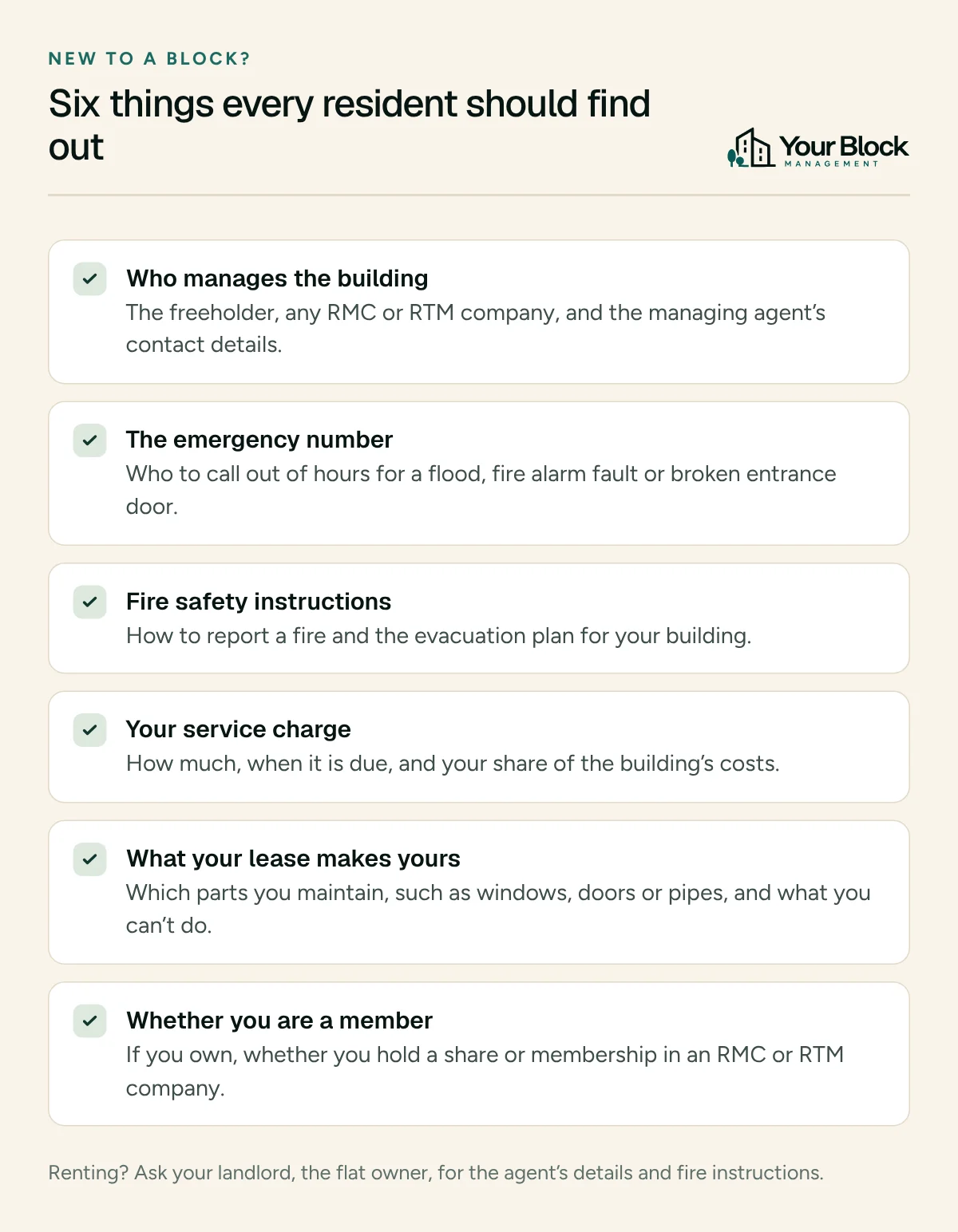
Your lease is the most important document. If you do not have a copy, you can usually download it from HM Land Registry for a small fee, or ask your solicitor. LEASE, the government-funded Leasehold Advisory Service, gives free initial advice on what it means.
Block management glossary: the words you will hear
- Lease: the legal document that gives you the right to your flat for a set number of years and sets out everyone’s duties.
- Leaseholder: the owner of a flat on a long lease.
- Freeholder: the owner of the building and the land it stands on, and your landlord.
- Demise: the part of the building your lease gives you, in other words your flat.
- Common parts: the shared areas and structure that everyone pays to maintain.
- Service charge: your share of the cost of running the building.
- Ground rent: a separate yearly payment to the freeholder under some leases. Most new leases since 30 June 2022 can only charge a peppercorn, meaning nothing.
- Reserve fund (or sinking fund): money saved over time for big future costs such as a new roof.
- Managing agent: the firm paid to run the building day to day.
- RMC: residents’ management company, a company that runs the block, usually owned by the flat owners.
- RTM: Right to Manage, the legal right for qualifying leaseholders to take over management without buying the freehold.
- Share of freehold: where the flat owners jointly own the freehold, usually through a company. You still have a lease.
- Section 20: the consultation process required before major works or long contracts above set limits.
- Fire risk assessment (FRA): a written assessment of fire risks in the common parts, required by law.
- First-tier Tribunal: the tribunal that decides disputes about service charges and other leasehold matters.
- Redress scheme: an ombudsman-style service that managing agents must belong to, for complaints they cannot resolve.
What good block management should feel like
You should know who manages your building and how to reach them. Repairs should be acknowledged quickly and updated without you chasing. Bills should be explained and accounts should arrive on time. Big decisions should be explained before they happen, not after.
At Your Block we think residents deserve to see what is happening in their building. Every resident, owners and tenants, gets a login to our resident portal to report repairs with photos, follow progress and see how the budget is being spent. For a fuller test of your current service, see our checklist for a good block management service.
What if something isn’t right?
You have more rights than most people realise. Service charges must be reasonable (section 19 of the Landlord and Tenant Act 1985). You can ask for a summary of costs and then inspect the receipts (sections 21 and 22). If you are unhappy, complain in writing to the managing agent first, then to its redress scheme, either The Property Ombudsman or the Property Redress Scheme. Disputes about how much you have to pay can go to the First-tier Tribunal. And if you own your flat, Right to Manage may let you and your neighbours take over altogether. Our portal FAQs explain how residents raise issues with Your Block on the record.
Frequently asked questions
Is block management the same as a managing agent?
Not quite. Block management is the work of running the building. A managing agent is the firm usually paid to do it. Some blocks are managed directly by the freeholder or by volunteer directors of a residents’ management company, without an agent, although many small blocks find an agent saves time and reduces risk.
Who pays for block management?
The leaseholders do, through the service charge, in the shares set by their leases. That covers both the building’s running costs, such as insurance, cleaning and repairs, and the managing agent’s fee. Tenants renting a flat do not normally pay service charge directly, because it is the flat owner’s responsibility.
Can I choose my building’s managing agent?
It depends who appointed it. If the flat owners control an RMC or RTM company, the directors choose and can change the agent. If an outside freeholder appointed it, leaseholders usually cannot replace it directly, but they may be able to take over management through the Right to Manage.
Does block management apply to houses?
Not in the same way. Block management is about shared buildings. Some freehold houses on new estates pay estate charges to a management company for shared roads and green spaces, which is a related but different arrangement with its own rules.
Where can I get free advice about my lease?
LEASE, the Leasehold Advisory Service, is government-funded and gives free initial advice on residential leasehold law in England. For complaints about a managing agent, use the agent’s complaints procedure first, then its redress scheme, The Property Ombudsman or the Property Redress Scheme.
Sources and further reading
This article is general information about the law in England, not legal advice. Leasehold law is changing, so check your lease and get professional advice for your own situation. Spotted something out of date? Tell us and we’ll fix it.