Block of Flats Living: Who Runs It, Who Pays and How to Make It Work
Ownership set-ups, who fixes what, the neighbour issues that come up most, and how renters’ and owners’ rights differ in the same building.

The short version
- Your lease, not custom, decides which parts are yours to repair and which the building pays for.
- Roof costs are usually shared through the service charge, not paid by top-floor owners alone.
- Short-term lets can breach a ‘private residence’ covenant, as the Upper Tribunal found in Nemcova.
- Flat entrance doors fall within fire safety law even when the lease makes them yours.
- Tenants report to their landlord and cannot use leaseholders’ service charge rights.
In a block of flats in England, the building is usually owned by a freeholder, run by them or by a residents’ company, and managed day to day by a managing agent. You look after your own flat; everyone shares the cost of the roof, structure and common parts through the service charge. Your lease decides exactly where that line falls, and how neighbour problems get resolved.
This guide is about living in a block: the ownership set-ups you will meet, who pays for which repairs, the neighbour issues that come up most often, and how renters’ and owners’ rights differ. It covers England only.
Who owns and runs a block of flats? The common set-ups
Almost every flat in England is sold on a long lease. What varies is who owns the freehold and who controls management.
| Set-up | Who owns the building | Who runs it | What it means for you |
|---|---|---|---|
| Leasehold with an outside freeholder | An individual, company or investor | The freeholder, usually through a managing agent it chooses | You pay, but have limited say over who manages. |
| Residents’ management company (RMC) | Varies: the RMC may own the freehold or be a party to the lease | The RMC’s directors, often volunteer residents, usually with an agent | Owners are members and can vote on directors and big decisions. |
| Share of freehold | The flat owners together, usually through a company | The owners’ company, with or without an agent | You still hold a lease, but you are also part of your own landlord. |
| Right to Manage (RTM) | The freeholder keeps ownership | An RTM company formed by the leaseholders | Leaseholders take over management without buying the freehold. |
| Commonhold | Each owner owns their flat outright; a commonhold association owns the common parts | The commonhold association | Rare today. The Government plans to make it the default for new flats. |
Blocks owned by councils or housing associations often contain leaseholders too. Their complaints go to the Housing Ombudsman rather than the schemes covering private managing agents.
If you are not sure which applies to you, look at your lease and the Land Registry title, or ask your managing agent. Our guides to what share of freehold really means and how Right to Manage works go into those two routes in detail.
Who pays for what in a block of flats?
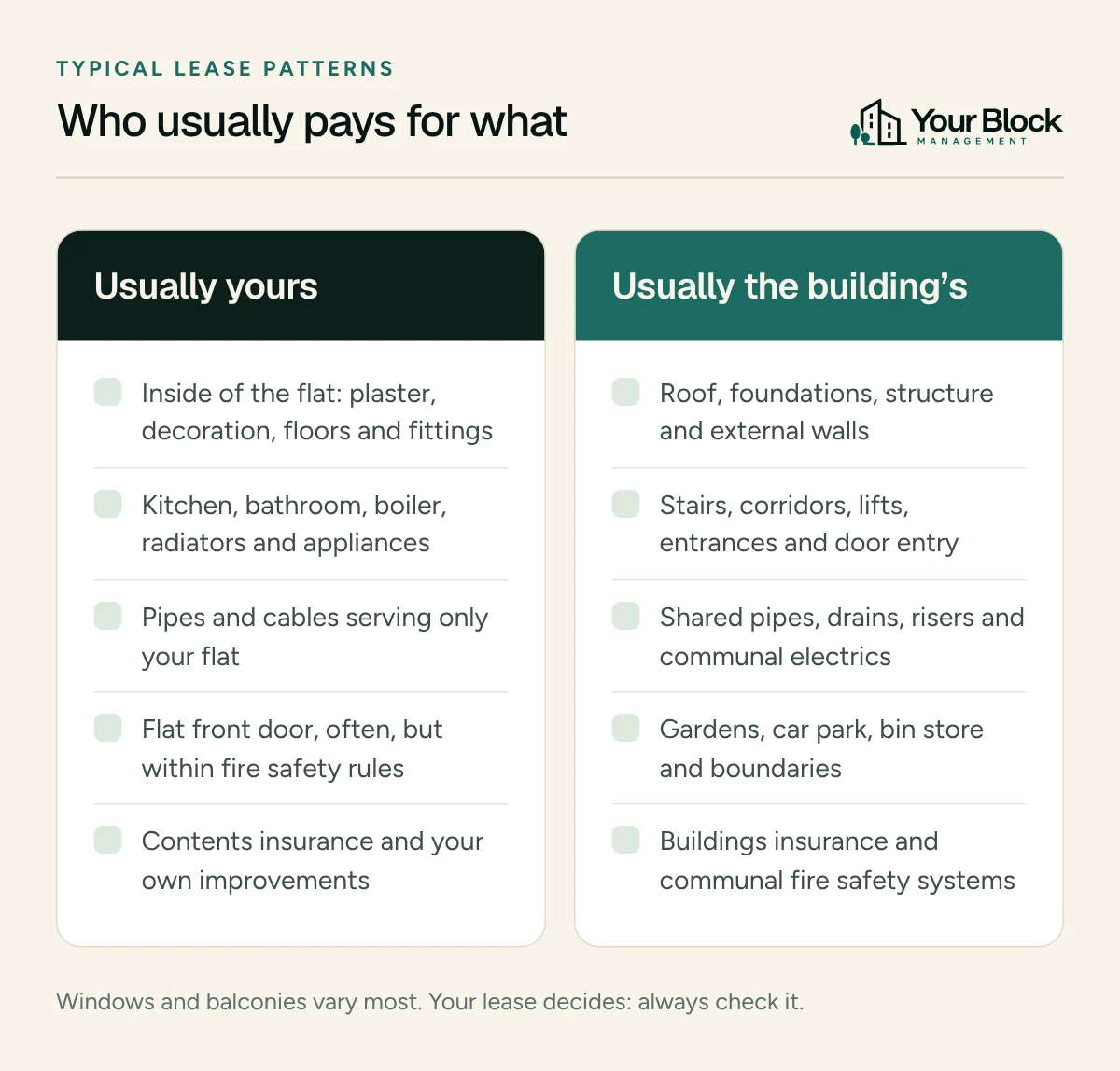
Your lease divides the building into your demise, meaning the flat you own and maintain, and the common parts and structure, maintained by the landlord or management company and paid for by everyone through the service charge. There is no universal rule. Two blocks on the same street can have different leases, so treat the patterns below as typical, not guaranteed.
Windows
This is the one leases disagree on most. Some include the window frames and glass in your flat, some include only the glass, and some keep the whole window as part of the building’s structure. Read the lease definition of the flat, usually in the first schedule, before replacing anything.
Roof
The roof is almost always part of the building. Top-floor owners do not normally pay for it alone: the cost is shared through the service charge in the proportions the lease sets. If your share of a roof replacement would be over £250, the landlord must consult first under section 20 of the Landlord and Tenant Act 1985. As an illustration, a £60,000 roof split equally across 12 flats is £5,000 each.
Pipes, drains and wiring
A common rule in leases is that pipes and cables serving only your flat are yours, while those serving more than one flat, such as the main stack or rising mains, belong to the building. Where they run matters less than who they serve.
Balconies
Often the surface and railings are treated differently from the slab or structure. Fire safety law now expressly covers external walls and balconies, so the responsible person may need to check them whatever the lease says about repairs.
Your front door
Your lease may make your flat entrance door yours to maintain, but the Fire Safety Act 2021 confirmed that flat entrance doors fall within the Fire Safety Order. In buildings over 11 metres, the responsible person must make annual “best endeavours” checks of them. Do not swap your fire door for a non-fire-rated one, however nice it looks.
Buildings insurance, normally arranged for the whole block, covers the structure. Contents and your own improvements are usually for you to insure. Our guide to block management insurance explains what the building’s policy should include.
Neighbour issues in a block of flats, and what the lease says
Most disputes in blocks are not about money. They are about how people live. Your lease usually contains covenants, meaning promises, about behaviour, and every leaseholder has signed up to the same ones.
Noise
Most leases ban nuisance or annoyance to neighbours, and many require floors to be carpeted or properly soundproofed. Replacing carpet with hard flooring without consent is a classic breach. Separately, if noise is severe and persistent, your council can investigate it as a statutory nuisance under section 79 of the Environmental Protection Act 1990, whatever the lease says.
Subletting and Airbnb
Many leases allow letting on an ordinary tenancy, sometimes with notice or consent. Short-term holiday lets are different. In Nemcova v Fairfield Rents Ltd [2016] UKUT 303 (LC), the Upper Tribunal held that letting a flat for short stays breached a covenant to use it only as a private residence. If your lease has similar wording, short lets are likely to be a breach. Insurance and mortgage terms may also prohibit them.
Pets
Leases range from an outright ban to “not without consent”. Where consent is needed, the landlord may charge a fee. In September 2026 the Government announced plans to cap permission fees such as these, but that is not yet law.
Parking
Check whether your space is part of your demise, let to you separately, or simply a shared right to park. That decides who can enforce against someone using it. Visitor parking and any private parking enforcement should follow rules the residents have been told about.
Bins, bikes and clutter
Overflowing bin stores and fly-tipped furniture end up on everyone’s service charge when a contractor is paid to clear them. Bikes, buggies and boxes in corridors are also a fire safety issue: escape routes must stay clear, and your fire risk assessment will say so.
How to raise a problem in your block (and get it dealt with)
- Talk first, if it is safe to. Plenty of neighbour issues end with a polite conversation.
- Report it in writing to the managing agent or the RMC or RTM directors, with dates, photos and, if you can, the lease clause involved.
- Ask about enforcement. Many leases include a covenant requiring the landlord to enforce other leaseholders’ covenants if you ask, often provided you cover the costs. Ask whether yours does.
- Use outside routes where they fit. The council for statutory noise nuisance; the police for anti-social behaviour or crime.
- Escalate a poor response. Use the agent’s complaints procedure, then its redress scheme (The Property Ombudsman or the Property Redress Scheme).
For serious breaches, the landlord can apply to the First-tier Tribunal for a determination that a covenant has been broken. Under section 168 of the Commonhold and Leasehold Reform Act 2002, a landlord cannot serve a forfeiture notice for a breach of covenant until that breach has been admitted or determined.
Renting vs owning: your rights in the same building
Tenants and leaseholders can live on the same landing yet have very different relationships with the building.
| Leaseholder (owner) | Tenant (renting from an owner) | |
|---|---|---|
| Your landlord | The freeholder, or RTM/RMC for management | The flat owner |
| Pays service charge | Yes, directly | Not usually; it is the owner’s cost |
| Repairs inside the flat | Your own responsibility, as the lease says | Your landlord’s, for structure, heating, water and electrics under section 11 of the Landlord and Tenant Act 1985 (leases under 7 years) |
| Communal problems | Report to the managing agent | Report to your landlord; you can usually tell the agent too |
| Challenge service charges, section 20 rights | Yes | No; these belong to the leaseholder |
| Bound by building rules | Yes, by the lease | Yes, usually through your tenancy agreement |
| Vote in RMC/RTM company | If a member | No |
Tenants still have a real stake in how the building is run. At Your Block every resident, owners and tenants, gets a login to our resident portal to report communal repairs and follow progress, so a renter does not have to go through a chain of people to get a broken entrance light fixed.
Making block of flats living work
The blocks that work best tend to share a few habits: everyone knows who manages the building and how to contact them; repairs are logged and visible; the budget is explained before it is billed; and decisions about the building are discussed openly rather than announced. Clear house rules that match the lease, shared at move-in, prevent many disputes before they start.
For the bigger picture, our guide to what block management is explains the roles in plain English, and our service charge guide shows what your money pays for. If you want to see how a resident-first approach works in practice, our portal FAQs explain how discussions, repairs and informal polls work, kept separate from formal legal decisions.
Frequently asked questions
Who is responsible for the roof in a block of flats?
In most leases the roof is part of the building’s structure, maintained by the landlord or management company and paid for by all leaseholders through the service charge. Top-floor owners do not usually pay alone. If any leaseholder’s share of roof works would exceed £250, section 20 consultation is required first.
Can I let my flat on Airbnb?
Check your lease first. Many leases restrict use to a private residence, and the Upper Tribunal held in Nemcova v Fairfield Rents (2016) that short-term letting breached such a covenant. Your mortgage lender and the building’s insurer may also prohibit short lets. A breach can lead to enforcement action by the landlord.
My neighbour is noisy. Who do I complain to?
Start by raising it with the neighbour if it is safe to do so. Then report it in writing to the managing agent, quoting any lease clause on nuisance or flooring. For severe, persistent noise, your local council can investigate it as a statutory nuisance under the Environmental Protection Act 1990.
Do tenants in a block of flats pay service charge?
Not usually. The service charge is the leaseholder’s liability under the lease, so a landlord who rents out a flat pays it and factors it into the rent. A tenant’s rights are against their own landlord, the flat owner, rather than the freeholder or managing agent.
Who is responsible for windows in a block of flats?
It depends entirely on your lease. Some leases make the whole window part of your flat, some only the glass, and some keep windows as part of the building’s structure. Check the definition of the flat in your lease, usually in a schedule, before replacing or repairing any window.
Sources and further reading
This article is general information about the law in England, not legal advice. Leasehold law is changing, so check your lease and get professional advice for your own situation. Spotted something out of date? Tell us and we’ll fix it.