RTM Company Explained: What It Is, Who Can Join and What It Really Costs
The company behind the right to manage: what the law requires, who can be a member, how votes work since 2025 and what you will pay each year.
 By Sam Charlesworth8 min read
The short version
- An RTM company is a private company limited by guarantee with articles prescribed by law.
- Only qualifying leaseholders can join before takeover; landlords may join afterwards.
- Since March 2025 landlord votes are capped at one third of qualifying tenants’ votes.
- If Companies House strikes the company off, the right to manage ends automatically.
- Budget for filings, accountancy, D&O insurance and possibly a managing agent every year.
An RTM company is the private company limited by guarantee that leaseholders form to claim and then exercise the right to manage their block. Qualifying leaseholders join as members, directors run it, and its articles are set by law. Once it takes over, it handles insurance, repairs and service charges. It also has its own filing, accounting and insurance duties, and real running costs.
This guide is about the company itself: what the law requires, who can join, how voting works, what directors and Companies House expect each year, and what it really costs. The claim process is covered in our complete right to manage guide. The law described here is for England.
What is an RTM company, legally?
Section 73 of the Commonhold and Leasehold Reform Act 2002 (CLRA 2002) says a company is an RTM company for a building if:
- it is a private company limited by guarantee (no shares; each member promises a nominal sum if the company is wound up); and
- its articles say its object, or one of its objects, is acquiring and exercising the right to manage those premises.
Three further rules follow from the Act:
- One building, one RTM company. A company cannot be the RTM company if another company already is for the same premises (section 73(4)). On an estate with several blocks, each self-contained block usually needs its own claim, and often its own company.
- It is not a commonhold association, and it stops being an RTM company if it buys the freehold (section 73(5)). At that point you would be running a freehold company instead.
- The articles are prescribed. The RTM Companies (Model Articles) (England) Regulations 2009 set out the articles in full, and they apply whether or not the company formally adopts them. Anything in your articles that conflicts with them has no effect.
The prescribed articles also fix some practical details. By convention the name ends “RTM Company Limited”, and only an RTM company is allowed to use “RTM” in its name. Each member’s liability is limited to £1. No profits can be paid out to members, and all income must be used for the company’s objects.
Who can join an RTM company?
Section 74 allows two groups to be members:
- Qualifying tenants of flats in the building, meaning people who hold a flat on a long lease (broadly, one originally granted for more than 21 years).
- Landlords under leases of the whole or part of the building, but only from the acquisition date, when the company actually takes over.
So the freeholder cannot join and influence the company before it acquires the right to manage. Renters on assured shorthold tenancies cannot be members, although their landlord, the flat owner, can.
The articles also govern day-to-day membership:
- You apply in writing on the form in the articles, and the directors register you once satisfied you are entitled.
- Joint owners of a flat are one member for that flat.
- Membership is not transferable. When you sell your flat, you stop being a member immediately. The buyer has to apply to join. Make joining part of your welcome pack for new owners.
- A member can resign on seven clear days’ notice, but not while a claim notice is live. That stops numbers collapsing mid-claim.
Why do numbers matter? On the day the claim notice is served, members must include the qualifying tenants of at least half of all the flats in the building. After takeover, a large membership gives the board legitimacy when it sets budgets or plans major works.
The landlord’s right to membership, and the 2025 vote cap
Once the company has acquired the right to manage, the freeholder (and any intermediate landlord) can become a member. Article 33 of the prescribed articles sets out how votes are shared:
- If no landlord is a member, it is simple: one vote per flat, cast by the qualifying tenant who is a member.
- If a landlord joins, each residential unit gets a number of votes equal to the number of landlord members. Any non-residential part (such as a shop) gets votes in proportion to its floor area. The landlord casts the votes for non-residential parts and for flats with no qualifying tenant.
- Since 3 March 2025 (SI 2025/130), landlords’ votes are capped at one third of the votes exercisable by qualifying tenants.
Illustrative example: a 12-flat block above a shop, where the shop’s floor area is half the residential area. One landlord joins, so each flat carries one vote and the shop carries 6 (12 × 0.5). If 9 leaseholders are members, they hold 9 votes, and the landlord’s votes are capped at one third of that: 3. Before the 2025 change, a big commercial unit could give a freeholder real weight in general meetings. Now it cannot outvote the leaseholders.
Directors: who runs the company
The directors manage the company’s business. Under the prescribed articles:
- Directors are appointed by ordinary resolution of members or by a decision of the existing directors.
- The quorum for directors’ meetings is two, so in practice you need at least two directors, and three is more resilient.
- Directors are unpaid unless members approve pay in a general meeting, though reasonable expenses can be reimbursed.
- A director with an interest in a contract (say, a relative’s building firm) is not counted in the vote on it.
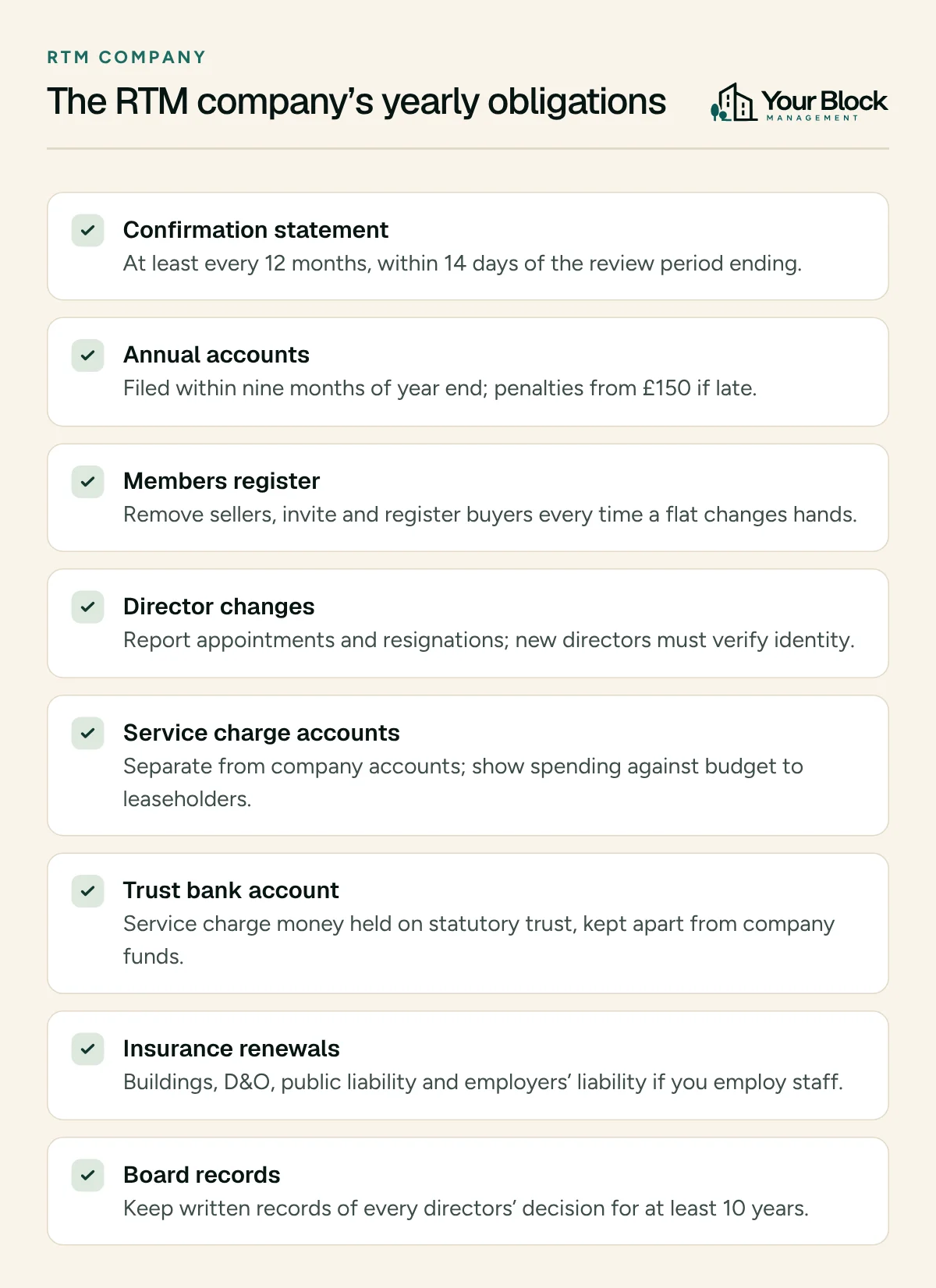
- A written record of every board decision must be kept for at least 10 years.
Since 18 November 2025, new directors must verify their identity with Companies House (free through GOV.UK One Login). Existing directors give their personal code in the company’s next confirmation statement. Duties, liability and time commitment are covered in RTM company directors’ responsibilities.
RTM company obligations at Companies House
An RTM company is a normal company for Companies House purposes. The key recurring obligations are:
- Confirmation statement at least every 12 months, filed within 14 days of the end of the review period. The fee is £50 online.
- Annual accounts within nine months of the financial year end (section 442 Companies Act 2006). Late filing penalties for a private company run from £150 (up to a month late) to £1,500 (over six months), and double if you are late two years running.
- Changes to directors or the registered office must be reported promptly, normally within 14 days.
- Registers: keep a register of members, and update it every time a flat changes hands. You also need a register of people with significant control (PSC). In a very small block, a member who holds more than 25% of the votes may need to be recorded as a PSC.
Do not let filings lapse. If Companies House strikes the company off, the right to manage ends automatically (section 105(3)(d) CLRA 2002) and you are back where you started.
Accounts: two sets, not one
New directors often expect one set of accounts. In fact there are two:
- Statutory company accounts filed at Companies House. Many RTM companies qualify as micro-entities, so the filed version can be a simplified balance sheet. Ask your accountant how service charge money held on trust should be shown.
- Service charge accounts for leaseholders, prepared under the terms of the leases. These show what was spent against the budget. Leaseholders have statutory rights to a summary of costs and to inspect receipts.
Mixing the two is a common early mistake. Our guide to right to manage company accounts goes through what must be filed and when. HMRC is separate from Companies House: a new company is likely to hear from HMRC about corporation tax. Take an accountant’s view on whether returns are needed, especially if the company earns interest on reserves.
Bank account, trust money and insurance
Bank account. Service charge money paid to an RTM company is held on statutory trust (section 42 of the Landlord and Tenant Act 1987, applied by Schedule 7 CLRA 2002). Keep it in a separate, clearly designated account, not mixed with the company’s own money. Set up two-signature authorisation for payments above an agreed limit.
Buildings insurance. Where the leases make the landlord insure, that function passes to the RTM company on the acquisition date. Arrange cover to start that day, and check the existing policy end date so the block is never uninsured. The freeholder may still insure at their own expense (section 97(3)), but cannot charge it to leaseholders.
Company insurance. The prescribed articles expressly allow the company to insure its directors. Directors’ and officers’ (D&O) cover, public liability and, if you employ anyone such as a cleaner, employers’ liability are standard. Our guide to block management insurance covers what a building needs.
What an RTM company really costs to run
Since 3 March 2025 an RTM company is generally no longer liable for the freeholder’s costs of the claim. Its own costs remain. Here is what to budget for:
| Cost | When | What it is |
|---|---|---|
| Incorporation | Once | £100 online at Companies House |
| Help with notices | Once | Optional legal or specialist RTM fees; varies by provider and building |
| Confirmation statement | Yearly | £50 online |
| Accountancy | Yearly | Company accounts, plus service charge accounts if not done by an agent |
| D&O and company insurance | Yearly | Premium depends on block size and cover |
| Managing agent | Yearly | If appointed; usually a per-unit fee |
| Bank charges, postage, meetings | Ongoing | Small, but real |
Building costs such as repairs, insurance, cleaning and the agent’s fee are recovered through the service charge under the leases. Whether the company’s own corporate costs (filing fees, D&O premium) can also go through the service charge depends on the lease wording, so get advice. If it cannot, members can agree to fund those costs separately. If you plan to pay for help with the claim, our guide on right to manage solicitors explains what to ask before you sign.
At Your Block we work with RTM boards on the recurring admin: membership changes, meeting packs, compliance dates and service charge accounts. That leaves directors to make the decisions. Our FAQs for directors answer the common questions.
Is an RTM company worth it?
For many blocks, yes: control over the agent, budgets and contractors, at modest company running costs. But the company only works if people keep it alive. Someone has to file, someone has to update the members register, and someone has to step up as director when others move on. Before forming one, weigh the pros and cons of right to manage honestly with your neighbours.
Frequently asked questions
Can a leaseholder be forced to join the RTM company?
No. Membership is voluntary. The company only needs qualifying tenants of at least half the flats as members on the day the claim notice is served. Leaseholders who do not join still pay service charges to the RTM company once it takes over, and the company must manage the building for every flat, members or not.
Do RTM company directors get paid?
Not by default. The prescribed articles say directors are not entitled to pay unless the members approve a specific amount at a general meeting. Directors can be reimbursed reasonable expenses, such as travel to meetings. Most RTM directors are unpaid volunteers, which is why many boards appoint a managing agent to handle routine work.
What happens to my RTM membership when I sell my flat?
It ends automatically, because only current qualifying tenants can be members and membership cannot be transferred. Your buyer has to apply to join using the form in the articles. Good RTM companies send new owners a membership form as part of their welcome pack and keep the members register up to date.
Can the freeholder become a member of our RTM company?
Yes, but only from the acquisition date, when the company takes over management. Since 3 March 2025 the votes a landlord can cast are capped at one third of the votes exercisable by qualifying tenants. In a block with a large commercial unit, that cap is what stops a freeholder controlling general meetings.
Is an RTM company the same as a residents’ management company?
No. An RTM company is formed by leaseholders under the 2002 Act to take management away from a landlord, using prescribed articles. A residents’ management company is usually set up by the developer and named in the leases from the start. Both are run by resident directors, but their legal basis and rules differ.
Sources and further reading
This article is general information about the law in England, not legal advice. Leasehold law is changing, so check your lease and get professional advice for your own situation. Spotted something out of date? Tell us and we’ll fix it.