
Share of Freehold: The Good, the Bad and the Neighbour Disputes
Owning your building together brings real control and cheaper lease extensions. It also makes your neighbours your co-landlords. Here’s how to make it work.
 By Sam Charlesworth7 min read

The short version
- Share of freehold gives owners control of costs, contractors and cheap lease extensions.
- You also become the landlord: insurance, repairs, fire safety, consultation and Companies House filings.
- Most disputes involve repairs, spending decisions, non-payers, deadlock, sales or absent owners.
- Good articles, a shareholders’ agreement, a budget and proper demands prevent most problems.
- Owners can grant 999-year leases at a peppercorn, with each lender’s consent.
Share of freehold puts flat owners in control of their own building: no outside landlord, usually no ground rent, and the power to extend leases cheaply. The catch is that you and your neighbours become the landlord, with the legal duties and disagreements that brings. Here are the honest pros and cons, the disputes that come up most, and the governance fixes that prevent them.
If you need the basics first, our guide to the share of freehold meaning explains what you actually own: a lease of your flat plus a stake in the company (or joint ownership) that holds the freehold. This guide is about living with it, in England.
The good: what share of freehold gives you
- Control over costs and contractors. The owners set the budget, choose the insurer and decide whether to appoint a managing agent and which one. No one adds a margin you can’t see.
- Cheap, long lease extensions. The owners can agree to grant each other new leases, commonly 999 years, usually without the premium an outside freeholder would demand. More on that below.
- No ground rent to an investor. Any ground rent is paid to your own company, and most share of freehold blocks reduce it to a peppercorn (nothing). See our guide to ground rent and how the law has changed for why that matters to buyers and lenders.
- No permission fees to an outside landlord. Consents for alterations, subletting or pets are decided by the owners, not charged for by a third party.
- Usually easier to sell. Buyers and agents treat share of freehold as a plus, especially once leases have been extended.
The bad: what you take on as your own landlord
- Legal duties. The company is the landlord. It must insure the building, keep the structure and common parts in repair as the lease requires, arrange a fire risk assessment of the common parts, follow service charge law (including section 20 consultation for major works) and file accounts and a confirmation statement at Companies House each year.
- Volunteer time. Someone has to be a director, chase contractors, collect money and answer a buyer’s solicitor’s questions when a flat is sold. In small blocks it’s often the same one or two people every year.
- No automatic saving. Insurance, repairs and fire safety cost the same whoever owns the freehold. Share of freehold removes a landlord’s margin and fees, not the cost of running a building.
- Your neighbours are your co-landlords. The person who won’t pay, never replies or blocks every decision is now your problem to solve, not a freeholder’s.
The neighbour disputes: six that come up again and again
1. Repairs: “that’s your problem, not the building’s”
A leak through a top-floor ceiling, a rotten window, a cracked patio. Whether it’s a service charge cost or an individual owner’s job depends on what the lease says each flat includes. Read the demise clause before arguing. If leases in the block differ, which is common in conversions, the answer may differ by flat.
2. Decisions: “I never agreed to spend that”
Directors make day-to-day decisions; some matters may need a shareholder vote under the articles. Problems start when spending is agreed informally on a group chat. Minute decisions, follow the articles, and remember that being the landlord doesn’t exempt you from consultation: works costing any one leaseholder more than £250 still need section 20 consultation or tribunal dispensation.
3. The non-paying owner
Every other owner ends up covering the gap. The company can recover arrears under the lease like any landlord, through a letter before action and then a court claim, or the First-tier Tribunal can decide what is payable. Two traps for DIY blocks: a service charge demand must include the statutory summary of rights and obligations, or the owner can lawfully withhold payment; and costs billed more than 18 months after they were incurred are generally irrecoverable. Forfeiture is restricted: it isn’t available for unpaid service charges unless the debt has been admitted or decided by a tribunal or court.
4. Deadlock
A two-flat building with 50/50 shares, or a four-flat block split two against two. Without a tie-break, nothing happens, including urgent repairs. Fix it in advance with a casting vote in the articles, or a shareholders’ agreement that sends deadlocks to mediation or an independent expert. In serious cases of mismanagement, a leaseholder can apply to the First-tier Tribunal to appoint a manager under Part 2 of the Landlord and Tenant Act 1987, but that is a last resort.
5. Selling
When an owner sells, the buyer’s solicitor will ask the company for accounts, insurance, minutes and planned works, and the seller’s share must be transferred to the buyer. Slow answers delay sales and sour relationships. Agree who handles these requests, what reasonable fee (if any) is charged, and keep the paperwork in one place.
6. The absent owner
An investor who lives abroad, an owner who has died with probate unresolved, or someone who simply never replies. Keep the company’s register of members and service addresses up to date, serve notices at the address the lease or articles require, and make sure the articles allow decisions to be made without unanimous participation.
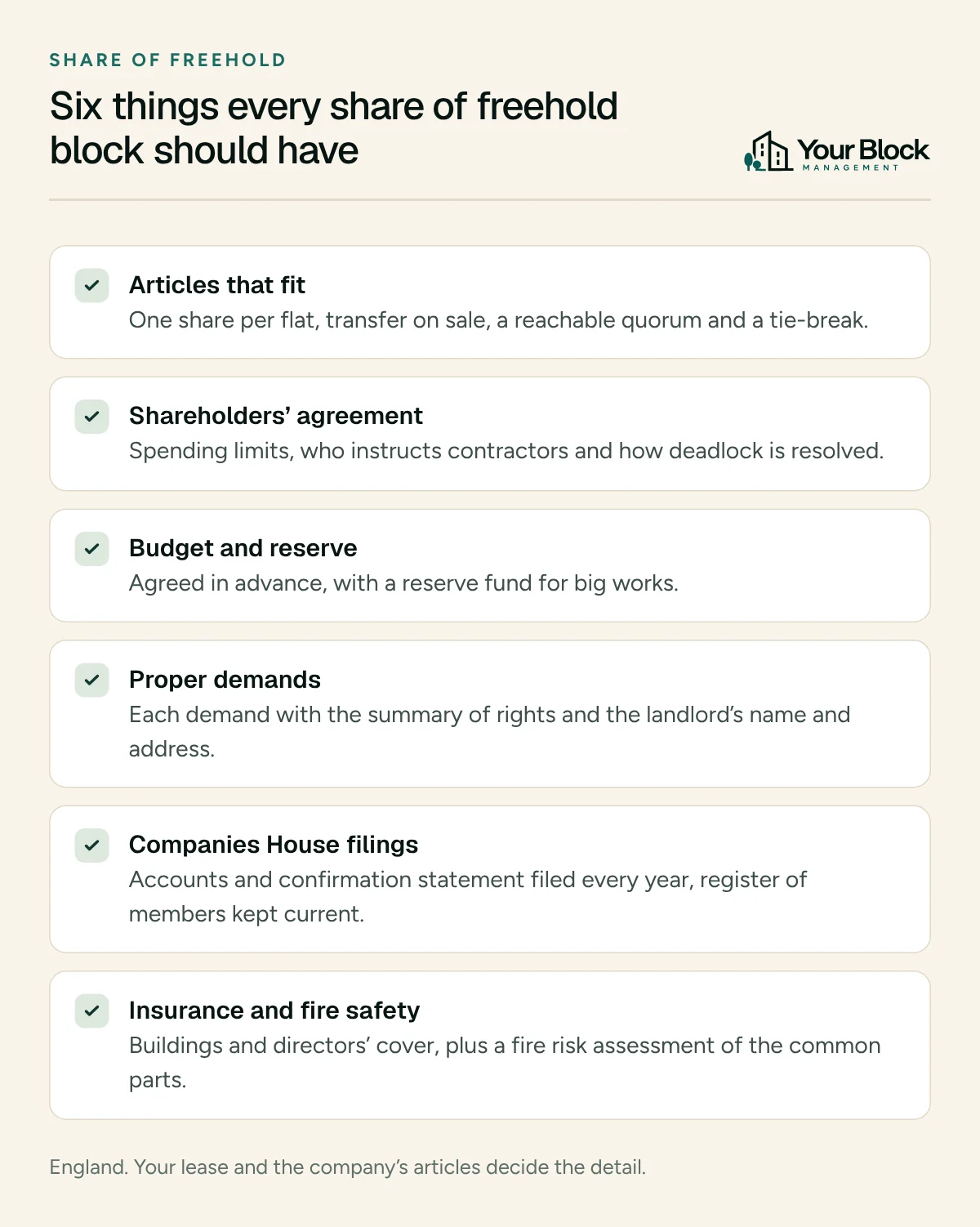
Governance fixes that prevent most share of freehold disputes
Most of the disputes above come from paperwork that was never written or never updated. The fixes are dull but effective:
- Company articles fit for a block of flats. One share or membership per flat, automatic transfer on sale, a quorum that can be reached, and a tie-break.
- A shareholders’ agreement (or house rules adopted by resolution) covering spending limits, who can instruct contractors, how disputes are resolved and what happens when someone won’t engage.
- An annual budget and a reserve fund, agreed in advance, so big jobs don’t become emergency arguments. Our guide to the service charge shows what a typical small-block budget looks like.
- Proper demands and accounts, even if everyone is friendly. Friendly blocks fall out too, usually over money.
- Insurance that fits: buildings cover in the company’s name and, ideally, directors’ and officers’ liability cover for the volunteers. See our guide to block management insurance.
- A managing agent where it helps. An agent doesn’t take control away from the owners; it does the admin while the directors keep the decisions.
Extending your share of freehold lease to 999 years at a peppercorn
Owning the freehold doesn’t stop your lease running down. A share of freehold flat with 75 years left still has a 75-year lease until the company grants a new one. The usual approach:
- The owners agree, ideally for every flat at once, so the terms stay consistent.
- Each owner’s mortgage lender consents, because their security is changing.
- The company grants a new lease (or a deed of variation) for 999 years at a peppercorn rent, often modernising outdated clauses at the same time.
- The new lease is registered at HM Land Registry.
Since 30 June 2022, the Leasehold Reform (Ground Rent) Act 2022 limits the rent a voluntary replacement lease can charge for the extended period to a peppercorn, which suits share of freehold blocks anyway. Each owner should use a conveyancer for their own lease and lender, and ask about any tax or registration points. The company can agree no premium, but the owners should decide that openly and record it.
Mortgages and share of freehold
Lenders treat a share of freehold flat as leasehold, so the lease is what they examine. Expect your conveyancer to report on:
- The lease length. A short unextended lease can limit lenders or reduce value; extending first often solves it.
- The ground rent. A peppercorn removes the concerns lenders have about high or escalating ground rents.
- The company. That it owns the freehold, is active at Companies House and that your share will transfer on completion.
- Repair and insurance arrangements. Who insures, whether cover is in place and whether major works are planned.
When you sell, the same checks run in reverse, which is why good records make a share of freehold flat easier to sell. For the wider picture of running a block well, see our guide to how block management works.
When directors need help
Many small share of freehold blocks run happily on goodwill and a spreadsheet. The moment that tends to break them is a big repair, an owner who stops paying or a director who moves away. That is where Your Block fits: we work for the owners’ company, take the admin off volunteer directors, draft agendas and meeting packs, and give every resident a portal login so decisions and spending are visible to everyone. See how we support directors and the questions directors usually ask.
Frequently asked questions
Is share of freehold better than leasehold?
Usually, for owners willing to take part. You control costs, choose contractors and can extend leases cheaply, and buyers tend to value it. The trade-off is responsibility: the owners’ company is the landlord, with legal duties and the need to agree with neighbours. In a block where nobody engages, it can work worse than a well-run managed block.
What happens if one share of freehold owner won’t pay?
The company can pursue the arrears under the lease like any landlord, through a letter before action, a court claim or a tribunal determination. Make sure demands include the statutory summary of rights and are sent within the 18-month limit. Other owners may need to cover the shortfall temporarily, which is why a reserve fund helps.
Can a share of freehold owner be forced to extend their lease?
No. Each owner decides whether to take a new lease, and their lender must consent. Most blocks extend all leases together because it keeps terms consistent and helps every flat’s value, but a reluctant owner can’t be compelled. The company can, however, set fair terms that apply to everyone who does extend.
Do share of freehold blocks need a managing agent?
Not legally. Many small blocks self-manage well. An agent becomes worthwhile when directors lack time, the building has more complex compliance needs, or owners keep falling out over money. A good agent handles administration and paperwork while the owners’ company keeps control of decisions and budgets.
Are share of freehold directors personally liable?
Directors act for the company and are not normally personally liable for its debts, but they have duties under company law and must act properly. The company, as landlord, carries legal obligations for insurance, repairs and fire safety. Directors’ and officers’ insurance and clear records reduce the risk for volunteers.
Sources and further reading
This article is general information about the law in England, not legal advice. Leasehold law is changing, so check your lease and get professional advice for your own situation. Spotted something out of date? Tell us and we’ll fix it.