Share of Freehold Meaning: What You Actually Own (It’s Not What You Think)
You own a lease and a stake in the company that owns the building. Here’s what that really means, and what an estate agent’s listing won’t tell you.
 By Sam Charlesworth6 min read
The short version
- Share of freehold isn’t a separate tenure: you own a lease plus a stake in the freehold.
- The freehold is usually owned by a company whose shareholders or members are the flat owners.
- Service charge law still applies, and the lease can still run down until owners extend it.
- Owners can usually grant themselves long leases at a peppercorn rent, often without a premium.
- Check the freehold title, the company’s filings, your share certificate and the lease length before buying.
The share of freehold meaning is simpler than listings make it sound: you own a long lease of your flat and, together with your neighbours, a stake in the freehold of the building, usually through shares or membership of a company that owns it. It isn’t a separate kind of ownership. You are still a leaseholder; your landlord is, in effect, you and the other flat owners.
That’s the short answer. The rest of this guide explains what that means in practice, how it differs from ordinary leasehold, freehold and commonhold, and what to check before you rely on an estate agent’s listing. It covers England only.
What you actually own: two separate things
When you buy a share of freehold flat, you normally acquire two distinct assets:
- A long lease of your flat. This is registered at HM Land Registry with its own title number. It sets out what you own (typically the inside of the flat, sometimes windows or a garden), what you must pay and what you can and can’t do.
- A stake in the freehold. Usually this is a share certificate or membership of a company that owns the freehold title of the building and land. Less often, the freehold is held in the personal names of some or all of the owners.
The two should always travel together. When you sell, your share in the company is transferred to your buyer along with the lease, and many company articles require exactly that. A flat sold without its share, or a share left behind by an owner who has moved, is one of the commonest tangles in small blocks.
Why you still have a lease (and why that’s a good thing)
People are often surprised that a share of freehold flat still comes with a lease, and that the lease can still run down. Here is why it exists.
The company is a separate legal person. Because the freehold belongs to the company and not to you personally, your lease doesn’t disappear when the owners buy the freehold. You are the tenant; the company is the landlord.
The lease is the building’s rulebook. It decides who repairs the roof, how service charge costs are split, whether pets or short lets are allowed, and what happens if someone doesn’t pay. Without leases, a block of flats in England would have very little legal structure to hold it together, because positive obligations like “pay towards the roof” don’t pass easily between freehold owners.
The law still applies to you. Service charge protections in the Landlord and Tenant Act 1985, including reasonableness, section 20 consultation for major works and the 18-month rule, apply even though the landlord is owned by the leaseholders. Our guide to the service charge explains those rules.
You control the lease terms. Owners can agree to grant each other new leases, often 999 years at a peppercorn (zero) ground rent, usually without the premium an outside freeholder would charge, subject to agreement between the owners and their mortgage lenders. If your lease is still short, that’s a job to do, not a problem to ignore.
How the freehold is usually held
Through a company
The most common set-up. The company may have been formed when the leaseholders bought the freehold together (collective enfranchisement) or set up by the developer. It might be called something like “Riverside Court Freehold Ltd” or be a residents’ management company. Each flat owner is a shareholder or member, the owners appoint directors, and the company must file accounts and a confirmation statement at Companies House every year. If you’re unsure how these companies work, see our guide to the residents’ management company.
In joint names
In very small buildings, such as a converted house split into two or three flats, the owners may hold the freehold personally, as joint registered proprietors. HM Land Registry will register no more than four people as legal owners, so this only works for small numbers, and it needs careful paperwork every time someone sells.
Share of freehold vs leasehold, freehold and commonhold
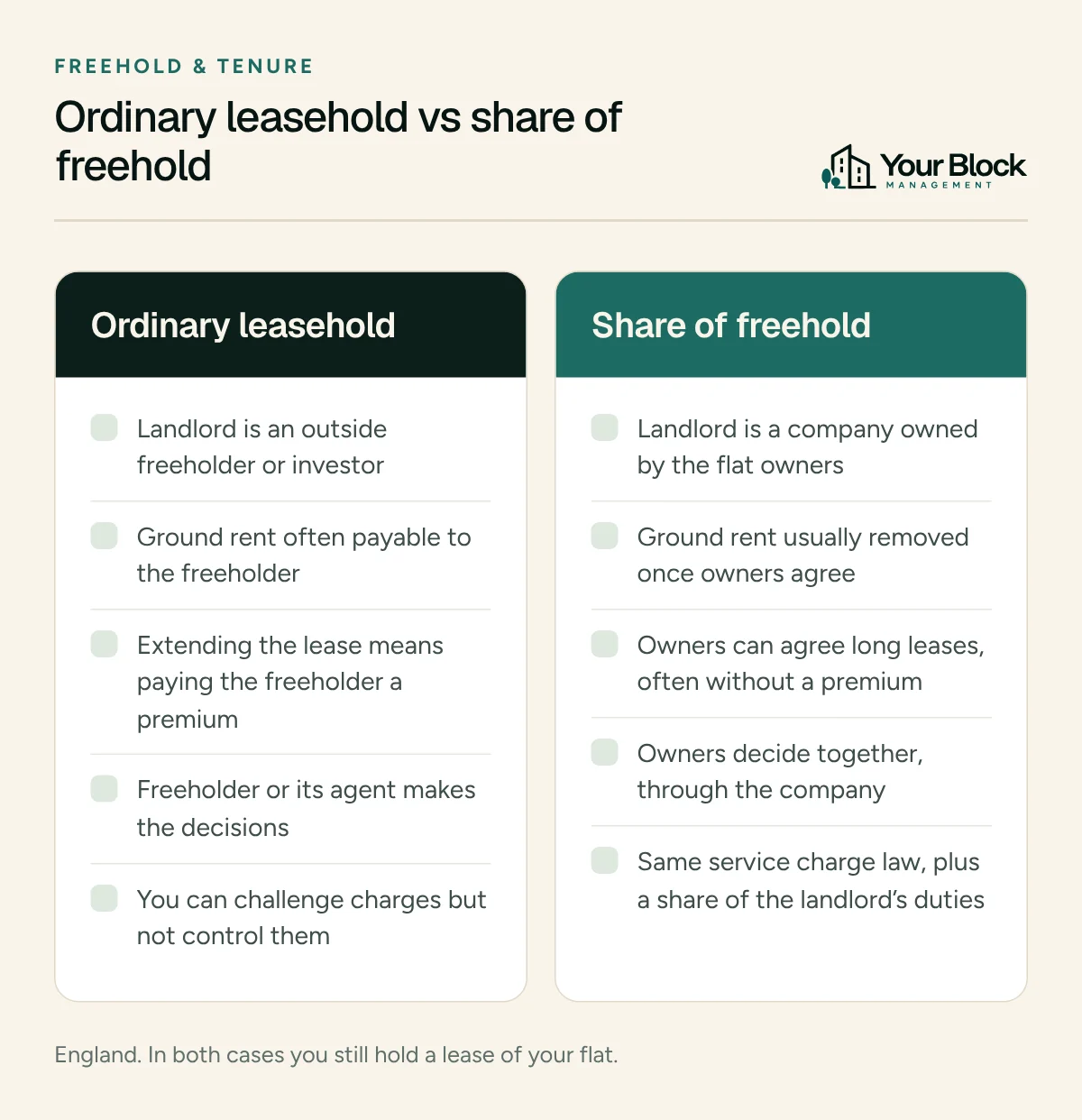
Here is how the four arrangements compare for a typical flat or house in England.
| Ordinary leasehold | Share of freehold | Freehold | Commonhold | |
|---|---|---|---|---|
| What you own | A lease of your flat | A lease plus a stake in the freehold | The property and land outright | Your unit outright, plus membership of the association |
| Is there a lease? | Yes | Yes | No | No |
| Who is the landlord? | An outside freeholder | The owners’ company | No landlord | No landlord; the association owns the common parts |
| Ground rent | Often payable | Usually nil or peppercorn once owners agree | None | None |
| Who runs the building? | The freeholder or its agent | The owners, often with an agent | You | The association, often with an agent |
| Does it run down? | Yes, as the lease shortens | Yes, until owners extend | No | No |
Commonhold has existed since the Commonhold and Leasehold Reform Act 2002, but very few schemes have been created. The draft Commonhold and Leasehold Reform Bill, published in January 2026, proposes making it the default for most new flats. It has not yet been introduced to Parliament, so for now share of freehold remains the closest most flat owners get to owning their building.
Share of freehold meaning on property listings: what agents get wrong
On property portals, “share of freehold” is a selling point, and it usually is a good one. But it gets used loosely. Listings sometimes say share of freehold when:
- The company only manages. A residents’ management company that runs the building but doesn’t own the freehold is not share of freehold.
- It’s a right to manage company. An RTM company takes over management, not ownership. The freeholder still owns the building and collects any ground rent.
- The lease hasn’t been extended. A share of freehold flat with 70 years left on its lease still has a short lease until the owners grant a new one. Some lenders will be cautious until that’s done.
- The share isn’t actually available. Not every flat in a building always participated in buying the freehold. The flat you’re looking at may not have a share to transfer.
So “share of freehold” on a listing is the start of the questions, not the end of them.
What to check before you buy
Your conveyancer will cover most of this, but it helps to ask early:
- The freehold title. Who is the registered owner of the freehold at HM Land Registry? It should be the company, or the named owners.
- The company’s status. Is it active at Companies House, with accounts and confirmation statements filed? A company struck off for not filing can leave the freehold in limbo.
- Your share. Will a share certificate and signed transfer form be handed over on completion? Do the articles require each flat owner to hold one?
- The lease length and ground rent. Has the lease been extended? If not, will the company agree to a new lease, and on what terms?
- The money. Is there a service charge budget, a reserve fund and up-to-date accounts? Are any owners in arrears?
- How decisions are made. Who are the directors, and is there a managing agent? Ask for the last few sets of meeting minutes.
The last point matters more than buyers expect. In a share of freehold building you become one of the landlords, with a say in decisions and a share of the responsibility. Our companion guide on the good, the bad and the neighbour disputes of share of freehold covers what living with that looks like, from repairs to absent owners.
Do share of freehold owners need a managing agent?
No law requires one. Plenty of small share of freehold blocks run themselves well. The difficulty is that the directors are volunteers who take on legal duties: insurance, fire risk assessment of the common parts, service charge accounting and section 20 consultation. When that becomes too much, a managing agent can do the administration while the owners keep the decisions. That’s the model we built Your Block around: support for volunteer directors of RMCs and RTM companies, with every resident given a portal login so decisions and spending are visible to all the owners.
Frequently asked questions
Is share of freehold the same as owning the freehold?
No. With share of freehold you own a lease of your flat and a stake in the freehold, usually through a company. You don’t own the building outright, and you share decisions and responsibilities with the other owners. A freehold house, by contrast, has no lease and no landlord.
Do I pay ground rent with share of freehold?
Often not, or only a peppercorn. Because the owners control the freehold company, they can agree to remove ground rent, usually when granting each other new long leases. Some older leases still mention a ground rent that the company simply doesn’t collect, so check the lease rather than assuming.
Do I still pay a service charge with share of freehold?
Yes. The building still needs insuring, cleaning, repairing and managing, and the lease sets out how those costs are shared. The difference is that the owners, through their company, decide the budget and choose any managing agent. Service charge law still protects each leaseholder.
Can a share of freehold lease run out?
Yes. Owning a share of the freehold doesn’t stop your lease shortening each year. The owners can agree to grant new long leases, often 999 years, but until that’s done a short lease can affect value and mortgage options. Check the remaining term before you buy.
Is commonhold the same as share of freehold?
No. In commonhold each owner holds their flat as freehold and a commonhold association owns the common parts, with no leases at all. Share of freehold keeps leases in place. Commonhold is rare in England today, though proposed reforms would make it the default for most new flats.
Sources and further reading
This article is general information about the law in England, not legal advice. Leasehold law is changing, so check your lease and get professional advice for your own situation. Spotted something out of date? Tell us and we’ll fix it.