
Right to Manage Solicitors: Do You Actually Need One? (And What Should It Cost?)
Which parts of a right to manage claim you can safely do yourselves, where professional help earns its fee, and what to ask before you pay anyone.

The short version
- No law requires a solicitor for right to manage; the notices and company articles are prescribed.
- The risky steps are defining the premises, counting members, the claim notice and any tribunal dispute.
- Since March 2025 a failed claim rarely means paying the freeholder’s costs, but unreasonable claims still can.
- Compare written quotes on the same scope, especially whether counter-notice and tribunal work is included.
- Check any adviser’s independence if their fee is tied to appointing a managing agent.
You don’t legally need right to manage solicitors: leaseholders can form an RTM company and serve the prescribed notices themselves. But a mistake in the claim notice, the building’s description or the list of people served can sink a claim. Most blocks do best organising themselves and paying a professional to check or prepare the high-risk documents.
This guide covers which steps are safe to do yourself, what a solicitor or specialist RTM firm actually does, how fees are structured, how the March 2025 cost changes shift the decision, and how to choose. It covers the law in England. The full process is explained in our right to manage guide.
Do you need a right to manage solicitor?
No law requires one. The Commonhold and Leasehold Reform Act 2002 (CLRA 2002) and the Right to Manage (Prescribed Particulars and Forms) (England) Regulations 2010 set out the notices in prescribed form, and anyone can complete them. The RTM company’s articles are also prescribed, so you are not drafting a constitution from scratch.
Your realistic options are:
- Do it yourselves, using the prescribed forms and free initial advice from LEASE (the Leasehold Advisory Service).
- A solicitor with leasehold experience, regulated by the Solicitors Regulation Authority and required to carry professional indemnity insurance.
- A specialist RTM firm that is not a law firm. These can be efficient, but check how they are regulated and insured.
- A managing agent’s RTM service, sometimes offered cheaply or free if you then appoint that agent. Read the terms: you may be committing to a management contract before you have compared agents.
Which RTM steps are safe to do yourself, and which are risky?
The risk sits in a few specific places. Here is how we would rate each step:
| Step | DIY risk | Why |
|---|---|---|
| Canvassing neighbours and signing up members | Low | Organisation, not law. You know your neighbours better than any firm. |
| Incorporating the RTM company | Low | Prescribed articles, £100 online at Companies House. By convention the name ends “RTM Company Limited”, and only an RTM company may use “RTM” in its name. |
| Getting lease details (office copies, section 82 notices) | Low to medium | Straightforward, but the claim notice needs each member’s lease date, term and start date. |
| Defining the premises | High | “Self-contained building or part”, shared plant, estates with several blocks: a wrong definition is a classic counter-notice ground. |
| Checking qualification and membership numbers | High | Two-thirds of flats held by qualifying tenants; members from at least half of all flats; non-residential space no more than 50%. |
| Notices of invitation to participate | Medium | Prescribed form and 14-day wait. Since Cresta Court (2026) a slip is not fatal on its own, but it can still lead to a tribunal order. |
| Claim notice: content, dates and service | High | Must go to every landlord, any other party to the leases and any appointed manager, with correct counter-notice and acquisition dates. |
| Responding to a disputed counter-notice | High | Tribunal application within two months, or the claim is treated as withdrawn. |
| Handover after acquisition | Medium | Contract notices, documents within 28 days, transfer of unspent service charges. |
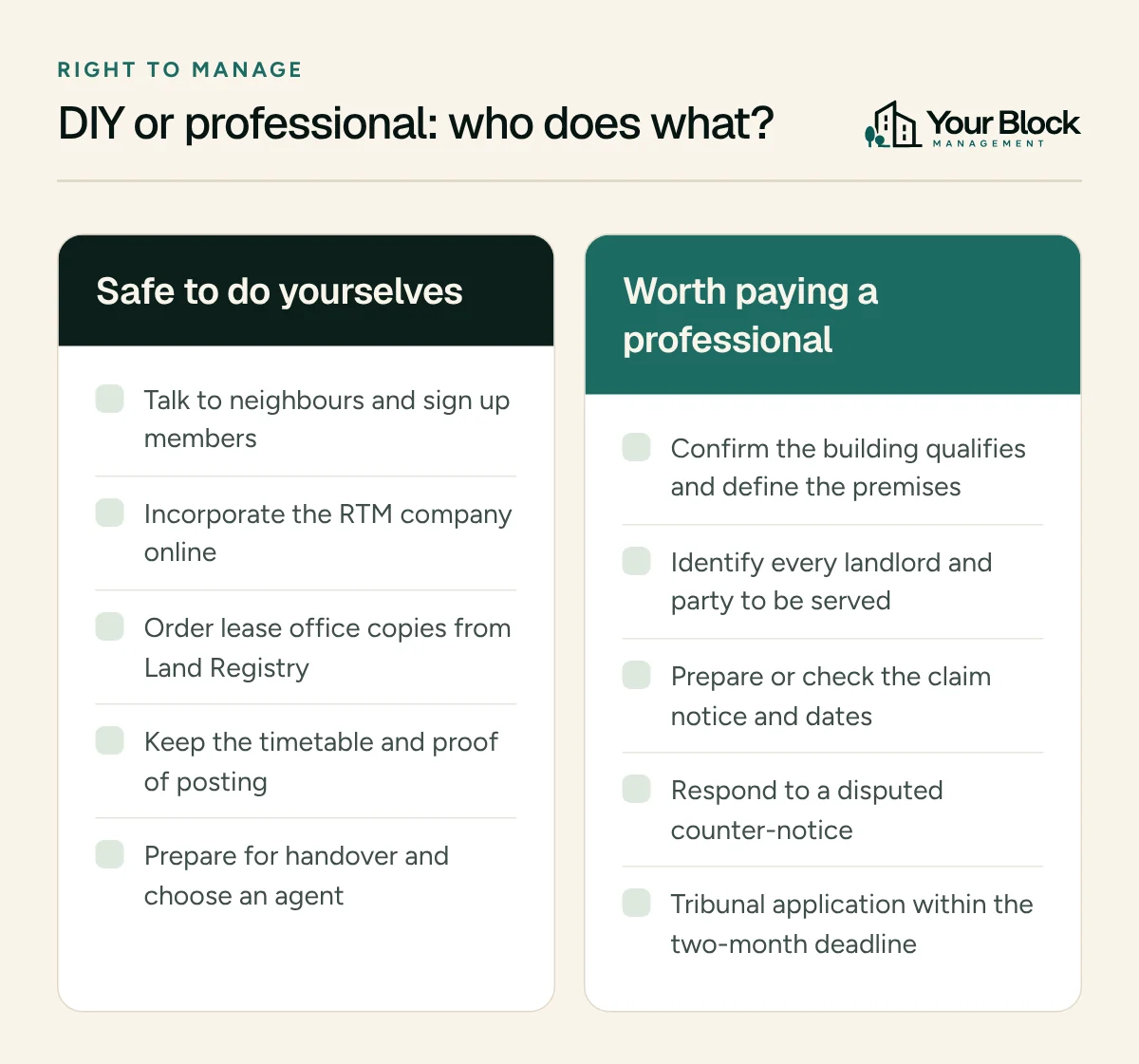
The pattern: the people side is easy to do yourself. The legal precision (who is served, what is claimed, which dates) is where professional help earns its fee.
What does an RTM solicitor or specialist actually do?
A full-service instruction usually covers:
- A qualification check: reviewing title, leases and the building layout to confirm the premises meet the right to manage qualifying criteria and identifying every landlord and lease party. Intermediate landlords and head-lessees are easy to miss.
- Company formation with the prescribed articles, and a members register built from signed applications.
- Information gathering, including section 82 notices where the freeholder or agent holds what you need.
- Preparing and serving notices: invitation notices, the claim notice and copies, with proof of service.
- Handling the counter-notice, and if disputed, preparing the tribunal application and representing the company.
- Handover support: chasing contract notices, documents and unspent service charge funds.
What a solicitor will not normally do is run the building afterwards, organise your neighbours or act as your directors. Those jobs stay with the RTM company and whoever it appoints to manage.
How much should right to manage solicitors cost?
Fees vary widely by provider, building size and complexity. There is no official or independent benchmark we can point you to, so we won’t quote a figure. What we can tell you is how pricing is usually structured and what to ask.
Common fee structures
- Fixed fee for the whole uncontested claim, sometimes with a per-flat element for larger blocks.
- Fixed fee per stage: formation, notices, then handover priced separately.
- Hourly rates, more common for tribunal work or unusual buildings.
- Bundled or “free” RTM from a managing agent, recovered through a management contract.
Questions to ask before you instruct anyone
- Exactly which steps does the fee cover? Is the counter-notice response included?
- What happens, and what does it cost, if the freeholder disputes the claim and it goes to tribunal?
- Is VAT included? What disbursements will there be, such as Land Registry copies and postage?
- Who will actually do the work, and what is their RTM experience?
- Are you regulated and insured? If you are not a law firm, who regulates you?
- Is the price tied to appointing a particular managing agent? If so, for how long, and on what terms?
Get two or three written quotes on the same scope. A low headline fee that excludes the counter-notice stage is not comparable with one that includes it.
How the 2025 cost changes affect the decision
Until 3 March 2025, the RTM company had to pay the freeholder’s reasonable costs of the claim, under the old section 88. A defective claim meant paying for your own mistake and the freeholder’s lawyers. That was a strong argument for professional help.
Section 50 of the Leasehold and Freehold Reform Act 2024 replaced that rule with a new section 87A. The RTM company and its members are now generally not liable for anyone else’s costs arising from a claim notice. The exceptions are:
- the reasonable cost of complying with a section 82 information notice;
- costs ordered by a court or tribunal under another power, for example where a party behaves unreasonably in proceedings;
- section 87B: if a claim is withdrawn or fails and the company acted unreasonably, the tribunal can order it to pay the landlord’s reasonable costs, with current and former members jointly liable.
So a DIY mistake is now cheaper than it was. Usually the cost is your own time and a fresh start, not the freeholder’s legal bill. But the risk has not gone. A failed claim delays control by months, a contested claim can run past a year, and an unreasonable one can still cost you under section 87B. Our guide to right to manage legal costs covers the rules in detail.
How to choose a right to manage solicitor or specialist
- Look for RTM experience, not just leasehold. Ask how many RTM claims they have handled recently and how many were disputed.
- Check they are up to date on the March 2025 changes and the Supreme Court’s Cresta Court decision of 27 August 2026.
- Look for independence. If the adviser is linked to a managing agent, make sure choosing that agent is optional.
- Ask for a written scope listing every notice they will prepare and serve.
- Ask about tribunal capability in case the freeholder disputes the claim.
- Ask for a dated timetable from invitation notices to acquisition date, so the board knows what happens when and can plan insurance and agent appointments around the takeover.
- Agree who is the client. It should be the RTM company, with clear instructions from its directors.
A sensible middle route for most blocks
For a straightforward single block, a cost-effective split is:
- Directors organise the block, sign up members and incorporate the company themselves.
- A professional checks qualification and the premises definition, and prepares or reviews the claim notice and service list.
- Directors serve notices with proof of posting, keeping copies and a timetable.
- If a disputed counter-notice arrives, instruct a professional straight away. The two-month tribunal deadline is unforgiving.
Before you start, weigh up the pros and cons of right to manage, and read what RTM directors are responsible for once the claim succeeds. Your Block doesn’t give legal advice or run RTM claims. We work with boards from takeover onwards, and our directors’ page explains how. If you would like to talk through what the company will need on day one, get in touch.
Frequently asked questions
Can leaseholders do right to manage without a solicitor?
Yes. The notices are in prescribed form, the RTM company’s articles are set by regulations, and LEASE offers free initial advice. Many simple claims succeed this way. The risk lies in describing the premises correctly, serving every landlord and party, and getting the dates right in the claim notice, so a professional check of those steps is often worthwhile.
Who pays the solicitor’s fees for a right to manage claim?
The RTM company pays its own advisers, which in practice means the participating leaseholders, often by an agreed contribution per flat. The freeholder cannot recover its costs of the claim through the service charge, and since March 2025 the RTM company is generally not liable for the freeholder’s costs either, with limited exceptions.
Is a free RTM service from a managing agent a good idea?
It can be, if the terms are clear. Check whether you must appoint that agent, for how long and at what fee, and whether you can leave if the service is poor. Compare the management contract with others before you sign. Otherwise you may give up the choice of agent, which for many blocks is the point of RTM.
What happens if our DIY claim notice is wrong?
The freeholder may serve a counter-notice disputing entitlement. You then have two months to apply to the tribunal, or withdraw and start again. Since the 2025 reforms you will not normally pay the freeholder’s costs. But if the tribunal finds the company acted unreasonably in pursuing a failed claim, it can order costs under section 87B.
Sources and further reading
- Commonhold and Leasehold Reform Act 2002, section 87A (costs: general)
- Commonhold and Leasehold Reform Act 2002, section 87B (costs where claim ceases)
- The Right to Manage (Prescribed Particulars and Forms) (England) Regulations 2010
- LEASE: Supreme Court clarifies right to manage rules for leaseholders
This article is general information about the law in England, not legal advice. Leasehold law is changing, so check your lease and get professional advice for your own situation. Spotted something out of date? Tell us and we’ll fix it.