
Ground Rent: What It Is, Why You Pay It and How the Law Has Changed
New leases are now peppercorn, but many older ones aren’t. Here’s how ground rent works, which rules protect you, and what the proposed £250 cap would and wouldn’t do.
 By Sam Charlesworth7 min read

The short version
- Ground rent is the freeholder’s income from your lease. It pays for no service and isn’t held on trust.
- New leases since 30 June 2022 (retirement homes 1 April 2023) can only charge a peppercorn.
- Older leases keep their ground rent, including doubling clauses, until extended or reformed.
- You don’t have to pay until a valid section 166 notice has been served.
- The £250 cap on existing ground rents is only proposed in a draft Bill. It isn’t law.
Ground rent is a regular payment a leaseholder makes to the freeholder simply because the lease requires it. You get no service in return. Most new residential leases granted since 30 June 2022 can only charge a peppercorn (nothing), but older leases still carry ground rents, some of them rising steeply. Here’s how ground rent works, the rules on demands, and where reform really stands.
This guide covers England. Wales has partly different rules and Scotland doesn’t use this system.
What is ground rent, and why do you pay it?
A long lease is, legally, a very long tenancy. The freeholder grants you the right to occupy the flat for, say, 99 or 125 years, and historically the lease reserved a rent in return. That ground rent is the freeholder’s income from owning the building. It isn’t a contribution towards any cost, and unlike a service charge it isn’t held on trust for the leaseholders.
Freeholds with a stream of ground rents are often sold on to investors, which is why the company sending your ground rent demand may be one you’ve never heard of. If the freeholder is a company owned by the flat owners, as in a share of freehold block, ground rent is usually reduced to a peppercorn or simply not collected.
How ground rent is set in your lease
Your lease fixes the ground rent and any increases. The common patterns are:
- Fixed: the same sum for the whole term, for example £100 a year.
- Stepped: fixed increases at set dates, for example £150 rising to £300 after 33 years.
- Doubling: doubles every 10, 15 or 25 years. The most criticised type.
- Index-linked: rises in line with RPI or another index, sometimes with a cap or collar.
- Peppercorn: a nominal rent with no financial value. Effectively no ground rent.
Here is why doubling clauses cause so much trouble. An illustrative lease with a £250 ground rent doubling every ten years:
| Years into the lease | Annual ground rent |
|---|---|
| Start | £250 |
| 10 | £500 |
| 20 | £1,000 |
| 30 | £2,000 |
| 40 | £4,000 |
| 50 | £8,000 |
Escalating and doubling ground rents: the real problems
A rising ground rent isn’t just a bigger bill. It can make a flat hard to sell or mortgage:
- Lenders are wary of ground rents that are high or escalate quickly, and some will not lend on them, which shrinks the pool of buyers.
- The assured tenancy problem. Under Schedule 1 to the Housing Act 1988, a tenancy with a rent above £250 a year outside Greater London (£1,000 in London) isn’t excluded from being an assured tenancy as a “low rent” tenancy. In some circumstances that can expose a leaseholder in arrears to possession proceedings under the rules designed for private renting. It’s a technical risk, but conveyancers and lenders take it seriously.
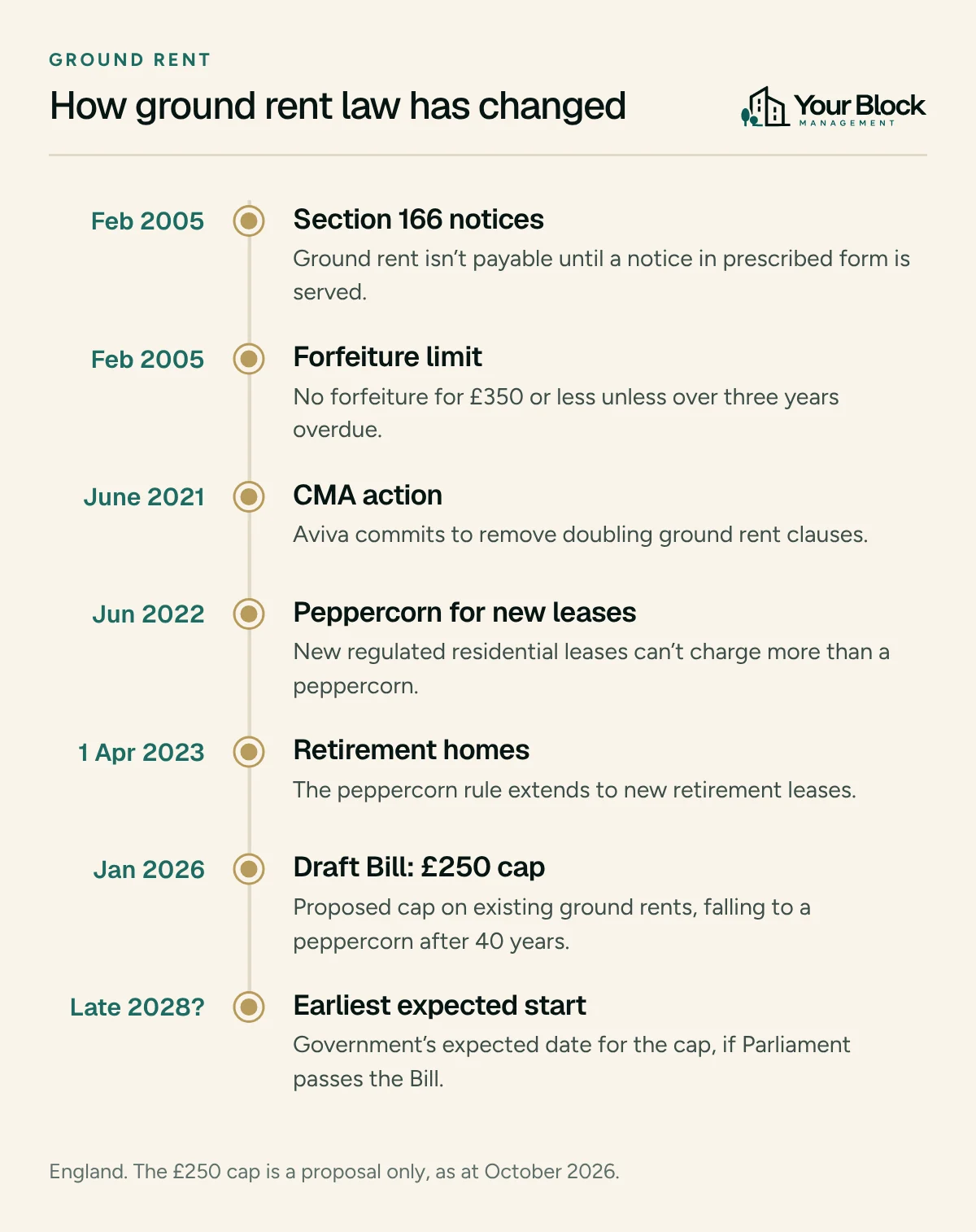
- Regulatory action. After a Competition and Markets Authority investigation, Aviva committed in June 2021 to remove doubling ground rent clauses from leases it held, and the CMA pressed other freeholders to do the same.
If you are buying, ask for the ground rent schedule for the whole term, not just this year’s figure.
The Leasehold Reform (Ground Rent) Act 2022
This Act is in force and applies to new regulated long residential leases:
- From 30 June 2022, a new lease can’t require more than a peppercorn ground rent.
- From 1 April 2023, the same rule applies to retirement homes.
- Exceptions include genuine business leases, community housing leases and home finance plan leases. Statutory lease extensions are excepted because they already carry a peppercorn rent under their own rules.
- Voluntary lease extensions granted after the Act can keep the old ground rent only until the original term would have ended; for the extra years, only a peppercorn is allowed.
- No admin fees may be charged for collecting a peppercorn rent.
- Penalties: a landlord who demands prohibited rent can face a civil penalty of £500 to £30,000, enforced by local Trading Standards.
The crucial limit: the 2022 Act did not reduce ground rent in existing leases. If your lease was granted before 30 June 2022, its ground rent still applies.
Ground rent demands: the section 166 rules
Ground rent has its own demand rules under section 166 of the Commonhold and Leasehold Reform Act 2002. You are not liable to pay ground rent on a long lease of a dwelling until the landlord has served a notice that:
- is in the prescribed form;
- states the amount due and the date it is payable (and, if different, the date the lease says it is due);
- gives a payment date at least 30 days and no more than 60 days after the notice is given;
- doesn’t set a payment date earlier than the date the lease provides.
Until a valid notice is served, late-payment charges shouldn’t start running. Two other protections are worth knowing. A landlord can’t forfeit a lease for unpaid rent, service charges or administration charges of £350 or less unless part has been outstanding for more than three years (section 167 and the 2004 regulations). And arrears of rent generally can’t be recovered more than six years after they fell due, under the Limitation Act 1980.
What to do if a ground rent demand looks wrong
Check it against your lease: the amount, any review date and the payment date. If it isn’t in the prescribed form, or the payment date falls outside the 30 to 60 day window, write back politely, explain why you don’t think the notice is valid and ask for a correct one. Don’t simply ignore it: the landlord can serve a fresh, valid notice and the rent will still be due. If you’re charged an administration fee for collecting a peppercorn rent, or more than a peppercorn on a lease granted after 30 June 2022, report it to your local Trading Standards, which enforces the 2022 Act. LEASE, the government-funded Leasehold Advisory Service, gives free initial advice if you’re unsure.
Ground rent vs service charge
They often arrive from the same company, but they are different things with different rules.
| Ground rent | Service charge | |
|---|---|---|
| What it pays for | Nothing specific: it’s the freeholder’s income | Insurance, repairs, cleaning, management, reserves |
| Amount | Fixed by the lease | Varies with actual costs |
| Held on trust? | No | Yes, under section 42 of the Landlord and Tenant Act 1987 |
| Demand rules | Section 166 notice in prescribed form | Summary of rights must accompany the demand |
| Can you challenge it? | Only on the lease terms or demand rules | Yes, on reasonableness and more, at the tribunal |
For the service charge side, see our guide to where every pound of your service charge goes. At Your Block we keep budgets and spending visible to every resident on the resident portal, so it’s always clear what the service charge pays for.
How to get rid of ground rent
There are three main routes, and they differ a lot.
1. A statutory lease extension
Under the Leasehold Reform, Housing and Urban Development Act 1993, a qualifying flat owner can claim a new lease for the remaining term plus 90 years at a peppercorn ground rent. Since 31 January 2025 you no longer need to have owned the flat for two years first. You pay a premium, which includes compensation for the ground rent the freeholder loses and, if the lease has under 80 years left, a share of “marriage value”. The 2024 Act would abolish marriage value and allow 990-year extensions, but those provisions are not yet in force. Our lease extension guide explains the process.
2. Buying the freehold together
Through collective enfranchisement, qualifying leaseholders buy the freehold, after which their company can grant everyone long leases at a peppercorn. That turns the building into a share of freehold. See our guide to buying the freehold of your building.
3. A voluntary deal with the freeholder
Quicker, sometimes cheaper, but read the terms. Because of the 2022 Act, a voluntary new lease can keep the existing ground rent for the rest of the original term. Some informal deals have also introduced fresh escalating rents. Get advice before you sign.
What’s coming: the proposed £250 ground rent cap
The draft Commonhold and Leasehold Reform Bill, published on 27 January 2026, proposes:
- a cap of £250 a year on ground rent in existing residential leases;
- the cap falling to a peppercorn after 40 years;
- commencement expected by the Government in late 2028, subject to Parliament.
The Housing, Communities and Local Government Committee recommended in May 2026 that the cap start by late 2027 with a shorter, 20-year transition. None of this is law. The Bill has not yet been introduced to Parliament; the Prime Minister has said it will be introduced before Christmas 2026. Until it passes and is brought into force, your lease’s ground rent terms still apply, and so do the rules above. Our leasehold reform guide tracks what has and hasn’t changed.
If you’re a resident or director in Suffolk or Essex wondering how your building’s charges are being handled, see what full block management includes.
Frequently asked questions
Do I have to pay ground rent?
If your lease reserves a ground rent, yes, but only once the landlord has served a valid section 166 notice in the prescribed form, giving at least 30 and no more than 60 days to pay. Leases granted from 30 June 2022 are generally limited to a peppercorn, so many newer flats have no ground rent to pay.
Is ground rent being abolished?
Not yet. New leases since 30 June 2022 are already limited to a peppercorn. For existing leases, a draft Bill published in January 2026 proposes a £250 annual cap falling to a peppercorn after 40 years, but it hasn’t been introduced to Parliament. The Government expects the cap to start in late 2028 at the earliest.
What is a peppercorn ground rent?
A peppercorn is a nominal rent with no financial value. In practice it means no ground rent is payable. The term comes from the old practice of reserving a single peppercorn as rent to make a lease legally valid. Landlords can’t charge administration fees for collecting a peppercorn rent.
Can my ground rent go up?
Only if your lease says so. Many leases include fixed increases, doubling clauses or RPI-linked reviews. Check the rent clause and any review dates. Increases can’t be imposed outside the lease terms, and a voluntary lease extension may change the position, so read new terms carefully before agreeing to them.
How do I get rid of my ground rent?
The most reliable route is a statutory lease extension, which adds 90 years at a peppercorn ground rent in return for a premium. Buying the freehold with your neighbours also lets you grant yourselves peppercorn leases. Voluntary deals with the freeholder can be quicker but may keep the existing rent for the original term.
Sources and further reading
- Leasehold Reform (Ground Rent) Act 2022
- Commonhold and Leasehold Reform Act 2002, section 166 (notice that rent is due)
- Housing Act 1988, Schedule 1 (tenancies at a low rent)
- CMA secures landmark commitments for leaseholders (June 2021)
- House of Commons Library: Leasehold reform in England and Wales: what’s happening and when?
This article is general information about the law in England, not legal advice. Leasehold law is changing, so check your lease and get professional advice for your own situation. Spotted something out of date? Tell us and we’ll fix it.