What Does Share of Freehold Mean for Your Mortgage, Your Lease and Your Neighbours?
The practical side of co-owning your building: what lenders check, how to extend your own lease, how votes work, and what happens when you sell.
 By Sam Charlesworth8 min read

The short version
- Lenders judge a share of freehold flat on its lease, so an unextended short lease still limits mortgages.
- Owners can grant themselves new leases, but some lenders want extensions done under the 1993 Act.
- Company voting follows the articles and Companies Act thresholds; trustees usually have to agree unanimously.
- Agree tie-breaks, spending limits and a budget before disputes start.
- When you sell, your share and lease transfer together, and the company must answer enquiries.
What does share of freehold mean in practice? You still own a lease, so mortgage lenders judge your flat largely on the lease and how many years it has left. You and your neighbours, as the freehold company or trustees, can grant yourselves longer leases. And you now take building decisions together, by vote, which brings real rules about majorities, deadlock and selling.
If you want the definition first, our guide to the share of freehold meaning explains what you own, and the pros, cons and common disputes are covered separately. This guide is about the practical consequences for your mortgage, your lease, your decisions with neighbours and your eventual sale. It covers England as at October 2026.
What share of freehold means for your mortgage
A lender’s security is your lease, not your shares in the freehold company. So the questions a lender’s conveyancer asks are mostly leasehold questions: how long is left, what is the ground rent, who repairs and insures, and is anything unusual in the lease. Share of freehold helps because the owners can fix a short lease, but until they do, the flat is judged on the lease as it stands.
Lenders publish their requirements in the UK Finance Mortgage Lenders’ Handbook (Part 2, section 5.14.1 on lease length). In October 2026, examples included:
| Lender | Published minimum lease requirement (summary) |
|---|---|
| Halifax and Lloyds | At least 70 years from the date of the mortgage |
| Barclays | Under 70 years at the start of the mortgage normally declined; 70–85 years referred to the lender |
| NatWest | Mortgage term plus 30 years |
| HSBC (residential) | More than 30 years remaining after the mortgage term ends; under 85 years at the outset referred for approval |
| Nationwide | At least 55 years (higher for some loans), and 30 years left when the mortgage ends |
These change, so treat the table as an illustration of how lenders think, not a current rate card. The point is that every lender sets a floor, and a share of freehold label does not lift your flat over it.
Illustrative example: you are 35 and want a 30-year mortgage on a share of freehold flat with 62 years left on the lease. NatWest’s test needs 30 + 30 = 60 years, so that passes on paper. Halifax’s 70-year minimum does not. A buyer in five years’ time would have 57 years left, and many lenders would decline. The cheapest fix is usually for the freehold company to grant a new lease before anyone needs a mortgage.
How the lender treats a lease extension
This is the detail most share of freehold owners miss. When owners extend their leases by private agreement with their own company, some lenders want more than a long lease. In the Handbook, Nationwide states that it requires all lease extensions to be completed under the Leasehold Reform, Housing and Urban Development Act 1993, and Santander accepts leases extended under the 1993 Act provisions. Ask your conveyancer to check your current lender’s and your likely buyers’ lenders’ requirements before you choose the route.
Extending your own lease when you co-own the freehold
Because the company (or the trustees) is your landlord, you have two routes.
- Voluntary (informal) extension. The company agrees to grant you a new lease, often 999 years at a peppercorn (nil) ground rent, by surrender and re-grant or a deed of variation. It can update old clauses at the same time. Since 30 June 2022, section 6 of the Leasehold Reform (Ground Rent) Act 2022 limits the rent on a voluntary replacement lease to a peppercorn for the extended period.
- Statutory extension under the 1993 Act. As a qualifying tenant you can serve a formal notice on your landlord, even when the landlord is your own company. A statutory extension adds 90 years to the existing term at a peppercorn. The 990-year term in the Leasehold and Freehold Reform Act 2024 is not yet in force.
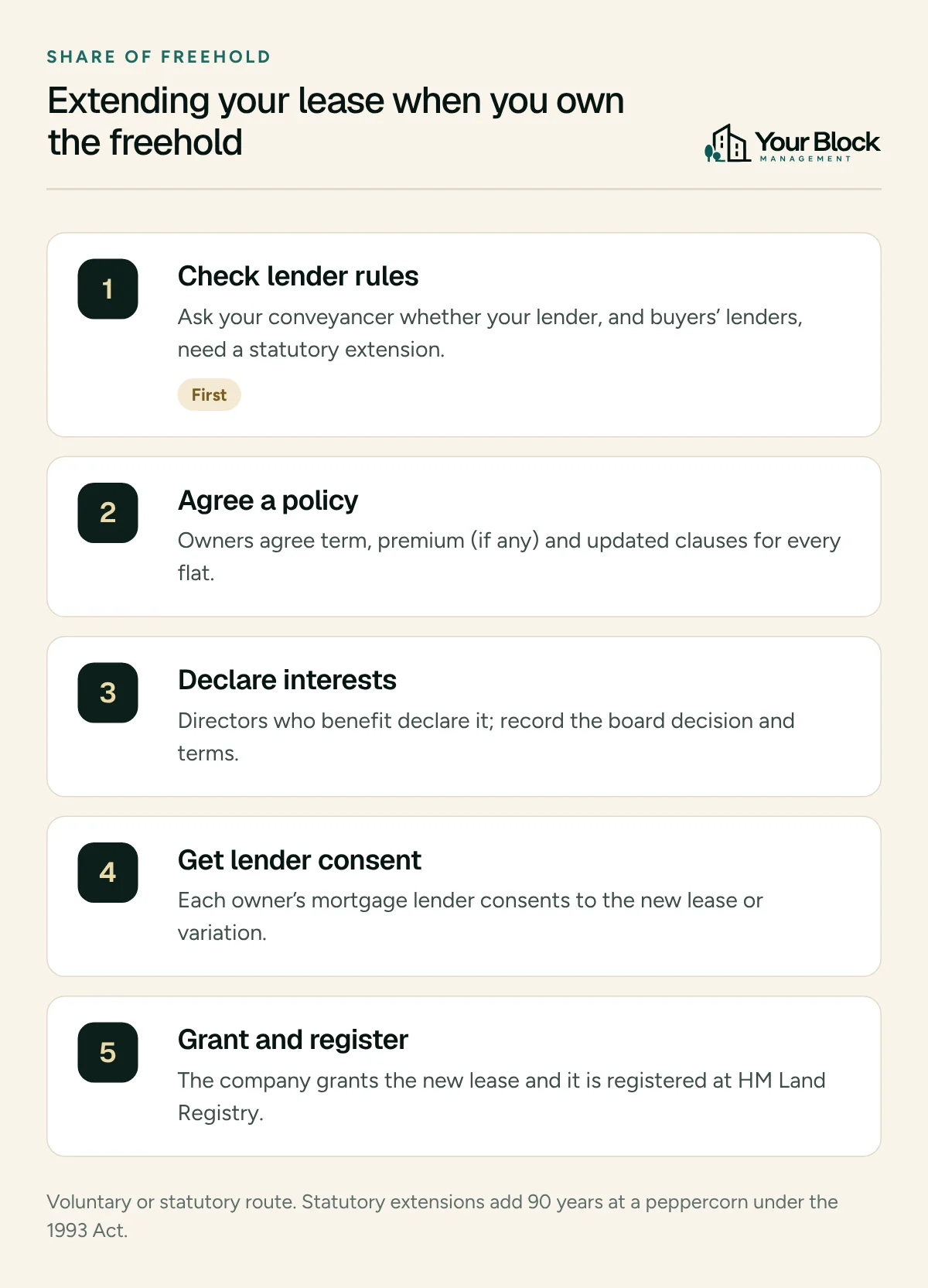
Three practical points decide whether this goes smoothly:
- Your lender must consent to a voluntary new lease, because its charge is over the old one. Build in time for that.
- Conflicts of interest. In a small block the directors approving the extension may be the people receiving it. Under section 177 of the Companies Act 2006 a director must declare an interest in a proposed transaction. Record the decision and the terms properly.
- Consistency. Agree a policy for every flat (term, premium, if any, and updated clauses) so nobody feels a neighbour got a better deal. Extending all leases together usually saves legal fees too.
If some flats did not take part when the freehold was bought, their owners are tenants of the company but not members. They keep their statutory right to extend under the 1993 Act, and the company is entitled to a premium under the statutory valuation rules unless it agrees otherwise. For the wider process, see our guide to extending a lease.
How the freehold is held changes how you decide things
The legal vehicle matters more than most buyers realise, because it sets the voting rules when you and your neighbours disagree.
A company limited by shares or by guarantee
Most share of freehold blocks hold the freehold through a company. Members (shareholders or guarantee members) appoint directors, and directors run the company day to day. Company law then sets the basic thresholds:
- an ordinary resolution of members needs a simple majority (section 282, Companies Act 2006);
- a special resolution needs at least 75% (section 283), and is required to change the articles (section 21);
- members can remove a director by ordinary resolution with special notice (section 168).
Whether votes are one per flat or weighted by shares depends on the articles. Check them. Two flats with extra shares can sometimes outvote four.
Trustees holding the freehold
In small conversions the freehold may be registered in the names of some or all of the owners, holding it on trust for everyone. HM Land Registry registers no more than four legal owners. As a general rule of trust law, trustees must act unanimously unless the trust deed says otherwise, so one reluctant trustee can stall a decision. If the trust cannot work, any trustee or beneficiary can ask the court for an order under section 14 of the Trusts of Land and Appointment of Trustees Act 1996, which is slow and costly. A written declaration of trust that sets out how decisions are made is worth having.
Not to be confused with RTM or a management-only company
A right to manage company or a residents’ management company that manages but does not own the freehold is not share of freehold. Our guide to the residents’ management company explains the difference.
Living with neighbours as co-landlords: decisions and deadlock
Share of freehold does not suspend leasehold law. Your company is still a landlord, so your service charge must be reasonable under section 19 of the Landlord and Tenant Act 1985, demands need the statutory summary of rights, and section 20 consultation applies where any flat’s share of works exceeds £250. Being friends with the landlord changes the tone, not the law.
Deadlock is the risk that hits hardest in small blocks. A two-flat building split 50/50, or a four-flat block split two against two, can stall a roof repair for months. The fixes all need agreeing before the argument starts:
- a casting vote for the chair in the articles, or an odd number of directors;
- a shareholders’ agreement or declaration of trust that sends disputes to mediation or an independent expert;
- spending rules: a limit below which directors can act alone, and a written process above it;
- a proper annual budget and reserve fund, so large jobs are planned rather than voted on in a crisis. Our guide to the service charge shows what a budget should contain.
If management breaks down entirely, a leaseholder can apply to the First-tier Tribunal to appoint a manager under Part 2 of the Landlord and Tenant Act 1987. That is a last resort, and an expensive one for everyone.
Selling a share of freehold flat
Your sale has two parts that must move together: the lease, and your share or membership. Expect your buyer’s conveyancer to ask for:
- the company’s accounts, confirmation that it is active at Companies House, and its articles;
- your share certificate and a signed transfer, or the paperwork to admit the buyer as a member;
- service charge accounts, the budget, reserve fund balance, insurance details, the fire risk assessment and any planned major works;
- minutes of recent meetings, which reveal disputes and upcoming costs.
Some leasehold titles carry a restriction on the register, so HM Land Registry will not register your buyer until the company confirms that its requirements have been met. Someone at the company has to answer these requests quickly, and in a self-managed block that is usually a volunteer director. Agree in advance who handles sale enquiries and what reasonable fee, if any, the company charges.
Practical checklist before you buy or extend
- Check the unexpired lease term against your lender’s Handbook entry, and against what your future buyer’s lender is likely to need.
- Find out whether leases have been extended and, if so, by which route.
- Read the company’s articles (or the declaration of trust) for voting rights and tie-breaks.
- Ask who the directors are, how often they meet and whether there is a managing agent.
- Confirm that every flat holds a share, and what happens to non-member flats.
Many small share of freehold blocks run happily on goodwill. When volunteers need help, a managing agent can do the admin while the owners keep the decisions. At Your Block we work for owner-run companies and their directors, preparing meeting packs and dealing with sale enquiries, and the directors’ FAQs answer the usual questions.
Frequently asked questions
Do I still need a long lease if I own a share of the freehold?
Yes, for practical purposes. Your mortgage is secured on your lease, and lenders set a minimum unexpired term. A share of freehold flat with a short lease is still a short-lease flat until the company grants a new one. The advantage is that you and your neighbours control the landlord, so extending is usually simpler and cheaper.
Can the freehold company give me a 999-year lease for free?
It can agree to, as a voluntary extension, with your lender’s consent and a proper decision by the company. Some lenders say they require extensions under the 1993 Act, which adds 90 years at a peppercorn, so check with your conveyancer before choosing the route. Directors who benefit should declare their interest.
What happens if share of freehold owners can’t agree?
It depends on how the freehold is held. In a company, members vote under the articles and the Companies Act: simple majority for ordinary resolutions, 75% for special ones. Trustees normally must act unanimously. Without a casting vote or a dispute clause, deadlock can stall repairs, and the last resorts are a court order or a tribunal-appointed manager.
Does share of freehold make selling easier?
Usually, especially once leases have been extended and ground rent is a peppercorn. But your buyer’s conveyancer will want company accounts, insurance, minutes and the share transfer paperwork, and the company has to answer those enquiries. A block with tidy records and an active board sells more smoothly.
Is a right to manage company the same as share of freehold?
No. A right to manage company takes over management of the building, but the freeholder still owns it and collects any ground rent. Share of freehold means the leaseholders, through a company or as trustees, actually own the freehold and can grant new leases.
Sources and further reading
- UK Finance Mortgage Lenders’ Handbook, Part 2, 5.14.1: minimum unexpired lease term
- Leasehold Reform (Ground Rent) Act 2022, section 6 (leases replacing earlier leases)
- Companies Act 2006, section 283 (special resolutions)
- Companies Act 2006, section 177 (duty to declare interest in proposed transaction)
- Trusts of Land and Appointment of Trustees Act 1996, section 14
This article is general information about the law in England, not legal advice. Leasehold law is changing, so check your lease and get professional advice for your own situation. Spotted something out of date? Tell us and we’ll fix it.