Fire Risk Assessment for Flats: Who Needs One, How Often and What It Should Cover
Who must arrange it, why “annual” isn’t the law, what a proper assessment checks and how duties grow with the height of your building.
 By Sam Charlesworth8 min read
The short version
- The Fire Safety Order requires a written assessment of common parts, structure, external walls and flat entrance doors.
- The responsible person is usually the freeholder, RTM company or RMC.
- The law says review “regularly”: annual review is common practice, not a statutory rule.
- Blocks over 11m need quarterly communal fire door checks; 18m+ blocks have further duties.
- The competence duty isn’t in force yet, so choose a certified or registered assessor.
A fire risk assessment for flats is a legal requirement for the shared parts of almost every block in England. The “responsible person”, usually the freeholder, right to manage (RTM) company or residents’ management company (RMC), must have one carried out, record it in writing and review it regularly. The law sets no fixed frequency: annual review is common practice, not a statutory rule.
This guide covers who needs one, who is responsible, how often it should be reviewed, what a good assessment covers, the extra duties that apply as buildings get taller, and what leaseholders can ask for. It applies to England.
Who needs a fire risk assessment for flats?
The duty comes from the Regulatory Reform (Fire Safety) Order 2005, usually called the Fire Safety Order. It applies to the non-domestic parts of residential buildings, which in a block of flats means the common parts: entrance halls, stairs, corridors, bin and bike stores, plant rooms, roof spaces and similar.
The Fire Safety Act 2021, in force since 16 May 2022, made clear that in buildings with two or more homes the Order also covers:
- the building’s structure and external walls, including windows, balconies and anything attached to them; and
- flat entrance doors that open onto common parts.
It doesn’t cover the inside of individual flats. So a converted house with a shared hallway, a 1970s three-storey block and a modern ten-storey building all need an assessment of the parts the Order covers. If your building is very small or has no shared internal areas at all, the position is less clear-cut; our guide to when a fire risk assessment isn’t required for flats explains the edge cases.
Who is the responsible person?
The responsible person is whoever has control of the common parts, typically the landlord, or the RTM company once it has acquired management. In an RMC block, it’s usually the RMC. A managing agent with control of the premises under its contract can also carry duties, and where several people share responsibility, they must co-operate and co-ordinate.
Since 1 October 2023, the responsible person must also:
- record the whole fire risk assessment in writing, along with the fire safety arrangements;
- record the name of anyone engaged to carry out or review it;
- share their contact details, including a UK address, with residents;
- pass relevant information to any successor responsible person; and
- in buildings with two or more homes, give residents relevant fire safety information in a form they can understand.
Some offences under the Order now carry unlimited fines. For RTM and RMC directors, this is a real responsibility of the company: our guide to RTM company directors’ responsibilities explains what that means for you personally.
In a higher-risk building (at least 18m or 7 storeys with two or more homes), the Building Safety Act 2022 adds a separate set of duties for the “accountable person”, including a safety case report. That is in addition to the fire risk assessment, not a replacement. Our guide to what the Building Safety Act means for your block covers it.
How often should a fire risk assessment be reviewed?
The Order says the assessment must be reviewed regularly so that it stays up to date, and also whenever there’s reason to suspect it is no longer valid or there has been a significant change. It does not specify a number of months.
In practice, many responsible persons review annually, and some higher-risk buildings more often. Whatever the routine, an earlier review should be triggered by:
- building works, especially anything affecting walls, doors, ceilings or service risers;
- a fire or near miss;
- a change in how the building is used, or new residents who may need help to evacuate;
- new information, such as findings from an external wall assessment or a fire door survey;
- a change of evacuation strategy, or actions from the last assessment not being completed.
A review is not always a full new assessment. The assessor checks whether anything has changed and whether previous actions were done, and decides whether a fresh assessment is needed. For more on timing, see how often fire risk assessments are needed in the UK.
What a good fire risk assessment for a block should cover
There’s no single prescribed format, but PAS 79-2:2020, the voluntary methodology for housing, is widely used. A good assessment of a block of flats should:
- Describe the building and its residents: height, storeys, construction, number of flats, and anyone who might need help to escape.
- State the evacuation strategy: usually “stay put” in purpose-built blocks with sound compartmentation, or simultaneous evacuation where that can’t be relied on, and check the building supports it.
- Check means of escape: stairs and corridors clear, travel distances, final exits that open easily.
- Assess compartmentation: the fire-resisting walls and floors between flats and the escape routes, including gaps around pipes and cables in risers.
- Inspect fire doors: communal doors and flat entrance doors, including self-closers, seals and gaps. Our guide to fire door risk explains why the front door matters so much.
- Review detection, alarms, emergency lighting and signage: what is fitted, whether it suits the strategy and whether it’s maintained.
- Identify fire hazards: stored items in corridors, bins near the building, electrical installations, smoking.
- Consider the external walls: and recommend a specialist external wall assessment, usually to PAS 9980, where needed. This is a different document from an EWS1 form, which is a lending tool.
- Set out an action plan: each finding with a priority, a timescale and who is responsible.
Assessments also differ in depth. Many assessors use the four types set out in the Local Government Association’s guide to fire safety in purpose-built blocks of flats: Type 1 (common parts, non-destructive) is the usual starting point, while Types 2 to 4 add opening up of construction and/or entry into flats where there’s reason to suspect problems. Make sure you know which type you’re paying for.
Extra fire safety duties by building height
The Fire Safety (England) Regulations 2022, in force since 23 January 2023, add duties that increase with height:
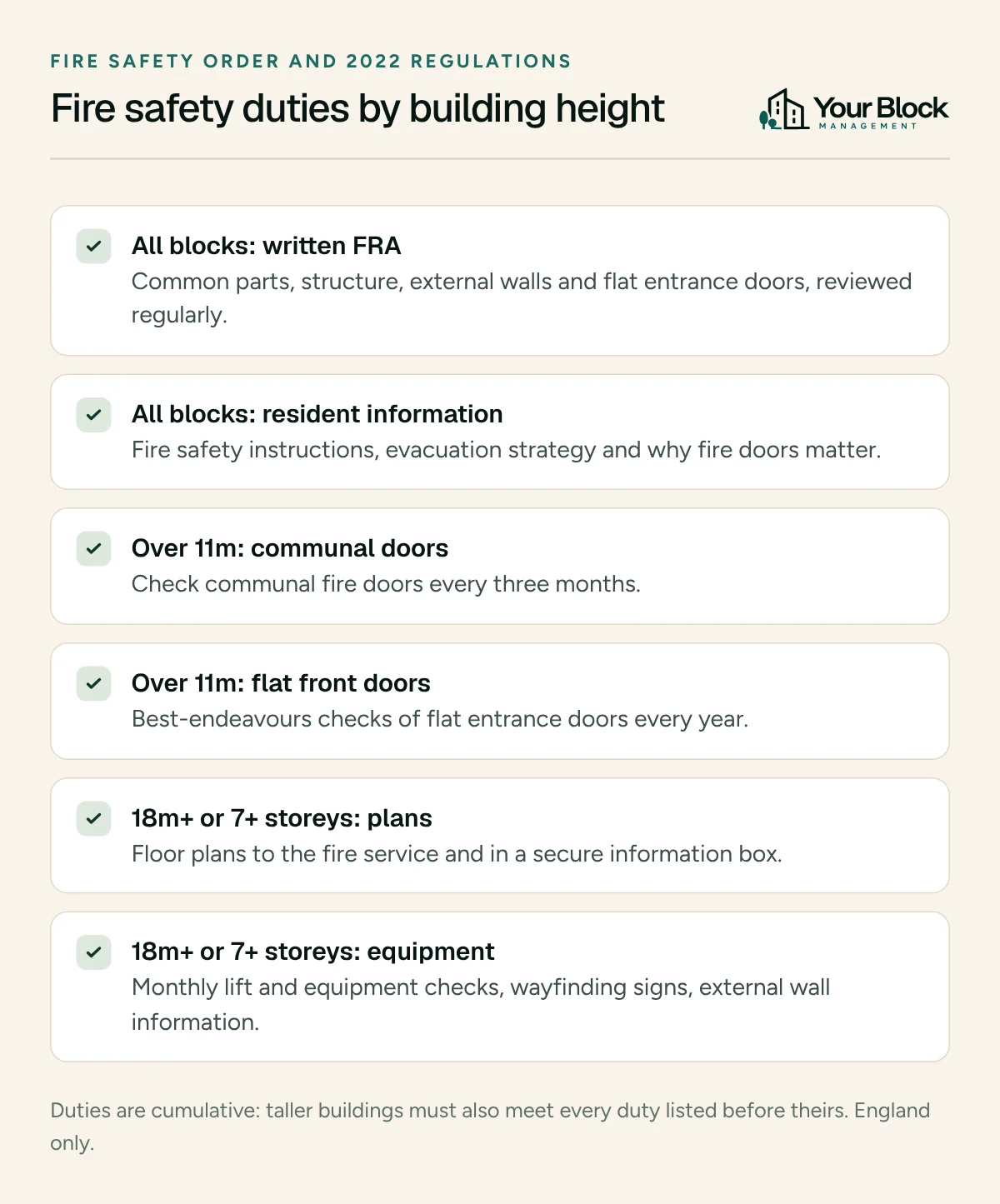
In more detail:
- All blocks with two or more homes: residents must be given fire safety instructions, including how to report a fire and what the evacuation strategy is, plus information on the importance of fire doors. These should be given to new residents and refreshed periodically.
- Over 11m: all of the above, plus checks of communal fire doors every three months and best-endeavours checks of flat entrance doors every year. “Best endeavours” means making genuine, recorded attempts to get access.
- 18m+ or 7+ storeys: all of the above, plus floor and building plans sent electronically to the fire and rescue service and kept in a secure information box on site, information about the external wall design and materials, monthly checks of firefighting and evacuation lifts and key firefighting equipment (with faults not fixed within 24 hours reported to the fire service), and wayfinding signage in stairwells.
As a rough guide, 11m is often around four or five storeys, but height is measured, not estimated, so check with your assessor. Communal fire door checks are quarterly, not annual: that’s a common mistake.
Choosing a competent fire risk assessor
The Building Safety Act 2022 added a duty to appoint only a competent person to carry out or review the assessment, but that provision hasn’t been brought into force yet, and there’s no date. In the meantime the responsible person still needs a “suitable and sufficient” assessment, so choosing well matters. Look for:
- registration with a professional register for fire risk assessors, or certification under a UKAS-accredited third-party scheme;
- experience with your type of building, such as converted houses, purpose-built blocks or buildings with cladding;
- professional indemnity insurance;
- a sample report you can read and understand, with a clear, prioritised action plan.
Be wary of very cheap assessments completed in an hour with a generic template. For a block of flats, the cost of the assessment is small compared with the cost of getting it wrong.
What leaseholders and residents can ask for
Residents are entitled to fire safety instructions, information about fire doors and, in blocks of two or more homes, relevant information about the risks identified and the measures in place. The law doesn’t clearly give every leaseholder a right to a full copy of the assessment, but many good landlords and agents share it anyway. Reasonable questions to ask:
- When was the fire risk assessment last done, by whom, and when is the next review due?
- What type of assessment was it?
- What actions were raised, and which are complete?
- What is the evacuation strategy, and is it still right for the building?
- If the building is over 11m, when were fire doors last checked?
The cost of fire risk assessments and follow-up works is normally recovered through the service charge where the lease allows, and you can ask to see the supporting invoices.
A practical plan for RTM and RMC directors
- Find the current assessment and check its date, type and the assessor’s name.
- List every open action with an owner and a deadline, and report on it at each board meeting.
- Diarise the review, plus quarterly door checks if you’re over 11m.
- Send residents the fire safety instructions and fire door information, and keep a record that you did.
- Recheck after any works, incidents or changes in residents’ needs.
At Your Block we track fire risk assessment dates, actions and door checks for every building and publish the resident-facing information in the resident portal, so nothing relies on someone’s memory. If you’re a volunteer director carrying this on your own, see how we support RTM and RMC boards.
Frequently asked questions
Is a fire risk assessment a legal requirement for flats?
Yes, for the parts covered by the Fire Safety Order. In a block of flats that means the common parts, plus the structure, external walls and flat entrance doors since the Fire Safety Act 2021. The responsible person, usually the freeholder, RTM company or RMC, must make sure it is done and recorded in writing.
How often does a fire risk assessment for flats need doing?
The law sets no fixed interval. It must be reviewed regularly, and whenever there is reason to think it is out of date or after significant changes such as building works or a fire. Annual review is common practice, and higher-risk buildings may be reviewed more often.
Can leaseholders see the fire risk assessment?
Residents must be given fire safety instructions and relevant information about the risks identified and the measures in place. The law doesn’t clearly entitle every leaseholder to a full copy, but many landlords and managing agents share it on request or publish it. If you are refused, ask for a summary of findings and actions.
Who can carry out a fire risk assessment for a block of flats?
Legally, the duty to appoint a competent assessor has been passed but is not yet in force. Still, the assessment must be suitable and sufficient, so choose someone on a professional register or certified under a UKAS-accredited scheme, with experience of similar buildings and professional indemnity insurance.
Does a fire risk assessment cover the inside of my flat?
No. The Fire Safety Order does not apply inside individual homes. It does cover your flat’s entrance door where it opens onto common parts, as well as the building’s structure and external walls. Fire safety inside your flat, such as smoke alarms, is generally your responsibility or your landlord’s if you rent.
Sources and further reading
This article is general information about the law in England, not legal advice. Leasehold law is changing, so check your lease and get professional advice for your own situation. Spotted something out of date? Tell us and we’ll fix it.