EWS1: The Form That Can Stop Your Flat Sale Dead (And How to Get One)
Not a legal requirement and not a safety certificate, but it can still stall a sale. Here’s when you need one, who arranges it and the alternatives.
The short version
- An EWS1 is a lending and valuation tool, not a legal requirement or fire safety certificate.
- From 1 November 2026, RICS says valuers should only request one where height and cladding criteria are met.
- The building owner, RTM or RMC commissions it for the whole block, not the individual seller.
- A qualifying PAS 9980 FRAEW summary or a funded remediation route can sometimes stand in.
- A form is valid for up to five years unless the external wall changes significantly.
An EWS1 (External Wall System fire review form) is a short form, signed by a qualified professional, that tells a mortgage valuer whether a block’s external walls need fire safety remedial work. It isn’t a legal requirement or a safety certificate. But if a lender’s valuer asks for one and the building hasn’t got one, a sale or remortgage can stall for months.
This guide explains what the form is, when you’ll actually be asked for it (the rules change on 1 November 2026), who signs it, who pays, how long it takes and what to do instead if your building can’t get one quickly. It covers England.
What is an EWS1 form, and what isn’t it?
The EWS1 is an industry form published by RICS (the Royal Institution of Chartered Surveyors) and used by valuers and mortgage lenders. It records a professional’s view of whether the materials in a building’s external wall, and attachments such as balconies, are a fire risk serious enough to affect the flats’ value as security for a loan.
Three things people often get wrong:
- It isn’t a legal requirement. No statute requires a building to have an EWS1. It’s a valuation and lending tool, and the House of Commons Library describes it that way.
- It isn’t a fire safety certificate. RICS says plainly that the EWS1 is for valuation and lending only and does not replace a life-safety fire risk assessment for the block.
- It isn’t about your flat. One form covers one whole block. You can’t get an EWS1 “for flat 4”.
A completed form is valid for up to five years from the date on it, unless significant changes are made to the external wall or attachments, in which case it needs reassessing.
The five EWS1 ratings
| Rating | What it means | Usual effect on lending |
|---|---|---|
| A1 | External wall materials unlikely to support combustion, and no attachments with significant combustible materials | Generally straightforward |
| A2 | As A1, but there are attachments; a risk assessment confirms no remedial works are needed | Generally straightforward |
| A3 | Neither A1 nor A2 applies, so remedial works to attachments (often balconies) may be needed | Lenders may want to know who pays and when |
| B1 | Combustible materials are present, but the fire risk is low enough that no remedial works are needed | Generally lendable |
| B2 | Combustible materials are present and the risk is high enough that remedial works are needed | Lenders usually need evidence of a funded route to remediation |
The lending column is a general guide, not a promise: each lender sets its own policy, and lender instructions override the RICS standard. For a fuller explanation of each rating, see our guide to EWS1 ratings A1 to B2.
When will a lender ask for an EWS1? The 1 November 2026 change
The person who asks for an EWS1 is almost always the valuer instructed by the buyer’s (or remortgaging owner’s) lender. What they ask for is guided by the RICS professional standard Secured lending valuation of properties in multi-storey, multi-occupancy residential buildings with cladding. RICS published the 2nd edition on 12 May 2026 and it takes effect on 1 November 2026. Its stated aim is that an EWS1 should only be requested where there is a clear reason.
Unless the lender gives its own instructions, the 2nd edition says an EWS1 should be required only where:
| Building height | EWS1 should be requested where… |
|---|---|
| Over 6 storeys | There is any cladding or curtain wall glazing, or vertically stacked balconies with combustible balustrades and decking, or combustible decking with balconies linked by combustible materials |
| 5 or 6 storeys | There is a significant amount of cladding, or the same balcony issues as above |
| 4 storeys or fewer | There is a significant amount of ACM, MCM or HPL panels (types of metal composite and laminate panel) |
Some details matter a lot in practice:
- A “significant amount” means roughly a quarter of the whole facade seen from ground level, or about a quarter of one elevation where the cladding links several floors or surrounds the main escape route.
- On buildings of six storeys or fewer, cladding only on a top storey that is set back from the main facades on all sides doesn’t trigger an EWS1.
- Where there are metal panels, the valuer needs written confirmation that they are not ACM or MCM, or must ask for an EWS1.
- Traditional masonry, cavity walls, concrete and stone panels are not “cladding” for this purpose.
- A building of mixed heights is assessed as a whole; separate detached blocks on a development are assessed individually.
The standard also says an EWS1 isn’t needed where the building owner’s own external wall assessment “raises no concerns that remediation is required”, or where a building over 18m has a valid building control certificate under the 2018 rules restricting combustible materials in external walls.
Two caveats. First, valuations carried out before 1 November 2026 may still follow the older guidance. Second, “specific lender guidance always takes precedence”, so an individual lender can still insist. If your building falls outside the criteria and a valuer asks anyway, it’s reasonable for your conveyancer to ask the lender to explain why.
Who can sign an EWS1?
The form has two routes, and the qualifications required differ:
- Option A (materials unlikely to support combustion): the signatory must be a qualified member of a relevant construction-industry professional body. Fire engineering expertise isn’t necessarily required.
- Option B (combustible materials present): a higher level of fire expertise is needed. For the Institution of Fire Engineers, that means a Chartered or Incorporated Engineer with full membership; other signatories need equivalent status in a body covering fire safety and construction products. For buildings whose top occupied floor is under 18m, someone who has completed the RICS EWS Assessment Training Programme may be acceptable.
Valuers check that the form shows the signatory’s name, organisation, qualifications and professional body, and that it is signed and dated. Our guide to finding a qualified EWS1 surveyor covers what to ask before appointing one.
Who arranges and pays for an EWS1?
Usually not the seller. Because the form covers the whole external wall, it’s commissioned by whoever is responsible for the building: the freeholder, the right to manage (RTM) company or the residents’ management company (RMC), normally through the managing agent. The form itself says it is for the client’s use; lenders and buyers wanting to rely on it are expected to contact the signatory’s firm.
An individual leaseholder generally can’t commission one. The assessor needs access to the whole facade, building records and sometimes permission to open up walls, which only the building owner can give.
The cost is normally a building cost, recovered through the service charge if the lease allows. In buildings of 11m or 5 storeys and above, the Building Safety Act 2022 protects “qualifying leaseholders” from cladding remediation costs entirely and caps what they can be charged for other relevant defects. Whether a particular assessment fee falls within those protections depends on the facts, so ask before you pay. Our guides to your Building Safety Act protections and what an EWS1 survey costs and who pays go further.
How long does an EWS1 take?
There’s no fixed timescale, and anyone who promises one without seeing the building is guessing. What drives the time:
- Records. A block with as-built drawings and product information is far quicker to assess than one with none.
- Opening up. If the assessor needs to remove panels or drill inspection holes to see what’s behind the facade, that means access equipment, contractors and making good.
- Option B analysis. Where combustible materials are found, a fire engineer’s risk assessment adds time.
- Decisions. The freeholder or board has to approve the spend and instruct someone. On a volunteer-run block, that alone can take weeks.
Plan in months, not days. If you’re thinking of selling in the next year and your building meets the criteria above, ask now.
Alternatives to an EWS1: FRAEW, PAS 9980 and remediation routes
An EWS1 isn’t the only document that can satisfy a valuer.
A FRAEW under PAS 9980
A Fire Risk Appraisal of External Walls (FRAEW) is a building owner’s assessment of external wall fire risk, carried out using the PAS 9980:2022 methodology. Under the RICS 2nd edition, a FRAEW summary can be relied on instead of an EWS1, but only if it gives a definitive yes-or-no answer on whether remedial works are required, confirms whether combustible materials are present, and is signed by someone with the same or higher qualifications than an EWS1 signatory. Many buildings already have one, so ask before commissioning anything new.
A funded route to remediation
Where works are needed, the valuer can take into account a clear route to remediation: funding through Homes England’s Cladding Safety Scheme, a Developer Remediation Contract, written confirmation from the freeholder that it will meet the costs, or a government grant. The Cladding Safety Scheme funds unsafe cladding remediation on buildings over 11m in England; in July 2026 it was extended to some buildings under 11m, but that application window closed on 9 October 2026, and only the responsible entity can apply. Our guide to what remediation works look like week by week explains what to expect if your block is on that path.
The landlord’s certificate
Not an EWS1 substitute, but often requested alongside one. In buildings of 11m or 5 storeys and above, the landlord must provide a certificate (within four weeks of certain triggers, such as notice of a sale) setting out who is liable for remediation costs. Paired with your leaseholder deed of certificate, it shows a lender whether you could be charged.
Change is also coming: the Remediation of Unsafe Cladding Bill was reported as introduced to Parliament on 14 October 2026, proposing a legal duty to remediate unsafe cladding. It is a Bill, not law, and its details may change.
What sellers and buyers should do about an EWS1
If you’re selling
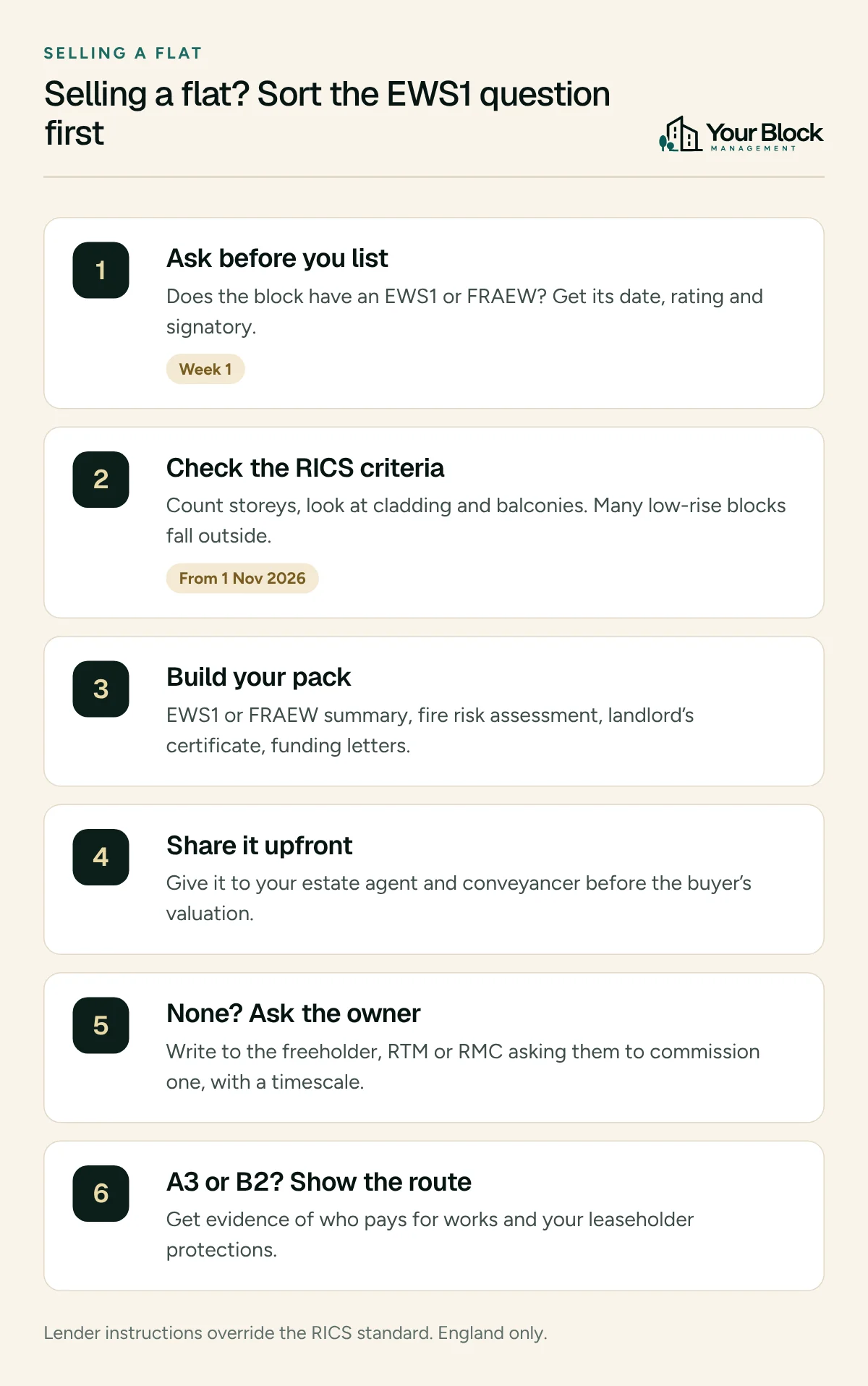
- Ask early. Before you list, ask the managing agent or board whether the block has an EWS1 or FRAEW, its date, its rating and who signed it.
- Check the height and facade against the criteria above. If your building clearly falls outside them, tell your estate agent and conveyancer so they can head off an unnecessary request.
- Assemble the pack: EWS1 or FRAEW summary, the current fire risk assessment, the landlord’s certificate and any remediation funding letters.
- If nothing exists, ask the freeholder, RTM or RMC in writing to commission one, and ask for a timescale. Copy the request to the board if there is one.
- If the rating is A3 or B2, get written evidence of who is paying and when works will happen, plus your leaseholder protections.
If you’re buying or remortgaging
- Ask your conveyancer to obtain the building’s fire risk assessment before exchange, as RICS now advises, not just the EWS1.
- Check the EWS1 is in date (under five years old) and that nothing significant has changed on the facade since.
- If the rating is B2, ask what the remediation plan is, who funds it and whether you would be a qualifying leaseholder. Qualifying status is fixed by the lease’s position on 14 February 2022 and passes to later buyers, so check the leaseholder deed of certificate carefully.
- Remember that “no EWS1 needed” is not a guarantee that works will never be needed; the RICS standard says valuers should state this in their report.
What directors, freeholders and agents should do
If you run a block that meets the criteria, the kindest thing you can do for every owner is to keep a current EWS1 or qualifying FRAEW summary ready, diarise its five-year expiry, and publish it alongside the fire risk assessment so sellers don’t have to chase. At Your Block we track these dates for every building and put the documents in the resident portal, so an owner can download them the day a buyer’s solicitor asks. If you’re a volunteer director juggling this on top of a day job, our support for RTM and RMC directors is built for exactly this kind of admin.
Frequently asked questions
Is an EWS1 a legal requirement?
No. There is no law requiring a building to have an EWS1. It is an industry form used by valuers and mortgage lenders to judge whether a flat is acceptable security. But because lenders can refuse to lend without one where their criteria apply, it can feel like a requirement when you are trying to sell or remortgage.
How long is an EWS1 valid for?
Up to five years from the date on the form. It must be reassessed sooner if significant changes are made to the external wall or attachments such as balconies. If your building’s form is close to expiry, ask the managing agent or board to plan a renewal before owners need it for sales.
Can I get an EWS1 for just my flat?
No. One EWS1 covers a whole block, and it is commissioned by the building owner or whoever is responsible for the external walls, usually the freeholder, RTM company or residents’ management company. As an individual leaseholder, your route is to ask them in writing to commission one.
Does a building under 18m need an EWS1?
Sometimes. Under the RICS standard effective 1 November 2026, a block of five or six storeys needs one only with a significant amount of cladding or certain combustible balconies, and a block of four storeys or fewer only with significant ACM, MCM or HPL panels. Individual lenders can still set their own rules.
Can a FRAEW be used instead of an EWS1?
Yes, in some cases. Under the RICS 2nd edition, a valuer can rely on a PAS 9980 FRAEW summary if it gives a clear yes-or-no answer on whether remedial works are needed, confirms whether combustible materials are present, and is signed by someone at least as qualified as an EWS1 signatory.
Sources and further reading
- RICS: updated standard for multi-storey residential buildings with cladding (2nd edition, effective 1 Nov 2026)
- RICS: Secured lending valuation of properties in multi-storey, multi-occupancy residential buildings with cladding, 2nd edition (PDF)
- RICS EWS1 form, version 3 (PDF)
- House of Commons Library research briefing CBP-10763
- GOV.UK: Buildings under 11 metres fund overview (Cladding Safety Scheme)
This article is general information about the law in England, not legal advice. Leasehold law is changing, so check your lease and get professional advice for your own situation. Spotted something out of date? Tell us and we’ll fix it.